
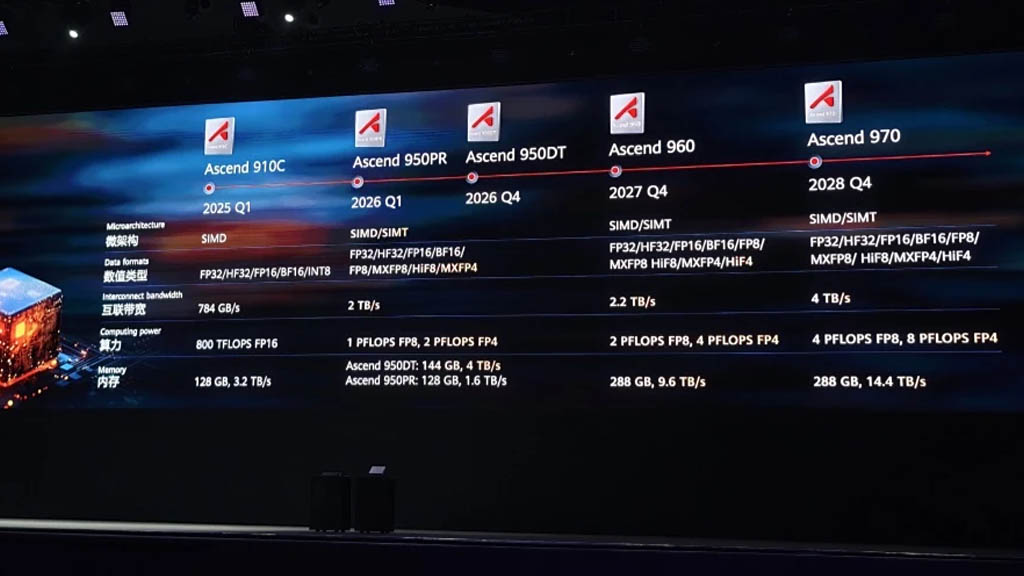
Amid intensifying China–U.S. technology competition, China’s Huawei on 2025‑09‑18 publicly unveiled a three‑year roadmap for its Ascend AI chips, launching the Ascend 950/960/970 series supercomputing platforms and committing to double computing performance each year to reach a million‑scale NPU (neural processing unit) deployment by 2028. The announcement was made during the Huawei Cloud Developer Conference livestream. Huawei rotating chairman Xu Zhijun said, "The Ascend series will move from domestic substitution to global leadership, and our Atlas 950 super node will be the world’s most powerful AI computing system." Reuters reported that the roadmap includes Ascend 950PR (Q1 2026), 950DT (Q4 2026), 960 (Q4 2027) and 970 (Q4 2028), accompanied by Atlas 950 and 960 supercomputing nodes supporting interconnection of 8,192 Ascend chips. The strategy directly challenges Nvidia’s GPU dominance and, against the backdrop of export controls, is expected to accelerate localization of China’s AI infrastructure and reshape the global supercomputing market. Huawei Central emphasized that the Ascend 950 will debut in‑house HBM (high‑bandwidth memory) technology, doubling compute performance and contributing to "dual‑carbon" targets and technological self‑reliance.
The Ascend 950 series represents the peak of Huawei’s Kirin/Ascend ecosystem, based on the in‑house Da Vinci architecture and integrated with the CANN (Compute Architecture for Neural Networks) software stack. The 950PR edition will be available externally in Q1 2026 and will support interconnection of 8,192 Ascend chips with compute reaching 10 EFLOPS (10 exaFLOPS), far exceeding the compliant version of Nvidia’s H20. The 950DT model optimizes data transfer and adopts in‑house HBM3e memory with bandwidth up to 1.4 TB/s, suitable for large‑scale model training such as Llama 3.1. The Atlas 950 super node will launch in Q4 2026 and support million‑level NPU clusters; Xu Zhijun claimed it "will surpass the performance of Nvidia NVL144." The 960 and 970 will continue the doubling strategy, with the 970 expected in 2028 to reach 2 PFLOPS per card, covering scenarios from edge computing to the cloud. TechRadar reported that Huawei plans to open‑source the CANN platform by the end of 2025 to further lower barriers for developers.
The roadmap stems from Huawei’s "full‑stack, self‑developed" strategy. Since the 2019 U.S. sanctions, Huawei has released Ascend 910B (2023) and 910C (March 2025), the latter integrated in the Atlas 900 A3 supercomputer supporting 384 910C chips. The Economic Times noted that Ascend series share in Chinese data centers has risen to 40%, aided by CANN’s CUDA compatibility. Xu Zhijun reflected at the conference: "The sanctions made us stronger; Ascend’s journey from 0 to 1 proves Chinese AI chips can lead globally." Compared with Nvidia’s Blackwell architecture, Ascend 950 emphasizes "ecosystem compatibility," supporting PyTorch and TensorFlow. Caixin reported Huawei has cooperated with Alibaba Cloud and Tencent Cloud to deploy Atlas 900 A3 and train domestic large models such as Pangu 4.0.
The announcement has global implications. China’s AI market size is forecast to reach 500 billion yuan in 2025, with Ascend series projected to take a 60% share. TechXplore analyzed that the roadmap will reduce dependence on imported chips and help achieve "dual‑carbon" goals by improving data center energy efficiency by 20%. In developing countries such as India and Brazil, Ascend’s lower cost (roughly $5,000 per chip) could accelerate AI adoption. However, challenges remain: the newly introduced in‑house HBM technology will require yield improvements, expected to reach 90% by 2026, and ecosystem compatibility still needs strengthening—CANN is open‑source but migration costs for developers remain high. Geopolitical risks are mounting: the U.S. may impose further controls, and Huawei must balance global exports. Combined with China's Cyberspace Administration requested ByteDance, Alibaba, Tencent and Baidu stop testing and purchasing Nvidia RTX Pro 6000D units customized for the Chinese market, and the State Administration for Market Regulation has launched an antitrust probe into Nvidia. This move will accelerate domestic chip substitution and could sharply reduce Nvidia’s revenue in China while reshaping the global AI chip supply chain.
Looking ahead, the Ascend 950/960/970 are expected to push Chinese AI from "catching up" to "leading." Xu Zhijun said, "We are not only building chips, we are building an ecosystem." The tech community is witnessing the rise of domestically produced AI, and this announcement may mark a new turning point in China–U.S. competition.
Sources:
- Reuters: "China's Huawei hypes up chip and computing power plans in fresh challenge to Nvidia" (https://www.reuters.com/business/media‑telecom/chinas‑huawei‑hypes‑up‑chip‑computing‑power‑plans‑fresh‑challenge‑nvidia‑2025‑09‑18/, 2025‑09‑18)。
- Huawei Central: "Huawei reveals 3‑year Ascend AI chip roadmap, 950 coming in 2026" (https://www.huaweicentral.com/huawei‑reveals‑3‑year‑ascend‑ai‑chip‑roadmap‑950‑coming‑in‑2026/, 2025‑09‑18)。
- TechRadar: "Huawei throws massive 1‑million NPU gauntlet at Nvidia and AMD as it positions itself as alternative to US AI giants" (https://www.techradar.com/pro/huawei‑throws‑massive‑1‑million‑npu‑gauntlet‑at‑nvidia‑and‑amd‑as‑it‑positions‑itself‑an‑alternative‑to‑us‑ai‑giants, 2025‑09‑18)。
- Economic Times: "China's Huawei hypes up chip and computing power plans in fresh challenge to Nvidia" (https://m.economictimes.com/tech/artificial‑intelligence/huawei‑announces‑two‑new‑supercomputing‑ai‑nodes‑say‑they‑are‑the‑worlds‑most‑powerful/articleshow/123962117.cms, 2025‑09‑18)。
- TechXplore: "How Huawei plans to outperform global tech leaders with less computing power" (https://techxplore.com/news/2025‑09‑huawei‑outperform‑global‑tech‑leaders.html, 2025‑09‑18)。
- Caixin Global: "Huawei Unveils Three‑Year AI Chip Roadmap as Nvidia Faces Setbacks in China" (https://www.caixinglobal.com/2025‑09‑19/huawei‑unveils‑three‑year‑ai‑chip‑roadmap‑as‑nvidia‑faces‑setbacks‑in‑china‑102363891.html, 2025‑09‑19)。
- Huawei News: "Groundbreaking SuperPoD Interconnect: Leading a New Paradigm" (https://www.huawei.com/en/news/2025/9/hc‑xu‑keynote‑speech, 2025‑09‑18)。