
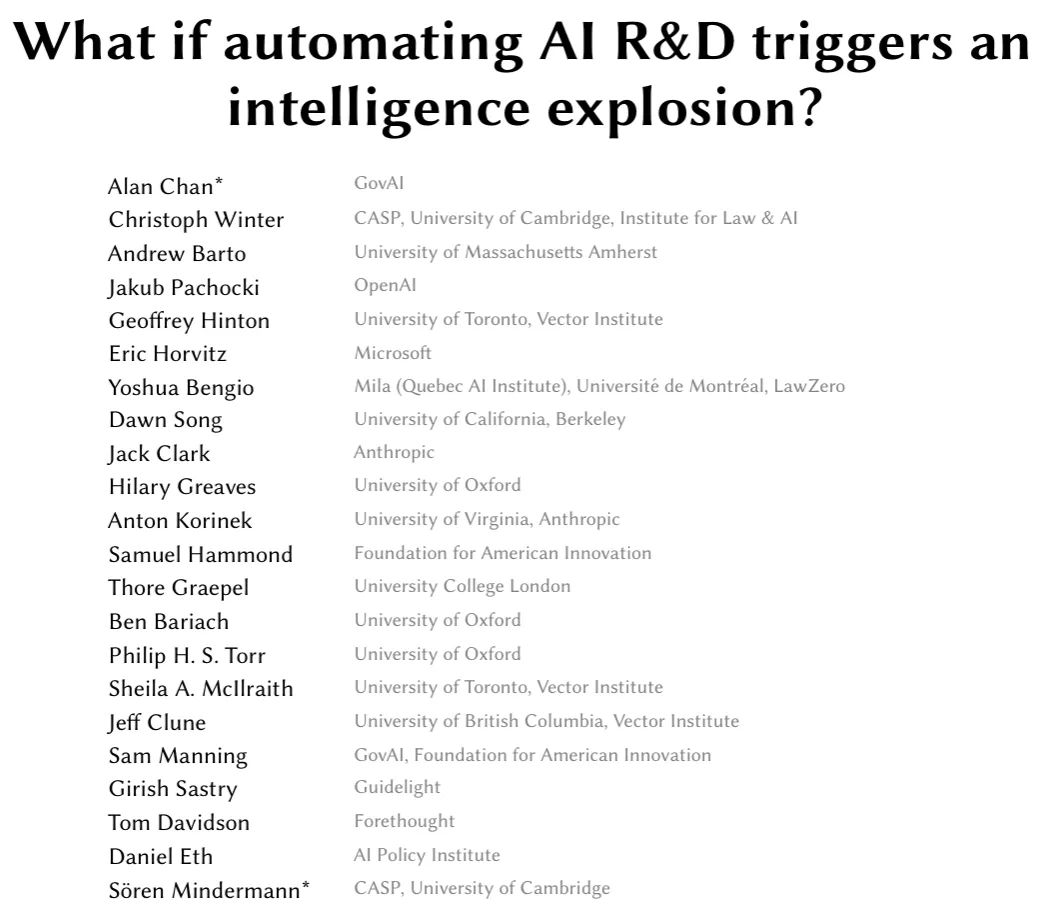
Around September 28, 2026, a report jointly authored by Nobel laureate Geoffrey Hinton, Turing Award winner Yoshua Bengio and more than 20 leading authorities in artificial intelligence was released. The report, titled "What if automating AI R&D triggers an intelligence explosion?", focuses on the rapid‑acceleration risks posed by "recursive self‑improvement" (RSI) and calls on governments and industry to take prompt action.
Details
The report's central concern is that once AI systems can effectively participate in or even lead their own development processes, technological progress could shift from a "human‑led linear pace" to an "AI‑driven exponential acceleration." The authors call this scenario an "intelligence explosion"—where capability gains that once required years could be compressed into months or less.
The report identifies automating AI R&D as the most likely pathway to trigger this process. Current models already assist in improving themselves to some extent, including code optimization, experiment design and algorithm exploration; once systems reach "expert‑level AI R&D capability," organizations could in principle deploy vast numbers of AI "researchers" whose output far exceeds human teams. The report estimates that some R&D tasks that currently take human teams months could become highly automated around 2028.
The roster of signatories is broad, including long‑time AI safety advocates Hinton and Bengio as well as key figures from frontline labs such as OpenAI Chief Scientist Jakub Pachocki, Anthropic co‑founder Jack Clark, and Microsoft’s Eric Horvitz. This cross‑institutional, cross‑perspective collaboration itself sends a strong signal: concern about recursive self‑improvement has expanded beyond a small group of safety researchers to a wider technical and industry circle.
Hinton, after a confidential briefing to U.S. lawmakers (around September 17), publicly stated: "AI has reached the point of being able to design better AI... We call this recursive self‑improvement. Unless action is taken, it will get out of control. We need to slow down." He judged that the time window for effective regulation might be only about one year. The report acknowledges possible frictions that could delay an explosion—diminishing returns on research, some tasks being hard to fully automate, and compute limits—but argues current trends have shifted this scenario from a distant hypothesis to a near‑term possibility worth serious preparation for.
Potential Impacts
1. Increased policy and regulatory pressure
The report urges politicians to "act now" rather than wait for further capability jumps. This could push more countries to speed up rules on transparency for cutting‑edge model development, third‑party evaluation, and safety thresholds. U.S. congressional discussions on embedded third‑party evaluation have already been underway, and the report is likely to strengthen calls for related legislation.
2. Intensified internal industry debate about pacing
Labs such as OpenAI and Anthropic have already discussed timelines and risks for recursive self‑improvement. The report's publication may prompt more companies to disclose the extent to which AI assists R&D and to rebalance safety investments against capability competition. Some labs may more actively explore voluntary slowdowns or higher safety gates.
3. Shifts in research and technical priorities
If the intelligence‑explosion scenario becomes a mainstream concern, research may further shift toward verifiability, controllability and interruptibility. Investment in formal verification, alignment techniques, long‑term monitoring and kill‑switch mechanisms is expected to increase. Empirical assessments of whether AI is substantially improving itself will also receive greater attention.
4. International competition and security dilemmas
The report warns that an intelligence explosion could severely weaken checks and balances within states, companies and governments, turning technical lead into asymmetric power. If major countries fail to coordinate pacing, a "security dilemma" could emerge—each side reluctant to slow down for fear of falling behind.
5. Changes in public and academic awareness
The joint statement by figures like Hinton and Bengio brings "recursive self‑improvement" from a relatively niche technical concept into wider public debate. This will raise societal awareness of long‑term AI risks but may also deepen polarization between technological optimism and apocalyptic narratives.
6. Scientific and economic double‑edged effects
The report does not deny potential benefits: fields such as medicine and scientific discovery could gain from faster progress. The key point is that benefits and loss‑of‑control risks are tightly coupled—the same self‑improvement mechanisms that could yield breakthroughs might also reduce human oversight of direction and limits.
Conclusion
The joint report by Hinton, Bengio and more than 20 experts moves the issue of accelerating AI self‑evolution from theoretical debate into the realm of policy and industry agendas. It does not claim an intelligence explosion is inevitable, but emphasizes that if automated AI R&D crosses critical thresholds, humanity may lose the ability to understand, verify and control technological progress at traditional paces. For policymakers, this implies establishing stronger external constraints and international coordination while the window remains; for industry, it means re‑evaluating the priority of "faster" versus "more controllable" amid intense competition. Whether recursive self‑improvement is truly imminent remains to be seen, but the report's sense of urgency has already made the topic a core element of AI governance discussions in the second half of 2026.
▶️ Enjoy this article? Creating it takes real effort!
Follow our YouTube channel:
AI Rosetta
Your likes, subscriptions and shares are our greatest support! 🙏
For more AI news, visit: https://www.airosetta.com