
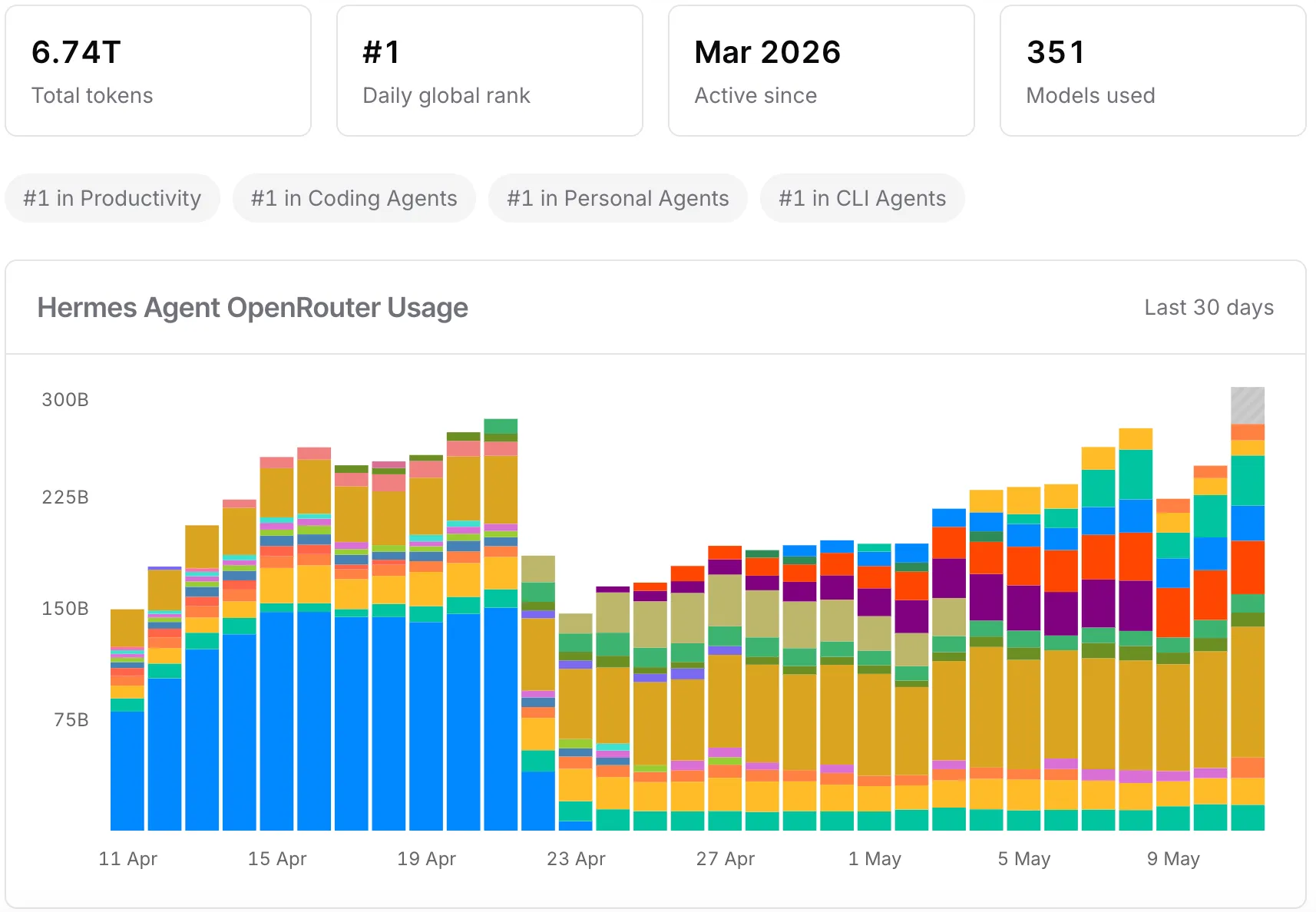
On May 6, 2026, the OpenRouter global application token‑consumption rankings saw a major shift: the open‑source AI agent Hermes Agent, developed by Nous Research, consumed 271 billion tokens in a single day, surpassing the long‑time leader OpenClaw to claim the top spot worldwide for the first time. This milestone not only marks the rapid rise of open‑source persistent AI agents but also reflects the developer community's strong demand for "self‑evolving agents." As of now, this lead continues to expand.
Released by Nous Research in February 2026, Hermes Agent is an open‑source (MIT license) AI agent framework that supports persistent memory and self‑evolving skills. It can retain memories across sessions and automatically generate and optimize reusable skills ("skills") through real tasks. This design enables strong performance on complex, long‑running tasks; although single interactions may consume more tokens, users have recognized its overall autonomy and efficiency.
By contrast, OpenClaw—an explosive open‑source agent from late 2025 to early 2026—had rapidly amassed over 370,000 GitHub stars thanks to its broad integration ecosystem and the "next‑generation ChatGPT" label, holding the top spot in token consumption for an extended period. Recent user feedback citing stability issues, security vulnerabilities, and token waste have prompted some users to migrate to Hermes.
Key factors behind the rise
Hermes Agent's lead is mainly attributable to the following characteristics:
- Self‑evolution mechanism: the agent can automatically distill skills from successful tasks, forming a "learning loop" that reduces repeated prompt consumption.
- Efficient memory system: built‑in SQLite persistent storage avoids the "forgetting" issues commonly seen with OpenClaw.
- Community and iteration speed: it attracted many contributors within months, quickly fixing pain points and supporting multiple underlying models (including routing via OpenRouter).
- Real‑world usage scenarios: developers widely use it for coding, automated workflows, personal assistants and other high‑frequency tasks, driving token consumption growth.
OpenRouter data show that Hermes Agent not only leads in single‑day token consumption but also holds advantages in productivity and coding‑agent subcharts.
Far‑reaching impact on the AI agent ecosystem and industry
1. Open‑source agents enter the "post‑OpenClaw" era
Hermes's top ranking signals a shift in open‑source AI agents from "ecosystem expansion" to "intelligent depth." OpenClaw won on gateway breadth and integrations, while Hermes prevailed through autonomous learning capabilities. This competition accelerates technical iteration across the field, giving users more high‑quality choices and pushing established projects like OpenClaw to speed up improvements.
2. Token economics and cost‑structure reshaping
High token consumption is a double‑edged sword. On one hand, it reflects Hermes's strong capability on complex tasks; on the other, it increases attention to token efficiency. Going forward, an agent framework's competitiveness will depend not only on features but also on memory optimization, skill reuse and model‑routing efficiency. This may prompt platforms like OpenRouter to further optimize pricing and stimulate more efficient agent architectures.
3. Accelerated adoption by developers and enterprises
The race for token‑consumption leadership highlights the practical value of "persistent personal AI assistants." More developers are integrating such tools into daily workflows, moving from simple automation to genuinely autonomous agents. This could lower the barrier for AI deployment in small and medium teams but will also raise demands on model supply and infrastructure.
4. Security, privacy and regulatory implications
High‑intensity token use implies agents have deeper system privileges, increasing security risks. Although Hermes has improvements such as memory isolation, the broader open‑source agent ecosystem still needs stronger security standards. This may draw regulatory attention to agent compliance and drive the industry to establish more robust auditing and permission‑control mechanisms.
5. A broader signal for AI development
This event exemplifies the rise of open‑source power at the AI application layer. Hermes Agent, as a later entrant, surpassed an early leader within months, demonstrating that innovation speed and community vitality currently outweigh first‑mover advantage. This will encourage more teams to invest in open‑source AI agents, further enriching the AI ecosystem.
Conclusion: the deeper meaning of the token‑consumption crown
Hermes Agent topping the global token‑consumption chart for the first time is more than a rankings change. It reflects developers' urgent demand for agents that can truly "learn and evolve," and it signals that open‑source AI agents are moving from experimental toys to core productivity tools.
In the fast‑evolving AI agent landscape of 2026, the competition between Hermes and OpenClaw is only the opening chapter. Whoever best balances capability, efficiency and security will lead in this trillion‑dollar market, and users will gain more powerful and trustworthy AI partners.
▶️ Enjoy this article? Creating takes a lot of effort!
Follow our YouTube channel:
AI Rosetta
Your likes, subscriptions and shares are our greatest support! 🙏
More AI news at: https://www.airosetta.com