
At the end of March 2026, AI startup Nous Research officially open‑sourced Hermes Agent, quickly becoming one of the most watched open‑source projects in the AI agent field. The project, under the slogan "the agent that grows with you", positions itself as a self‑improving AI agent framework with a built‑in learning loop that can automatically create and optimize skills from usage, achieving cross‑session memory and long‑term capability growth. As of April 12, 2026, the GitHub repository has over 58,000 stars, and the community regards it as the most powerful open‑source agent challenger since OpenClaw. The emergence of Hermes Agent not only enriches the AI agent tool ecosystem but also directly challenges OpenClaw's shortfalls in persistence, memory, and self‑evolution.

Core features and implementation details of Hermes Agent
Hermes Agent was developed by the Nous Research team, released under the MIT license, and is designed to run entirely locally. Its core innovation is the built‑in learning loop (learning loop), which distinguishes it from most other agent frameworks.
- Persistent memory and cross‑session learning: Hermes uses SQLite + FTS5 full‑text search to implement cross‑session memory, enabling it to remember project context, user preferences, and historical operations. After each task completes, it automatically distills successful workflows into reusable "skills" and continuously optimizes those skills in subsequent tasks, achieving true "smarter with use" behavior.
- Automatic skill creation and iteration: When the agent encounters new problems or errors during task execution, it autonomously generates new skills and logs the improvement process. The entire lifecycle requires no manual fine‑tuning, and the skill library naturally grows over time.
- Multi‑model support and no vendor lock‑in: Hermes supports OpenAI, Anthropic Claude, Gemini, OpenRouter (200+ models), local Ollama/vLLM, and more—allowing almost all mainstream LLMs to be switched seamlessly. A single command (hermes model) can switch backends without code changes.
- Security and deployment: Docker sandbox execution is recommended by default with strict permission restrictions. Hermes supports remote control through messaging platforms such as Telegram and Discord, enabling users to command the agent to operate computer tasks from a phone or Apple Watch.
- Architectural characteristics: Hermes adopts a lightweight Agent Runtime design centered on a "do‑learn‑improve" closed loop. Compared with traditional agents, it emphasizes the concept of "agent as a mind" rather than being merely a tool orchestrator.
Hermes Agent's installation and startup are very straightforward, supporting one‑click Docker deployment. Users can interact with the agent via CLI or a Telegram bot, making it suitable for long‑horizon tasks such as daily office automation, code development, and research assistance.
Detailed comparison with OpenClaw
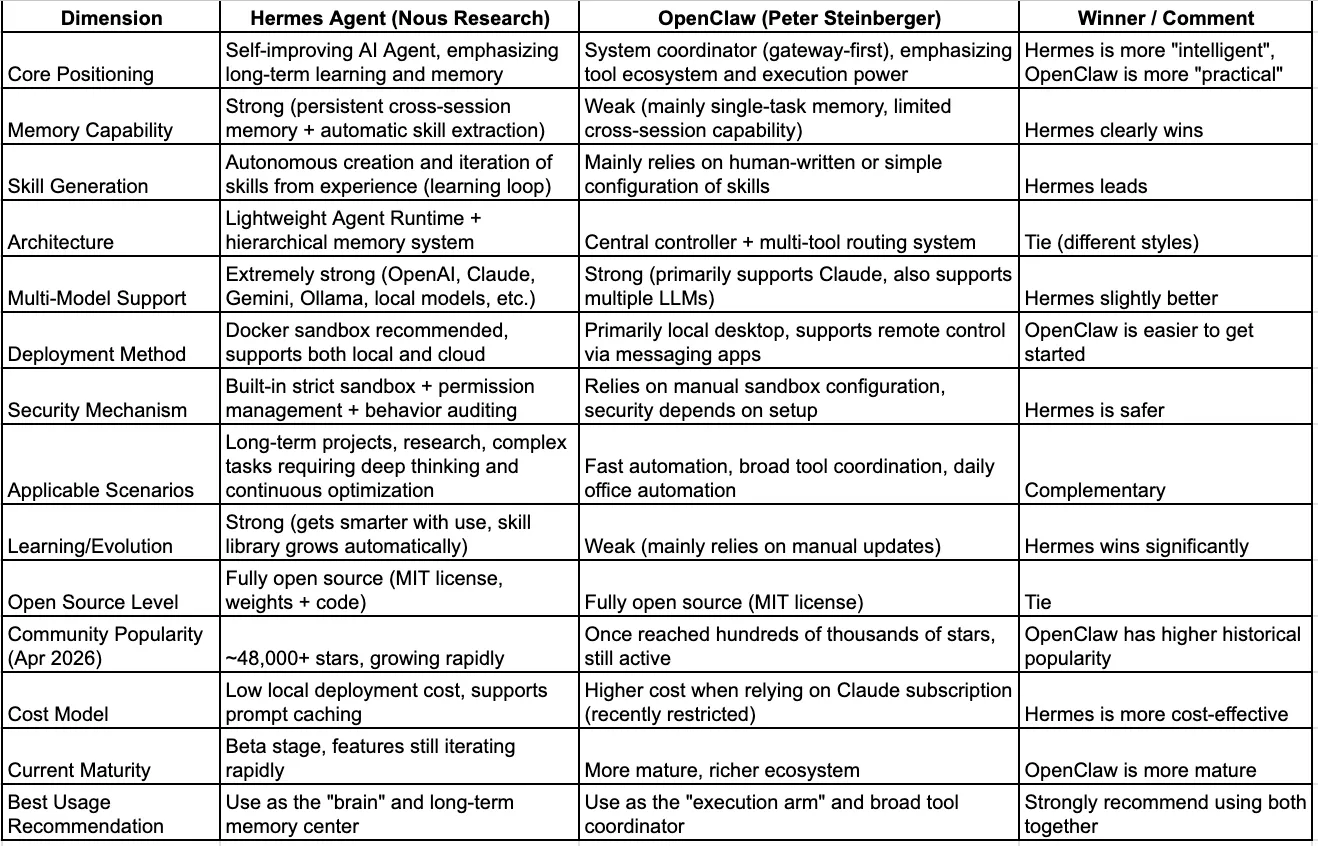
OpenClaw (developed by Peter Steinberger) became a breakout open‑source AI agent framework at the end of 2025, with "remote control of the computer" as its core selling point and enabling file operations, code debugging, and other tasks via messaging apps. Hermes Agent and OpenClaw present a clear contrast in positioning and implementation:
- Core philosophy:
- OpenClaw: system orchestrator (gateway‑first), emphasizing ecosystem breadth (50+ integrations), human‑led skill authoring, fast deployment, and a rich toolchain. It resembles a "powerful and flexible remote control."
- Hermes Agent: self‑growing agent (mind‑first), emphasizing deep learning, persistent memory, and automatic skill evolution. It resembles a "thinking, improving partner."
- Technical implementation:
- OpenClaw: central controller architecture focused on routing, permission management, and multi‑tool scheduling. Skills are mainly written or configured by humans, with limited cross‑session memory.
- Hermes Agent: built‑in learning loop + hierarchical memory system (persistent notes + retrieval + proceduralized knowledge). Skills are autonomously distilled and iterated by the agent from experience, giving it significantly stronger cross‑session capabilities.
- Advantages comparison:
- Memory and evolution: Hermes Agent clearly leads in long‑term accumulation of user‑specific knowledge and skills; OpenClaw is more efficient in single‑session tasks but is more likely to "forget" historical context.
- Deployment and ease of use: OpenClaw offers broader integrations and faster startup, suitable for plug‑and‑play scenarios; Hermes Agent's sandboxing is more robust for long‑term runs, though initial configuration is slightly more involved.
- Use cases: OpenClaw is better for broad tool coordination and quick automation; Hermes Agent is better suited to complex workflows that require deep reasoning, long‑term learning, and personalized evolution (e.g., research, long‑term project management).
- Performance and cost: Hermes Agent supports direct connections to Anthropic APIs and prompt caching, which may lower long‑term costs; OpenClaw's mature ecosystem can be cost‑volatile when relying on third‑party tools.
The community consensus is that the two are not zero‑sum but highly complementary. Many users run both—using Hermes Agent as the "thinking brain" and long‑term memory center, and OpenClaw as the "execution arm" and broad tool coordinator.
Industry impact and future outlook
Hermes Agent's open‑source release and rapid iteration accelerate the shift of AI agents from "one‑off tools" to "persistent intelligent companions." It provides developers with a low‑cost, high‑security self‑improving agent framework and helps foster an open‑source AI agent ecosystem. At the same time, it places pressure on closed or semi‑closed tools such as Anthropic Claude Code, prompting the industry to rethink the balance between control and openness.
For enterprise users, Hermes Agent lowers the barrier to deploying production‑grade AI agents; for individual developers, it offers a powerful, locally runnable tool that can sustainably evolve. With more model integrations and community contributions, Hermes Agent may become a benchmark in the open‑source AI agent space.
From OpenClaw's ecosystem breadth to Hermes Agent's depth of learning, both are driving AI agents into a new phase of "persistence + self‑evolution." This trend not only reshapes the automation tooling landscape but also signals a shift from "passive response" to "active growth" in AI. In an era of exponential AI capability growth, Hermes Agent reminds us that a true intelligent agent is not a one‑time task executor but a long‑term partner that grows with its user.
Following its open‑source release, Hermes Agent's community‑driven iteration is expected to accelerate, and co‑deployment with OpenClaw will likely become a common configuration for many developers. The next chapter of AI agents is being written by these open‑source innovators.
▶️ Enjoyed this article? Creating great content takes effort!
Subscribe to our YouTube channel:
AI Rosetta
Your likes, subscriptions and shares mean the world to us! 🙏
For more AI news, visit:
https://www.airosetta.com