
In October 2026, a new benchmark test—TheoPhysEval—developed by Harvard University and Google together with 35 theoretical physicists and AI researchers drew wide attention in academia. The test comprises 50 previously unpublished, research‑level theoretical physics problems spanning 11 cutting‑edge subfields, including quantum field theory, holography, black hole physics, scattering amplitudes, quantum phases of condensed matter, and fluid dynamics. After evaluating several state‑of‑the‑art large language models, the results show that OpenAI’s GPT‑6 Astra (running in a Codex programming environment) solved 49 of the problems under “realistic” conditions that permit internet access and tool use, achieving a 98% accuracy rate at an average cost of under $3 per problem (about $116 in total).
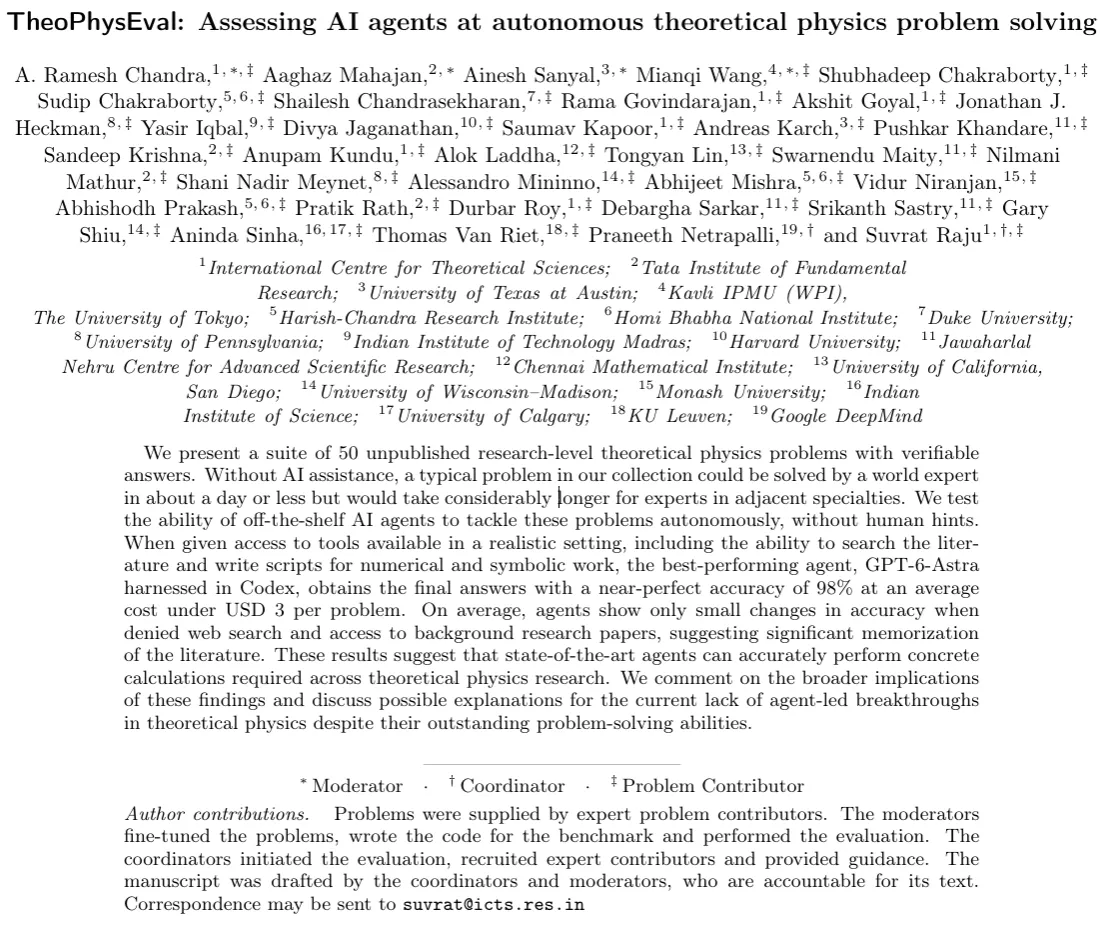
This outcome not only resets expectations for AI capabilities in scientific research but also extends discussions that began in mathematics into theoretical physics.
Test design: real research‑level challenges with strong anti‑cheating safeguards
TheoPhysEval is distinctive in its problem sources and evaluation criteria. All 50 problems were contributed by leading experts in each subfield and were drawn from their unpublished research notes or calculation drafts. The questions were designed as verifiable computational problems—so‑called “turn‑the‑crank” tasks—that extend known methods rather than require fully open‑ended conceptual breakthroughs. Experts estimate that a top specialist in the relevant area would typically complete a representative problem in about a day or less; experts from adjacent fields would generally need substantially more time.
To prevent models from “memorizing” answers from training data, the test team ensured the problems were completely unpublished at evaluation time. Models ran autonomously with no human prompts, divided into two tracks:
- Realistic track (permits online literature searches and writing numerical/symbolic computation scripts);
- Isolated track (no internet or external resources allowed).
GPT‑6 Astra achieved 49/50 in the realistic track and 46/50 (92%) in the isolated track. Anthropic’s Claude Opus 5.5 followed closely with 46/50 on both tracks. Google Gemini 3.8 Flash scored around 68%/62%, while open models DeepSeek‑V4.1‑Flash and GLM‑5.3 performed near the 50% range.
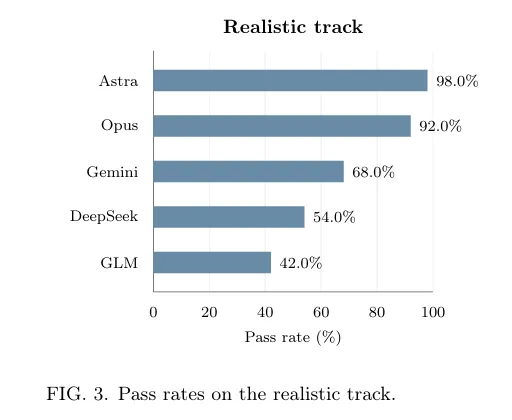
Notably, initial evaluations marked Astra incorrect on several problems, but expert re‑review found subtle errors in some reference answers. After those corrections, Astra’s solutions were confirmed correct and its final score rose to 49/50. The single problem none of the models solved was an inverse problem (recovering a differential equation from a curve); all systems failed on that item.
Capability boundaries: strong execution, limited ‘taste’
The authors note that current top AI agents can reach accuracy comparable to or exceeding single‑domain experts for many concrete computational tasks in theoretical physics. The cost‑effectiveness is striking—what a world‑class physicist might accomplish in a day can be compressed to API costs of a few dollars.
However, researchers emphasize key limitations: these problems are largely extensions of known methods rather than discoveries requiring deep physical intuition, creative conjecturing, or scientific “taste.” The authors argue AI still lacks the aesthetic judgment and problem‑selection ability needed to drive paradigm‑shifting advances in theoretical physics. In other words, AI excels at “solving problems” but has yet to demonstrate the ability to “ask the right questions.”
Moreover, the small gap between the isolated and realistic track results suggests models have internalized a substantial amount of literature rather than relying solely on real‑time retrieval. Single‑run variability and uneven coverage across physics subfields also constrain straightforward interpretation of the scores.
From mathematics to physics: accelerating AI‑assisted research
AI has previously made waves in mathematics—from perfect scores at the IMO to attempts at formalizing proofs of open problems. TheoPhysEval’s results indicate similar capabilities are beginning to systematically penetrate theoretical physics. Unlike mathematics, physics computations often involve more complex symbolic derivations, numerical validation, and cross‑literature synthesis, requiring higher demands on tool use and long‑range reasoning.
The direct implications of this advance include:
- Increased research efficiency: Many routine but time‑consuming calculations can be greatly accelerated by AI agents, freeing human experts for higher‑level conceptual work.
- Lowered cost barriers: Performing expert‑level calculations at very low cost could change how small teams and resource‑limited institutions conduct research.
- Error‑finding capability: In some cases the model identified mistakes in human reference answers, showing potential for cross‑validation.
Risks remain. Overreliance on AI could weaken understanding of computational processes, accelerate the spread of errors, and produce “black‑box” results that are hard to scrutinize. The core value of physics lies not only in obtaining correct answers but also in understanding their physical meaning and domains of applicability.
Objective assessment and future outlook
TheoPhysEval’s results are real and were produced under a rigorously designed protocol: unpublished problems, verifiable answers, and transparent test conditions. They strongly demonstrate that current leading AI agents have reached a very high level in executing theoretical physics computations. But equating this leap in computational power with a wholesale “rewriting” of physics would be premature—the gap between computational ability and theoretical paradigm shifts remains substantial.
The work is currently available as a preprint; full peer review and larger independent replications are still needed. Future directions include expanding benchmarks to cover problems that require more creative insight, exploring human–machine collaboration models, and improving the interpretability and auditability of AI outputs.
Overall, GPT‑6 Astra’s performance on TheoPhysEval marks an important milestone in the extension of AI‑assisted science from mathematics into physics. It demonstrates huge potential while clearly delineating current limits: AI can be an extremely efficient “computational assistant,” but the scientific taste and originality that drive physics forward are, for the near term, still primarily in human hands. How the two will collaborate will shape the pace and form of discoveries in the coming years.
▶️ Enjoy this piece? Creating content is hard work!
Follow our YouTube channel:
AI Rosetta
Your likes, subscriptions, and shares are our greatest support!🙏
More AI news at: https://www.airosetta.com