
On September 30, 2026, a cross between history and artificial intelligence attracted wide attention on X: a 217‑year‑old Napoleonic encrypted military letter was successfully deciphered. Carter Church, an AI engineer at U.S. cybersecurity firm SentinelOne, using OpenAI's flagship model GPT‑6 Astra, completed the full workflow from image transcription to cryptanalysis in about six hours and publicly released the letter's full plaintext for the first time.
Details
The letter was sent around March 1809 by Eugène de Beauharnais, Napoleon's stepson and Viceroy of Italy, to General Auguste de Marmont, who at the time commanded French forces in Dalmatia. Napoleon himself had instructed Eugène to send encrypted military reports to Marmont. The letter used a homophonic substitution cipher and contained about 1,300 cipher units and 155 different symbols, some representing single letters and others representing entire archaic words. The cipherbook had long been lost, and after a 1969 reproduction appeared in a French military journal the message remained unsolved. Previously, cipher‑history researchers such as Daniel Tant had only broken about 33 symbols (covering roughly 435 units).
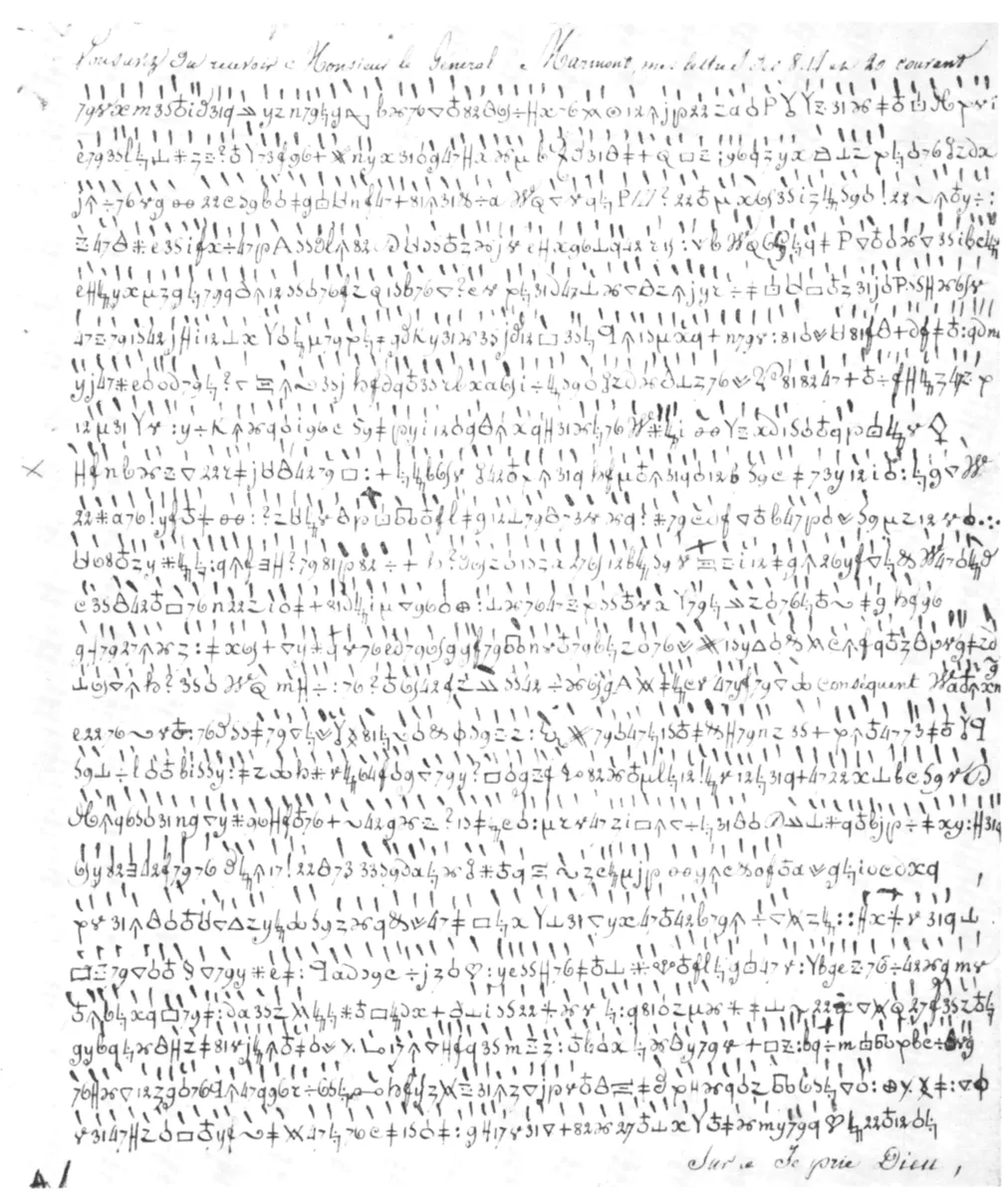
Church provided the model with archival images and task instructions. GPT‑6 Astra first performed handwritten‑variant recognition and transcription, combined the result with the known partial key, then used trial‑and‑error optimization methods such as simulated annealing to assign values to the remaining symbols, and cross‑checked results against Marmont's extant prose style and the historical context. The final reconstructed plaintext was a pre‑battle military briefing listing deployments of French and allied forces: for example, roughly 40,000 Bavarian troops near Munich and Passau, about 30,000 Polish troops near Kraków on the Vistula, some 80,000 French troops near Bayreuth, about 60,000 troops near Ulm and Donauwörth, and approximately 40,000 troops under General Oudinot near Augsburg and the Lech River. The letter's date was accordingly corrected to March 1809 (previously misattributed to 1807), aligning closely with Napoleon's related orders of March 16.
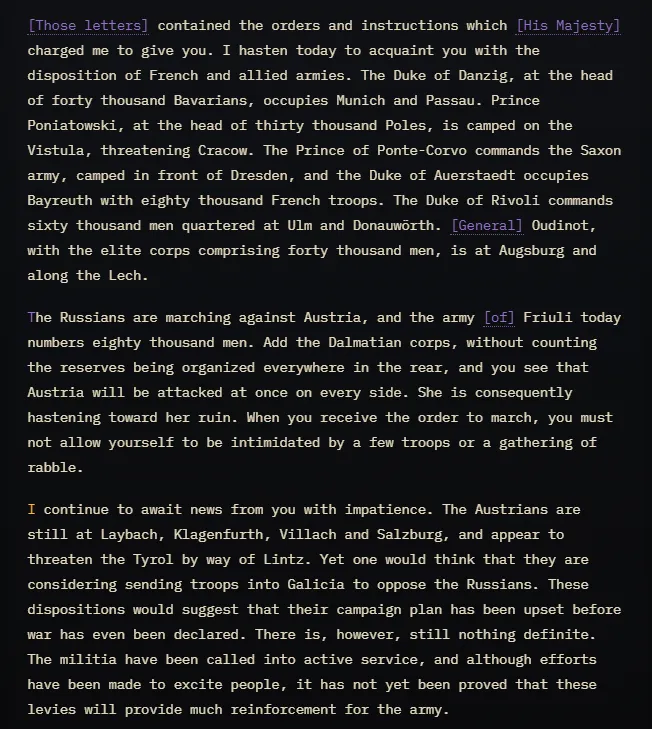
Full translation
Church subsequently published the key, transcription results and reproducible scripts. Cryptography researchers including Frode Weierud and maintainers of the unsolved‑ciphers list reviewed the plaintext and key and formally marked the entry as “resolved.” The entire process showcased large‑model capabilities in multimodal recognition, symbolic reasoning, historical‑context matching and autonomous tool use.
Technical points and methods
Decryption was not a simple “one‑click” operation but a complete research workflow:
- Accurate transcription of over 1,300 handwritten cipher symbols from low‑resolution archival images;
- Using the available partial key as a starting point;
- Generating and validating candidate assignments for unknown symbols via heuristic searches such as simulated annealing;
- Cross‑validation using French language patterns, military terminology and Marmont‑related historical texts;
- Producing a complete bidirectional mapping table and a fluent plaintext.
The model completed these stages in about six hours, significantly shortening the time and lowering the expertise threshold compared with traditional manual cryptanalysis. Around the same time, other researchers using Claude Opus 5, with pre‑provided analysis tools and historical materials, decrypted an Enigma‑related ciphertext from 1941, further indicating that state‑of‑the‑art models can provide practical assistance in historical cryptography.
Potential impacts
1. Changes to historical research paradigms
Many unsolved or partially solved historical encrypted documents (military dispatches, diplomatic correspondence, private diaries, etc.) may be decrypted faster with AI assistance. Researchers could shift effort from basic symbol‑breaking toward interpretation and contextual analysis, enriching primary‑source material for studies of the Napoleonic Wars and early modern communications history.
2. Cross‑development of cryptography and AI
The case shows that large models can handle classical cipher systems like homophonic substitution and independently design verification workflows. This has direct reference value for modern cryptanalysis education, museum digitization projects and intelligence‑archive organization, while also highlighting the need to consider boundaries for AI use on sensitive historical and contemporary encrypted materials.
3. Demonstration of model capability and trust verification
Completing the closed loop from image to full plaintext in six hours demonstrates GPT‑6 Astra's progress in long‑range reasoning, tool use and multimodal understanding. External expert review and the publication of reproducible materials help bolster the credibility of AI‑assisted research results. Accumulating similar cases will encourage academia to establish more standardized verification criteria for AI participation in historical cryptanalysis.
4. Public awareness and educational value
The event concretizes “AI solving historical mysteries,” which can raise public interest in AI applications within the humanities and spur more interdisciplinary collaborations (history + computational linguistics + cryptography). Concurrently, other researchers have used Claude Opus to handle different historical ciphers (such as a 1941 German Enigma telegram).
5. Potential risks and ethics
If models are later applied to decrypt currently sensitive contemporary materials, regulatory and ethical debates could ensue. Although historical documents are long past, transferring such capabilities to modern contexts will require clear usage policies and auditing mechanisms.
Conclusion
The 217‑year‑old Napoleonic military cipher, assisted by GPT‑6 Astra, is both a concrete historical discovery and a vivid example of large models evolving from “text generation” toward “assisting in complex symbolic and reasoning tasks.” It demonstrates that with partial keys and historical context, frontier AI can greatly reduce the time and threshold for classical cryptanalysis. For historians, this opens a window to reexamine many unsolved archives; for the AI field, it provides a reproducible, verifiable interdisciplinary success case. As more such projects are published and reviewed, AI’s role in the humanities may progress from an auxiliary tool to a deep collaborative partner.
▶️ Enjoyed this article? Creating great content takes effort!
Subscribe to our YouTube channel:
AI Rosetta
Your likes, subscriptions and shares mean the world to us! 🙏
For more AI news, visit:
https://www.airosetta.com