
September 24, 2026 — A real‑vehicle test called DrivingBench drew wide attention. OpenAI's flagship model GPT‑6 Astra, without specialized driving training, directly controlled a 2022 Toyota Corolla via tool calls and completed the full ~134.7‑meter run on a cone course in an empty parking lot in the San Francisco Bay Area, successfully parking in the designated spot in 5 minutes 22 seconds. It is the first general‑purpose large model to finish the benchmark since its establishment. Coeval tests by Claude Fable 5.1, Grok 4.6 and GPT‑5.6 Sol failed to complete. Chinese media often liken it to passing a 'driving test', but the experiment was a low‑speed, closed, controlled trial, not a full public‑road driving exam.
Details
DrivingBench was designed by researchers Tobias Gessler, Simon Mahns and Aditya Ramabadran to examine whether general‑purpose large language models (rather than dedicated autonomous driving systems) can control a real vehicle through a tool interface. The test vehicle was equipped with Comma Four hardware and the openpilot low‑level control software; the model drove by observing camera feeds and issuing steering/throttle/brake commands. A human safety operator was present throughout ready to apply the brake, and vehicle speed was strictly limited to very low levels (successful runs averaged about 0.42–0.8 m/s).
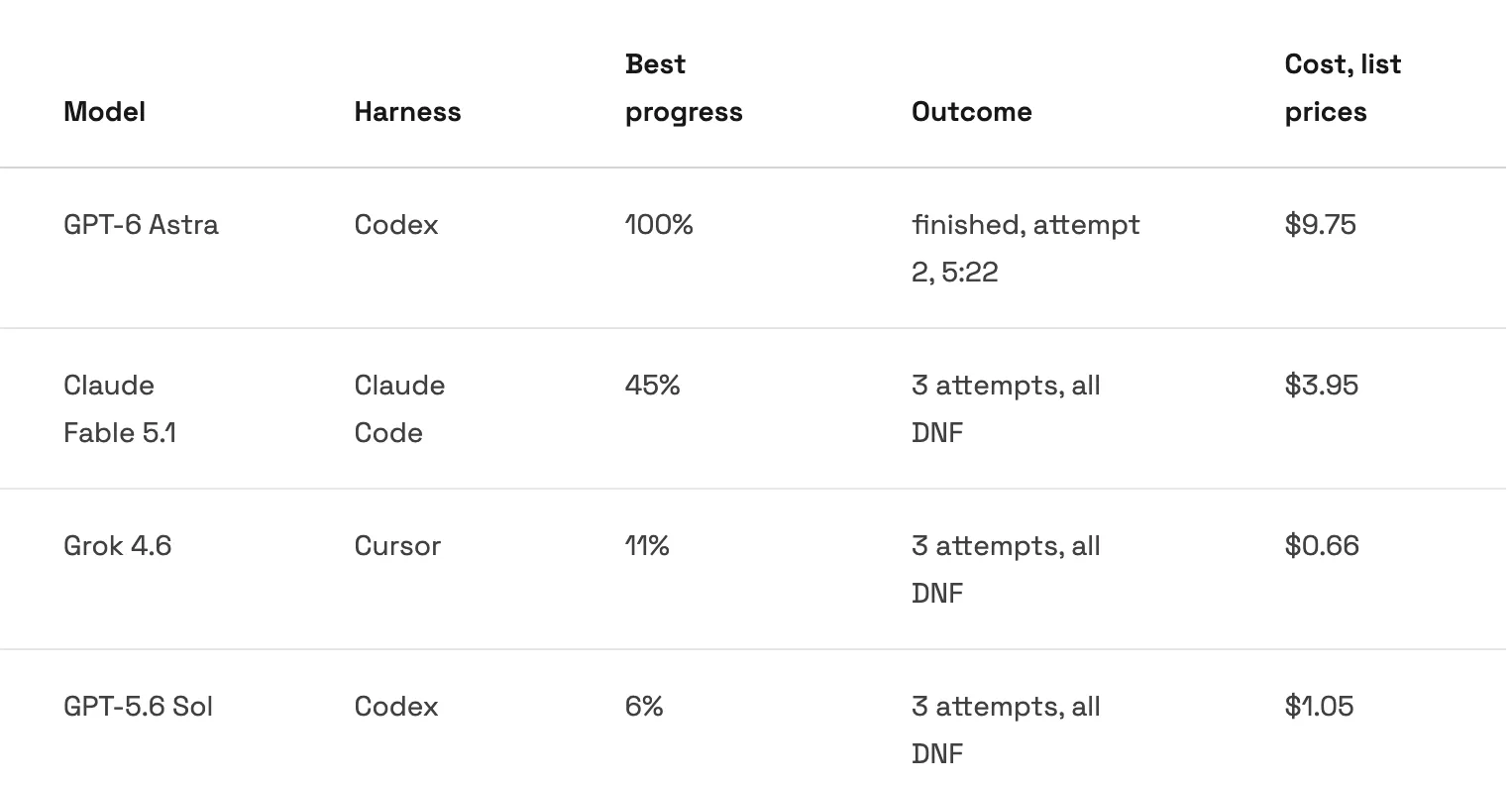
Track and results
The course consisted of colored cones forming a roughly 8‑meter‑wide corridor with turns, ending in a cone‑delimited parking area of about 7×5 meters and a total length of roughly 130–135 meters. On its first attempt GPT‑6 Astra stopped after completing about 49% due to collisions or deviations; on its second attempt it issued 24 motion commands, completed the full 134.7 meters and parked in the blue goal area in 5 minutes 22 seconds, consuming about 6.6 million tokens. Based on published pricing, that equates to an estimated cost of about $7.74. Other models lagged: Claude Fable 5.1 reached about 45% at most, Grok 4.6 about 11%, and GPT‑5.6 Sol about 6%; most runs failed at the first turn or cone‑line recognition, mainly due to spatial perception issues—misidentifying which side of a diagonal cone line was the drivable path.
During the test Astra regularly called an "observe" tool to view camera images and adjusted its strategy based on real‑time feedback. After the first failed attempt it revised its path planning for the second run. Notably, the model initially refused to directly control the real car, citing safety and responsibility concerns, and only continued after researchers explained the safety measures. There was no manual takeover during the completed run, but the vehicle was always under very low speed and human supervision.
Technical significance and limitations
The core value of this result is that: a general‑purpose large model completed a closed, low‑speed vehicle course on a real car for the first time. It demonstrates that state‑of‑the‑art models possess a degree of visual understanding, spatial reasoning, multi‑step planning and error recovery ability, enabling translation of language‑level reasoning into physical control actions. Unlike traditional end‑to‑end autonomous driving systems, this experiment did not fine‑tune the model on a dedicated driving dataset; the model relied on general capabilities and tool interfaces to perform the task.
However, limitations are clear:
- Very low speed, with latency a major bottleneck (model "thinking" time is significant);
- Simple environment (empty parking lot with static cones), far from complex traffic scenarios;
- Dependent on specialized hardware interfaces and a low‑level controller, not pure end‑to‑end vision‑based driving;
- High cost and token consumption, not yet practical economically;
- A human safety operator was present throughout, so it is not equivalent to driverless operation.
The researchers themselves emphasize this is more an exploratory benchmark and unlikely to convert directly into practical autonomous driving solutions in the short term.
Possible impacts
1. Extension of general agents into the physical world
The event indicates that large models' "action capabilities" have expanded from screen operations and code execution to real vehicle control. Future tests may extend to more embodied tasks (robots, drones, etc.), advancing research on the language–perception–action closed loop.
2. Changes to benchmarks and evaluation methods
DrivingBench shifts evaluation from purely digital benchmarks toward real physical interaction, complementing existing coding, tool use and computer‑operation tests. More teams are expected to follow with real‑world agent benchmarks, pushing models to improve spatial perception and real‑time decision‑making.
3. Discussion of autonomous driving technology routes
The result may boost interest in a "general model + tools/interfaces" approach, but it also highlights the advantages of dedicated autonomous driving systems in speed, reliability and cost. In the near term the two approaches are more likely to be complementary than mutually exclusive.
4. Safety and regulatory implications
Even under strictly controlled conditions, the model's initial refusal to drive and subsequent successful execution underscore the importance of alignment and safety boundaries. Before real‑world deployment, more comprehensive monitoring, kill‑switch and liability frameworks are required.
5. Public perception and industry expectations
Headlines like "large model takes a real car to pass a driving test" are easy to spread and can raise public awareness of embodied AI capabilities, but they may also inflate unrealistic expectations. The industry should keep a clear distinction between publicity and actual capability.
Conclusion
GPT‑6 Astra's completion of the DrivingBench cone course as the first general‑purpose large model to do so marks a milestone in AI moving from the digital to the physical. It shows that cutting‑edge models already have basic driving control abilities under low‑speed, closed and supervised conditions, but there remains a large gap to true public‑road autonomous driving. For research, it provides a new sample for embodied intelligence and real‑world agent evaluation; for industry, it is a reminder that pursuing stronger action capabilities must go hand in hand with enhanced safety, efficiency and verifiability. If replicated and improved at higher speeds and in more complex environments, the result's significance would grow further.
▶️ Enjoy this article? Content creation is hard!
Follow our YouTube channel:
AI Rosetta
Your likes, subscriptions and shares are our greatest support! 🙏
More AI news at: https://www.airosetta.com