
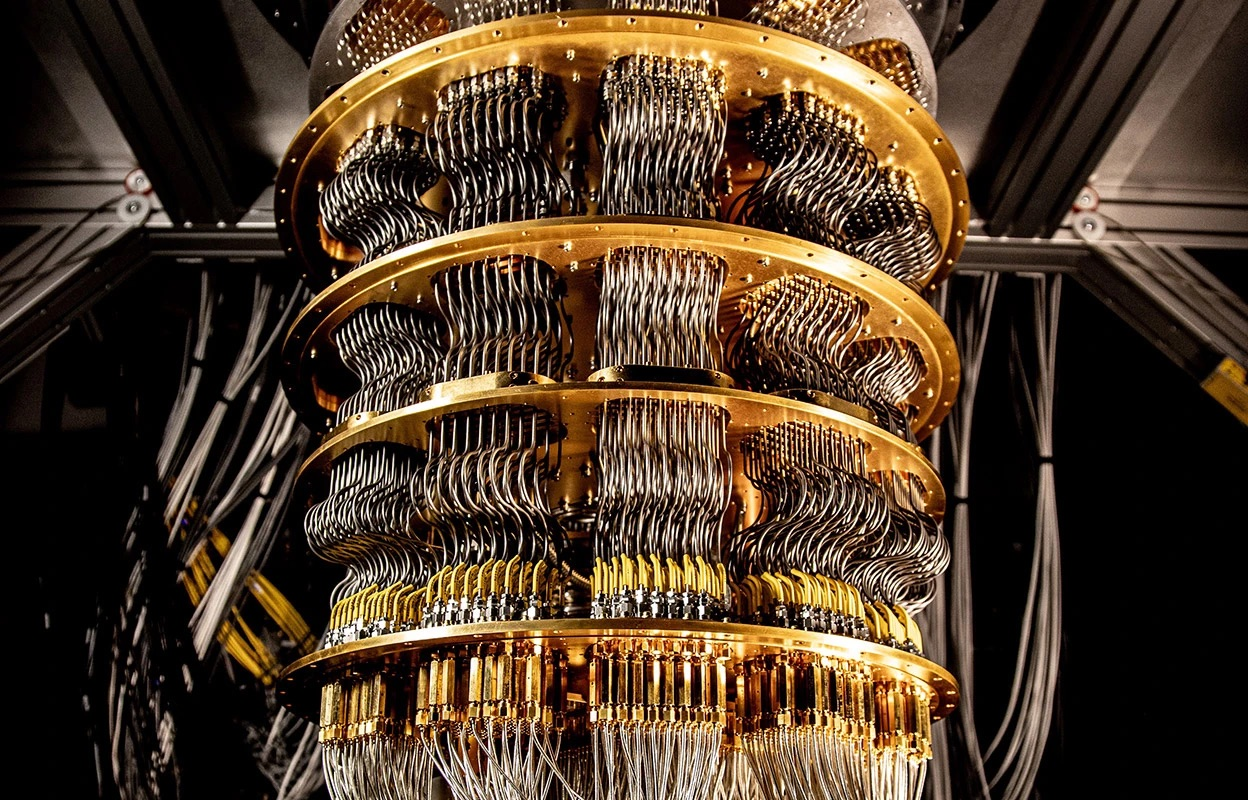
On October 22, 2025, Google Quantum AI published its latest research in Nature, announcing that its 65‑qubit processor "Willow" achieved quantum advantage. Running a new algorithm called "Quantum Echoes," the processor was reportedly 13,000 times faster than the world's fastest supercomputer. This breakthrough marks a key step toward making quantum computing practical. The advance builds on work by Google scientists who were recently awarded the 2025 Nobel Prize in Physics.
(Note: On October 7, 2025, the Royal Swedish Academy of Sciences announced that John Clarke, Michel H. Devoret and John M. Martinis jointly received the 2025 Nobel Prize in Physics for their pioneering discovery of macroscopic quantum tunneling and energy quantization in superconducting circuits. This discovery laid the foundation for quantum computing technologies, especially superconducting qubit architectures. Michel H. Devoret currently serves as Google Quantum AI's chief scientist for quantum hardware. He and John M. Martinis co‑led Google's quantum hardware development.)
What is the 65‑qubit processor?
A qubit is the basic unit of quantum computation. Unlike the bits in classical computers, a qubit can exist in multiple states simultaneously (quantum superposition) and can be highly correlated with other qubits via quantum entanglement. This gives quantum computers exponential parallelism for certain complex problems.
Google's "Willow" processor uses superconducting qubit technology in a square array of 105 superconducting qubits, of which 65 qubits were used in this experiment. Superconducting qubits are controlled by microwave pulses and maintain coherent quantum states at ultra‑low temperatures. The "Willow" design aims to reduce errors between qubits and extend coherence times to improve computational reliability.
Principle and applications of the Quantum Echoes algorithm
The "Quantum Echoes" algorithm is a novel quantum method designed to simulate the dynamics of quantum many‑body systems. The algorithm applies a sequence of operations to the quantum system, perturbs one qubit, then reverses the operations and compares the initial and final states to extract quantum features. This approach can effectively probe interference effects in quantum systems, such as out‑of‑time‑order correlators (OTOCs).
In this experiment, the Google team used the "Quantum Echoes" algorithm to successfully simulate molecular properties, achieving a speedup of about 13,000 times over the fastest current supercomputer. This result not only demonstrates the potential of quantum computing for molecular simulation but also offers new tools for drug discovery, materials science and other areas.
Beyond supercomputers: the significance of a 13,000x speedup
Currently, the world's second‑ranked supercomputer is the U.S. system "Frontier" (the fastest supercomputer is the El Capitan system, which reaches 1.742 exaFLOPS of performance). El Capitan was built by Hewlett Packard Enterprise (HPE) and Cray using the Cray EX architecture. It is equipped with 9,472 AMD EPYC 7713 processors (each with 64 cores) and 37,888 AMD Instinct MI250X accelerators, totaling about 8,699,904 compute cores. These CPUs and GPUs work together to deliver vast computational power, exceeding 1 exaFLOP of floating‑point performance per second (Frontier reached 1.353 exaFLOPS). However, even such systems face great challenges when simulating complex quantum systems. Classical algorithms for quantum many‑body problems scale exponentially and are infeasible to run in reasonable time.
By leveraging quantum parallelism and interference, the "Willow" processor can perform complex quantum tasks in very short times. In this experiment, running the "Quantum Echoes" algorithm on Willow's 65 qubits completed a calculation in about 2 hours that would take Frontier roughly 3.2 years. This gap demonstrates the huge advantage of quantum computing for certain problems.
Prospects and challenges for practical use
Despite the significant results, practical quantum computing still faces many challenges. Current processors are limited in qubit count, have relatively high error rates and short coherence times. Achieving large‑scale, fault‑tolerant quantum computing will require further breakthroughs in quantum error correction, qubit control and chip manufacturing.
Nevertheless, the Google team's experiment provides new directions and confidence for practical quantum computing. They plan to further improve processor performance over the next five years and expand applications in drug discovery, materials science and artificial intelligence. They are also exploring hybrid modes of quantum‑classical computing to leverage the strengths of both approaches.
Conclusion
The Google Quantum AI team's paper in Nature marks an important step toward moving quantum computing from the lab into real applications. The 65‑qubit "Willow" processor and the success of the "Quantum Echoes" algorithm not only showcase quantum computing's potential for simulating molecular structures but also lay groundwork for future practical quantum systems. As the technology advances, quantum computing is expected to play an increasing role in drug discovery, materials science and AI, driving scientific research and technological innovation into a new era.