
On March 31, 2026, Google officially launched a new member of its video generation family — Veo 3.1 Lite — and simultaneously opened a paid preview to developers via the Gemini API and Google AI Studio. This is the most cost‑efficient version Google has released following the Veo 3.1 series (including Fast and standard editions), designed to significantly reduce compute costs for video generation and bring high‑quality AI video from "high‑end demos" to "high‑volume applications." Google stated that Veo 3.1 Lite maintains Veo's high‑fidelity standards while achieving a breakthrough of "less than half the cost of Veo 3.1 Fast at comparable speeds" through architectural optimizations, directly competing with various lightweight video models on the market.
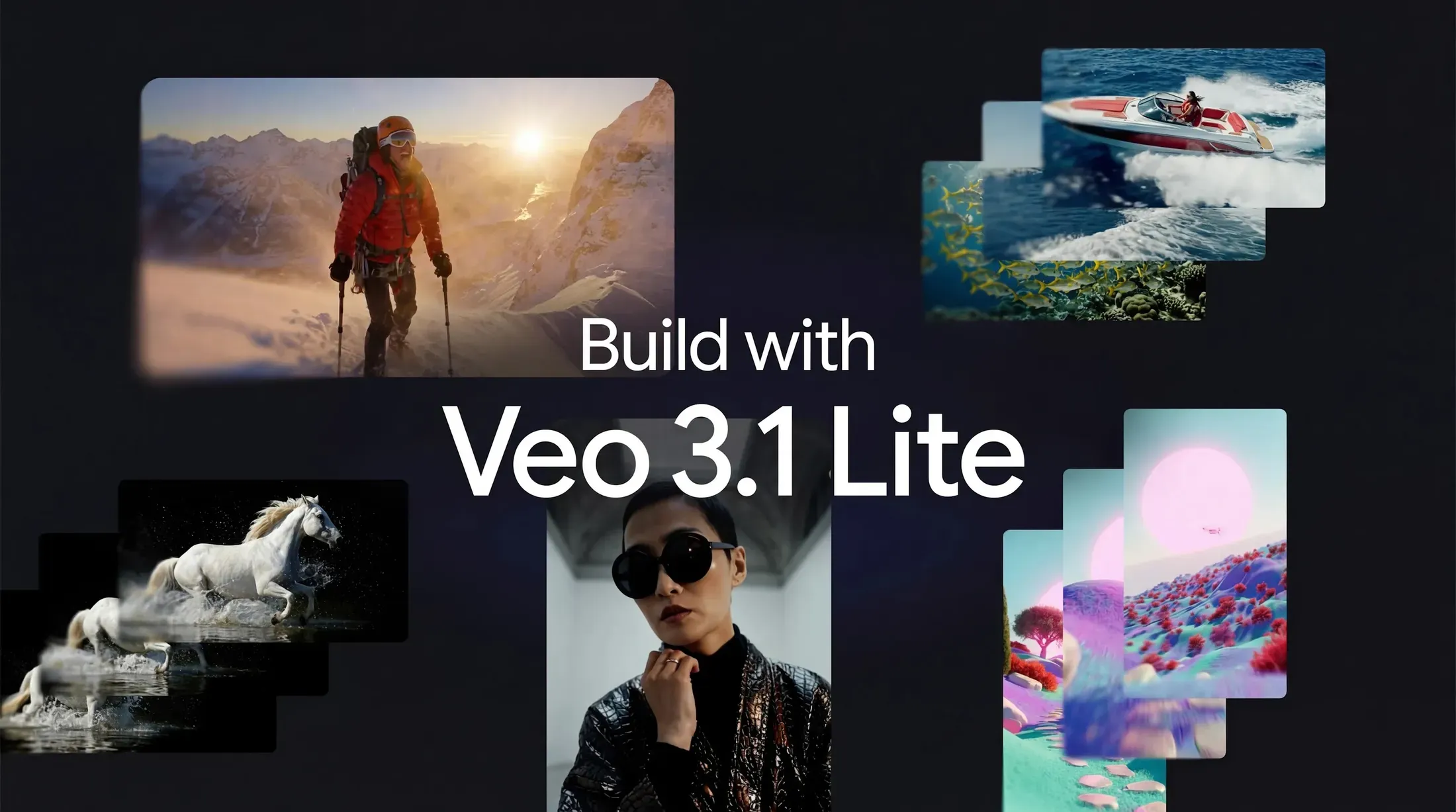
The release came one week after OpenAI's March 24 announcement terminating the Sora project, and the move has been interpreted in the industry as a clear signal that Google continues to invest in the video generation track. Veo 3.1 Lite supports text‑to‑video (Text‑to‑Video) and image‑to‑video (Image‑to‑Video) generation modes, offers durations of 4, 6, and 8 seconds, supports 16:9 landscape and 9:16 portrait aspect ratios, and provides 720p and 1080p resolutions (4K is not supported).
Core innovation: efficiency‑first architecture optimizations and developer‑oriented design
Veo 3.1 Lite is not a simple "trimmed" edition but a high‑efficiency, developer‑first model tailored by Google's DeepMind for high‑concurrency, large‑scale scenarios. Its innovations are concentrated in three dimensions:
- Extreme compute and cost optimization Google has not disclosed detailed architecture specifics, but the company emphasized that Veo 3.1 Lite uses a targeted distilled diffusion‑Transformer hybrid architecture, including attention pruning, parameter reduction and inference‑time quantization. While preserving the core generation quality of the Veo 3.1 series, its inference speed is roughly on par with Veo 3.1 Fast, but the cost is reduced to less than half. The stated pricing is: $0.05 per second for 720p and $0.08 per second for 1080p (Veo 3.1 Fast is $0.15 per second for 720p and higher for 1080p, with further reductions scheduled from April 7). That means generating an 8‑second 1080p video can cost as little as $0.64, well below previous industry norms, enabling truly affordable high‑volume applications.
- Flexible inputs and creative control The model supports dual inputs of text prompts and reference images and can produce clips with native audio. Developers can freely choose landscape or portrait formats, making it particularly suitable for short‑form video, social media and advertising portrait content. At the same time, it retains Veo's usual adherence to prompt guidance, physical plausibility and character consistency, fitting professional workflows that require rapid iteration.
- Developer infrastructure orientation Unlike the Veo 3.1 standard edition (which focuses on cinematic quality and creative controls), the Lite edition is explicitly positioned for "building high‑volume video applications," emphasizing scalability and programmability. It provides standardized interfaces through the Gemini API for easy integration into third‑party apps, content platforms or automated workflows. This marks a strategic shift from "technology showcase" to "infrastructure for broad access."
Pricing and access
Veo 3.1 Lite is now available on the paid tiers of the Gemini API and Google AI Studio. Google also announced a price reduction for Veo 3.1 Fast effective April 7 to further lower developer barriers. Although Lite is a "lightweight" edition, in practical tests it still produces high‑fidelity video suitable for advertising, social content, educational short films and other high‑frequency scenarios rather than top‑tier cinematic production.
Far‑reaching impact: accelerated video generation adoption and industry reshaping
For developers and content creators: Veo 3.1 Lite greatly lowers the entry barrier, enabling small teams and individual developers to deploy AI video capabilities at scale. Video generation has long remained experimental due to high compute costs; now high‑volume applications (such as automated short‑video production for platforms, e‑commerce product demos, and bulk brand marketing assets) become feasible. Google's move directly advances the idea of "video as infrastructure," likely triggering a new wave of content creation.
For the AI video track: After OpenAI's termination of Sora, Google's continued investment and cost‑cutting strategy further consolidate its leading position in video generation. Veo 3.1 Lite, together with Veo 3.1 Fast and the standard edition, forms a clear tiered pricing system that covers scenarios from broad‑access high‑volume use to top‑tier creative production. Compared with Chinese vendors (such as ByteDance's Seedance and others), Google leverages ecosystem advantages (Gemini API, Google AI Studio, YouTube integration) and cost leadership to create differentiated barriers. At the same time, this move sets a market example—compute costs are no longer the primary obstacle to the adoption of video AI.
For the global AI ecosystem: The release of Veo 3.1 Lite reflects Google's product philosophy of "efficiency first, accessibility first." In an environment of increasingly constrained compute resources, reducing costs through architectural innovation rather than brute‑force parameter scaling provides a new industry paradigm. In the long run, this will accelerate AI video penetration into education, advertising, entertainment, news and other fields, moving generative AI from a "tool" to a "foundational production infrastructure." It also gives small and medium developers more options and reduces dependence on single closed‑source models.
Potential challenges and outlook
Although the Lite edition offers excellent cost‑effectiveness, as a lightweight model it remains inferior to the Veo 3.1 standard edition in extreme creative control and 4K output; it is better suited to high‑frequency iteration than top‑tier film production. Google is expected to continue releasing additional video‑related updates to further enrich the developer toolchain.
The launch of Veo 3.1 Lite is Google's timely response after OpenAI's Sora exit and marks the beginning of a new phase of "cost competition + mass adoption" in AI video generation. It demonstrates that architectural innovation can deliver dramatic improvements in cost‑effectiveness, lowering barriers for enterprises and reshaping content production chains. For developers, this is a milestone in "democratizing video generation"; for the AI industry, it is a vivid example of sustainable innovation.
With Veo 3.1 Lite, Google once again shows that in generative AI both technical capability and commercial accessibility matter. As more lightweight, high‑efficiency models emerge, high‑quality video generation will increasingly reach mainstream users.
▶️ Enjoy this article? Creating content is really hard!
Follow our YouTube channel:
AI Rosetta
Your likes, subscriptions and shares are our greatest support! 🙏
More AI news at: https://www.airosetta.com