
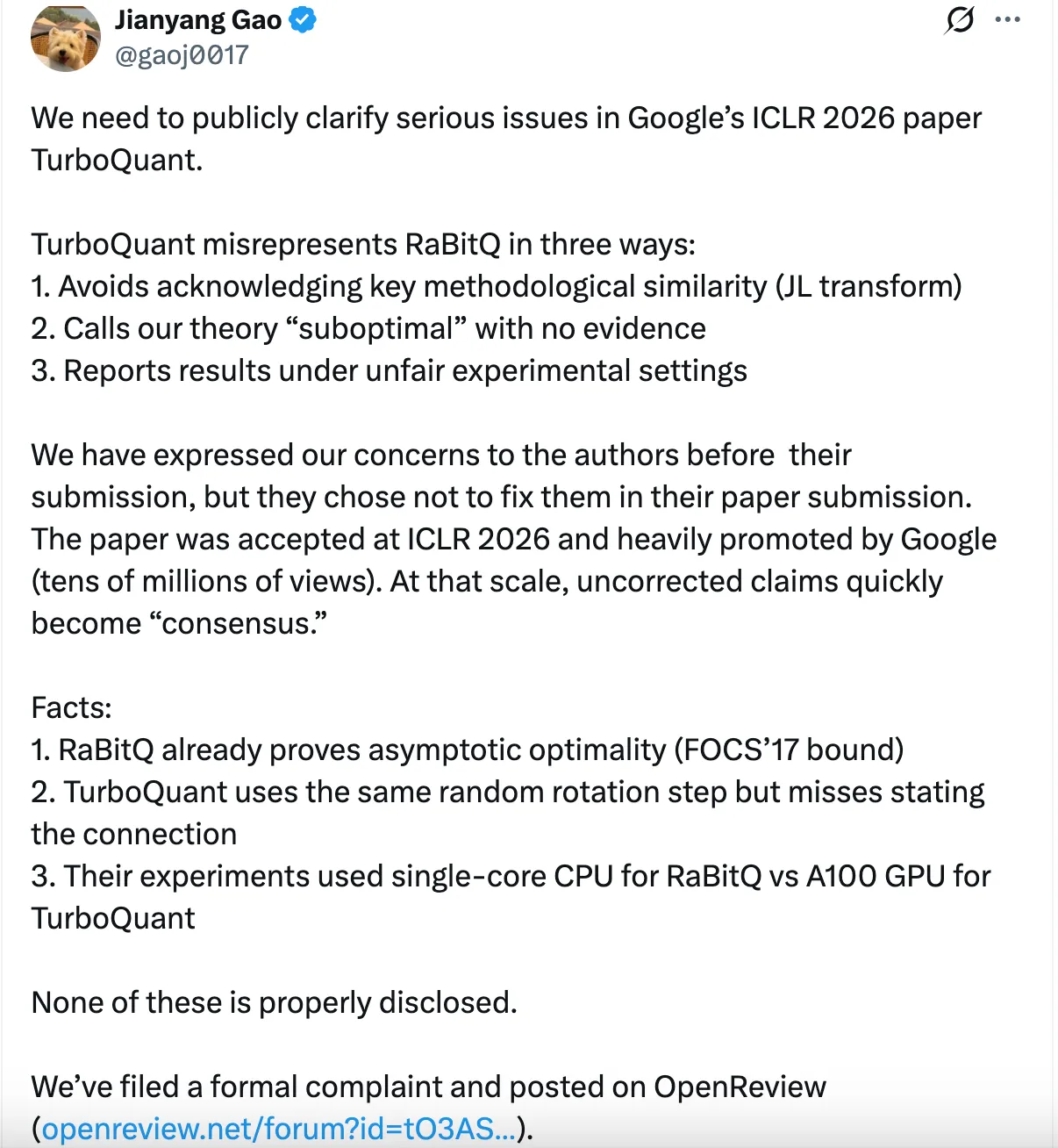
On March 24, 2026, Google Research publicly released the TurboQuant algorithm (arXiv:2504.19874) — though its paper had actually been published nearly a year earlier — which set the AI community abuzz with claims of "at least 6x KV cache memory compression, up to 8x speedup in attention computation, zero accuracy loss, and no training required," even causing short‑term market value swings of hundreds of billions of dollars in memory stocks (Micron, Western Digital, etc.). However, on the evening of March 27 the paper quickly became embroiled in serious academic controversy. Jianyang Gao, a postdoctoral researcher at ETH Zurich and first author of the RaBitQ series, posted on X and Zhihu alleging that TurboQuant's description of RaBitQ contained three major issues: evasion of methodological similarity, misleading theoretical claims, and unfair experimental comparisons. These issues were communicated by email to the Google team before the May 2025 submission; the team partially acknowledged them but did not fully correct them.
Gao has posted a formal public comment on the ICLR 2026 OpenReview platform and submitted a complaint containing the complete email evidence to the conference chairs, and plans to publish a detailed technical report on arXiv. Google has not yet publicly responded and the situation is still developing.
Technical deep‑dive: RaBitQ vs TurboQuant — Highly overlapping core innovations
RaBitQ (published in 2024, arXiv series such as 2405.12497, authored by Jianyang Gao with Cheng Long) is a data‑independent online quantization method for high‑dimensional vector quantization (especially ANN approximate nearest neighbor search). Its core innovations include:
- Random orthogonal rotation (Random Orthogonal Rotation / JL transform): applying a random rotation matrix to input vectors (based on Johnson‑Lindenstrauss) to make coordinate distributions more uniform (tending toward a Beta distribution in high dimensions), avoiding excessive information loss near "equatorial" regions of traditional quantization.
- Grid‑based quantization (Grid‑based / Nearest Codeword): after rotation, each coordinate is quantized independently (initially 1 bit/dimension, later extended to B bits) using a precomputed codebook.
- Theoretical guarantees: proofs of asymptotically optimal error bounds consistent with information‑theoretic lower bounds such as FOCS'17, particularly suitable for vector databases and search tasks.
- Experiments: the original paper emphasized CPU+SIMD implementations, highlighting low storage overhead and recall performance.
TurboQuant (Google team, lead author Amir Zandieh et al.) proposes a two‑stage pipeline: PolarQuant (main compression) + QJL (1‑bit residual correction), likewise claiming data‑independence, online applicability, and near‑optimal distortion rates (MSE and inner‑product bias close to information‑theoretic bounds, factor ≈2.7).
Key technical comparison:
- Common foundation: both use random rotations (JL‑type transforms) as the primary first step to induce coordinates into a predictable distribution (Beta/Gaussian), improving scalar quantization efficiency. This is a core innovation of RaBitQ, but while the TurboQuant paper mentions random rotation as "a key step of its method," when describing RaBitQ it only simplifies it as "grid‑based PQ" (grid‑based product quantization), avoiding this core methodological link.
- Quantization mechanisms: RaBitQ uses rotated grid/nearest‑codeword quantization; TurboQuant further employs a polar‑coordinate transform (PolarQuant stage) or direct scalar quantization plus residual correction (QJL) to eliminate inner‑product bias. TurboQuant claims this achieves "zero storage overhead" and higher accuracy, but critics view it as an incremental optimization built on RaBitQ's rotation foundation rather than a wholly new paradigm.
- Theoretical claims: the TurboQuant paper labels RaBitQ's "theoretical guarantees suboptimal," whereas RaBitQ has proved asymptotic optimality for MSE/inner‑product metrics. Google did not provide sufficient counterevidence.
- Experimental setup: TurboQuant tested on models like Gemma/Llama using A100/H100 GPUs; RaBitQ benchmarks were described as "single‑core CPU, without vectorization," with index times thousands of times slower. Although the paper noted RaBitQ "lacks GPU vectorization," it did not perform fair hardware comparisons, leading critics to say the "TurboQuant far superior" conclusion is misleading.
Gao summarizes: TurboQuant is not outright code plagiarism, but it "fails to fully and objectively present prior work with informed acknowledgment," making it difficult for readers to appreciate RaBitQ's contributions.
Email evidence screenshots and communication timeline: from private warnings to public complaint
The strongest evidence in the dispute comes from multiple rounds of emails (screenshots publicly shared by Gao's team on X, Zhihu and OpenReview):
- January 2025: TurboQuant's second author Majid Daliri proactively contacted the RaBitQ team requesting help debugging RaBitQ code (technical exchanges between parties recorded).
- From May 2025: Gao's team repeatedly emailed detailed notes pointing out the three major issues in TurboQuant's early draft (method description, theoretical denigration, unfair experiments). Daliri's replies explicitly acknowledged some errors and stated he had informed all coauthors.
- Late 2025 to March 2026: the Google team promised "minor revisions after the conference," but the final paper only moved RaBitQ's description to an appendix without adding a full discussion or correcting theoretical/experimental statements.
- March 2026: Gao's team formally wrote to all TurboQuant authors (including first author Amir Zandieh). Zandieh replied promising to fix issues two (theory) and three (experiments) after ICLR, but refused to discuss technical similarity.
Public email screenshots show Daliri writing content like "thanks for the clarification, we will consider correcting it" in an email, which was not implemented. Gao's X post included images (email timestamps, original excerpts) clearly showing this and stressed that "Google's paper has reached tens of millions of exposures and the erroneous narration is becoming accepted wisdom." These screenshots have been widely circulated on Chinese media (such as Sina Finance, NetEase) and X, becoming core evidence in the case.
Impact and industry reflection
- Academia: the ICLR committee may intervene to investigate, highlighting issues in big‑tech paper review and citation norms. The community calls for "prior art to be discussed objectively and comprehensively."
- Capital markets: the initial memory stock drop was driven by "revolutionary" promotion; subsequent controversy increased volatility and reminds investors to distinguish hype from reproducible technology.
- Developer perspective: despite the dispute, TurboQuant's PolarQuant+QJL pipeline has shown KV cache compression potential in early community implementations (combined with llama.cpp, etc.). RaBitQ's code was already open‑sourced, allowing developers to directly verify differences between the two.
- Broader lesson: resource imbalances in AI (big tech promotion vs independent researchers) can amplify citation disputes. Incidents like this remind the industry that innovation must respect prior work, otherwise even strong mathematical proofs cannot hide presentation flaws.
As of March 28, 2026, Google has not formally responded. Recommended follows:
- Jianyang Gao's X account (@gaoj0017) and his OpenReview comment.
- Direct comparisons of the TurboQuant paper and the RaBitQ series.
- Future arXiv technical report.
This is essentially a clash between academic norms and promotional speed, not merely a "plagiarism" label. It again demonstrates that while AI progresses rapidly, integrity remains the baseline. Regardless of the final outcome, RaBitQ's contributions have received greater attention and TurboQuant's practical engineering value still requires further community reproduction and verification.
▶️ Like this article? Creating it takes real effort!
Welcome to follow our YouTube channel:
AI Rosetta
Your likes, subscriptions and shares are our greatest support! 🙏
More AI news at: https://www.airosetta.com