
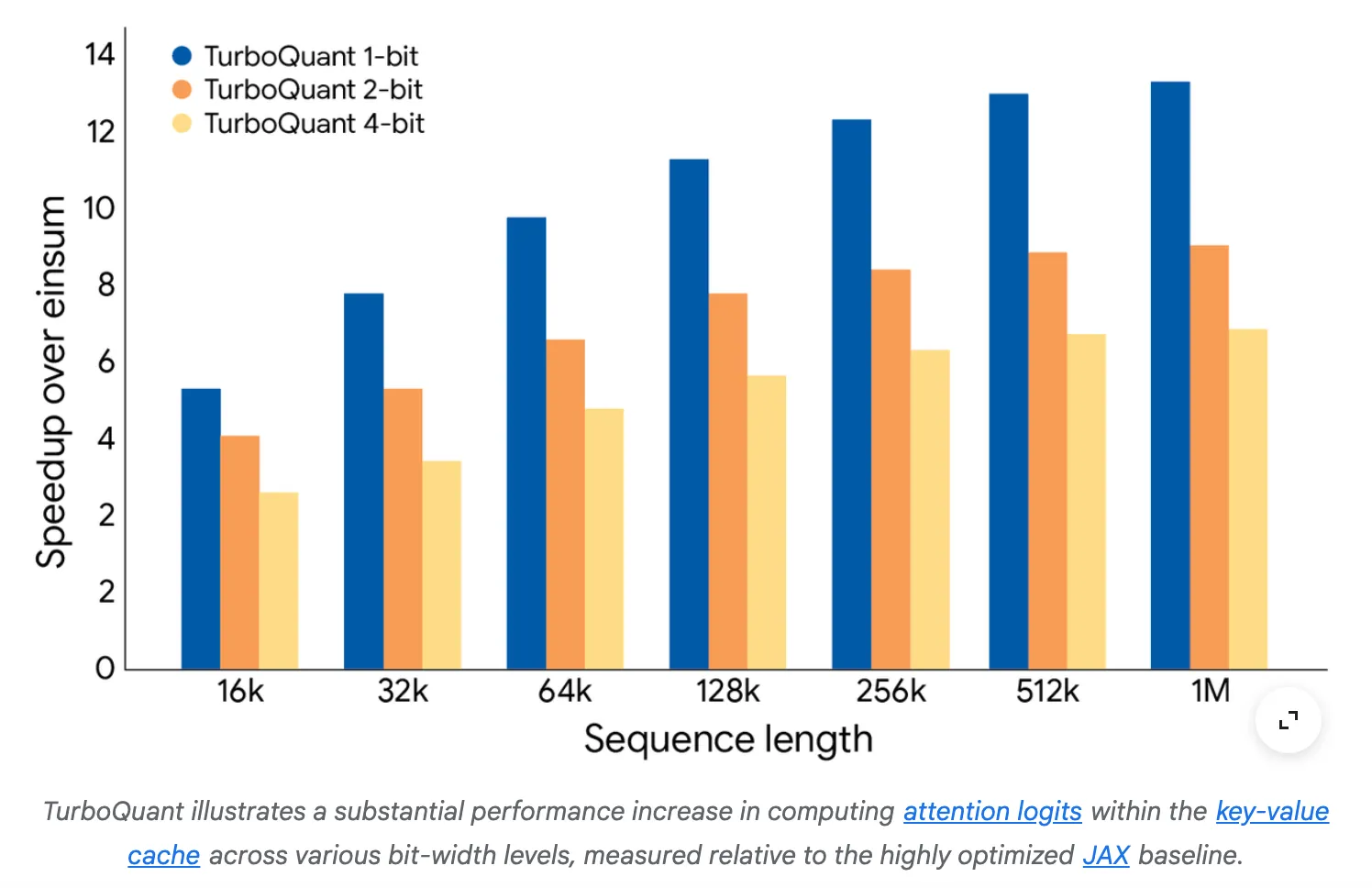
On March 24, 2026, Google Research officially released the TurboQuant algorithm, an advanced vector quantization compression technique designed for large language models (LLMs) and vector search engines. The core results are striking: without any training or fine‑tuning, it compresses the KV cache memory used during LLM inference by at least 6× (down to 3 bits/value), while achieving up to 8× acceleration of attention logits computation on NVIDIA H100 GPUs with zero downstream task accuracy loss.
This breakthrough was led by Google Research scientists Amir Zandieh and Google Fellow and VP Vahab Mirrokni. The related paper, "TurboQuant: Online Vector Quantization with Near‑optimal Distortion Rate" (arXiv:2504.19874), will be presented at ICLR 2026. TurboQuant integrates PolarQuant (AISTATS 2026) and Quantized Johnson‑Lindenstrauss (QJL, AAAI 2025) and is regarded as a "software‑level revolution" in AI efficiency.
KV cache bottleneck: the "hidden killer" of AI inference
In Transformer‑based LLM inference, the KV cache stores past token key and value vectors to avoid recomputing attention. As context lengths scale from thousands to hundreds of thousands of tokens, KV cache memory grows linearly and becomes the main bottleneck for long context, batched inference, and edge deployment. Traditional quantization can compress these caches but often incurs accuracy loss, extra memory overhead (for storing normalization constants), or requires data‑specific training, making them unsuitable for online use. TurboQuant addresses this by offering a data‑oblivious, online method that achieves near‑optimal theoretical compression.
How it works: PolarQuant high‑quality compression + QJL 1‑bit residual correction
At its core TurboQuant is a two‑stage pipeline that combines random rotations, polar coordinate transforms and Johnson‑Lindenstrauss (JL) transforms to achieve near‑optimal distortion for both MSE and inner products while eliminating the memory overhead of traditional quantizers.
Stage one: PolarQuant — high‑quality scalar quantization (primary compression)
The algorithm first applies a random rotation to the input vector x ∈ R^d (implemented via Gaussian matrix QR decomposition), projecting coordinates onto the unit sphere. This induces each coordinate to follow a predictable Beta distribution (in high dimensions approximating Gaussian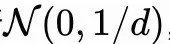 , with coordinates approximately independent).
Coordinates are then mapped to a polar coordinate system (radius captures magnitude, angles capture direction), avoiding the per‑vector normalization step required by Cartesian quantization (which usually needs an extra 1–2 bits to store constants). Exploiting the predictable Beta distribution, an optimal scalar quantizer (Lloyd‑Max, with precomputed codebooks) is applied independently to each coordinate, compressing vectors to low bitrates (e.g., 3 bits).
To dequantize, a lookup and inverse rotation restore the vector. Mathematically, the MSE distortion upper bound for this stage is  (b is the bit count), near the information‑theoretic lower bound (within a factor ≈2.7). PolarQuant alone approaches lossless performance, especially on "needle‑in‑a‑haystack" tasks.
Stage two: QJL — 1‑bit residual correction (removes inner product bias)
MSE quantization alone introduces bias in attention scores (for example, the bias can reach 2/π at 1 bit). TurboQuant therefore applies a quantized Johnson‑Lindenstrauss transform (QJL) to the residual: the residual is quantized with 1 bit (sign +1/−1) and an unbiased estimator is used to recover inner products.
This step uses only 1 bit yet removes the bias and guarantees  . Inner product distortion is also near the theoretical lower bound. The entire process runs in O(d) time with negligible space overhead (prestored codebooks, constant‑level memory), making it ideal for GPU accelerators and online inference. Arxiv
The two stages together enable TurboQuant to achieve "zero accuracy loss" at 3 bits, outperforming traditional Product Quantization (PQ) or KIVI methods without dataset tuning or preprocessing.
Experimental validation: real‑world, no compromises
On open models such as Gemma, Mistral, and Llama‑3.1‑8B, TurboQuant was evaluated on rigorous long‑context benchmarks including LongBench, Needle‑in‑Haystack (4k–104k tokens), RULER, and ZeroSCROLLS:
- Memory compression: KV cache reduced by at least 6× (3 bits/value); Llama‑3.1‑8B achieves perfect recall even with 0.25 memory budget.
- Speed ups: in 4‑bit mode, attention computation on H100 GPUs is up to 8× faster than the 32‑bit baseline, and overall inference is faster than the original model with negligible runtime overhead.
- Accuracy: question answering, code generation and summarization show zero loss; vector search (GloVe dataset) achieves higher recall@1@k than PQ/RabbiQ and index times near zero (0.0007–0.0021s vs tens of seconds).
Far‑reaching impact: reshaping AI deployment and industry effects
1. Inference efficiency and cost revolution
Enterprises can significantly reduce cloud compute costs — the same hardware can support longer contexts or larger batches. VentureBeat estimates deployment costs could fall by more than 50%. RAG (retrieval‑augmented generation) and long‑document processing are likely to see rapid adoption.
2. Hardware requirements and edge deployment
Software optimizations directly relieve HBM (high‑bandwidth memory) pressure; memory suppliers (e.g., Micron, Western Digital) saw short‑term stock pressure after the announcement. In future, consumer devices (such as Mac Mini) or phones could efficiently run hundred‑thousand‑token models locally, accelerating AI’s move from cloud to on‑device private deployments.
3. Vector search and search experience upgrades
Index build speeds greatly improve, enabling more efficient semantic search and a shift from keyword to intent understanding, which could serve as a model for the search industry.
4. Industry dynamics and ethical considerations
TurboQuant is open for research use and accelerates deployment in both open source and enterprise contexts, highlighting algorithmic efficiency as a new competitive frontier in AI. In the long term it supports more sustainable AI by reducing energy use and carbon footprint; in the short term it may reshape GPU and memory supply chains. Google plans to extend TurboQuant to its own models such as Gemini to amplify its impact.
Conclusion: a "software fusion" for AI efficiency
TurboQuant is more than simple quantization: it restructures vector compression with rigorous mathematics (Beta distributions, unbiased estimation, near‑optimal distortion bounds) and resolves the memory‑accuracy‑speed tradeoff. It shows that even in the post‑training era, pure algorithmic innovation can deliver exponential efficiency gains. As more models adopt this technique, AI will move toward truly ubiquitous access — lower barriers, higher performance, and greater sustainability.
Google’s move reaffirms its leadership in fundamental AI research and provides a free tool for developers worldwide. TurboQuant’s deployment may become one of 2026’s most important milestones in AI infrastructure evolution.
▶️ Enjoyed this article? Creating content is hard!
Follow our YouTube channel:
AI Rosetta
Your likes, subscriptions and shares are the biggest support! 🙏
More AI news at: https://www.airosetta.com