
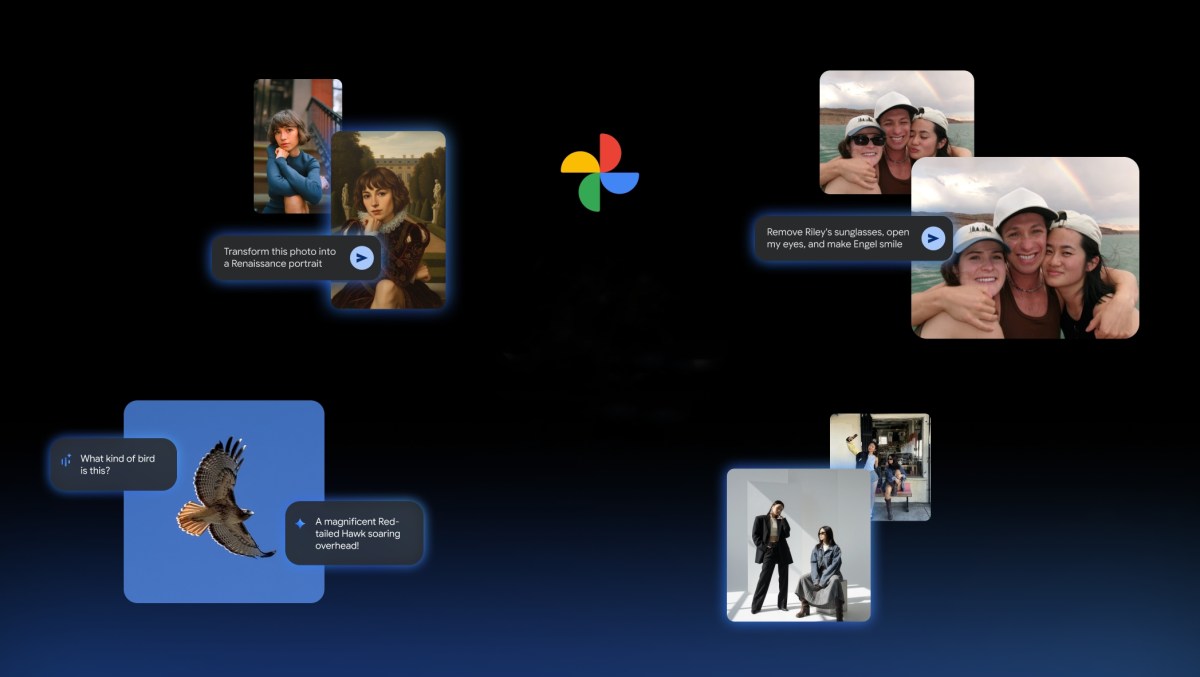
November 11, 2025, Google announced in a TechCrunch report that it is introducing a set of new AI editing features for Google Photos and expanding its AI‑driven visual search to over 100 countries and regions. Google said the improvements are powered by a generative image model called Nano Banana, designed to improve speed and interaction while preserving detail.
The new features are not just one‑click filters. In a product demonstration, Google showed capabilities that users can immediately notice:
- Local mask editing: after selecting an area of a photo with a brush, users can provide a short prompt or choose a style; the model will repair, replace, or stylize the selection while preserving detail and light interaction in the rest of the image.
- Canvas extension (Extend): extend the scene beyond the original composition; Nano Banana generates natural transitions based on existing textures, lighting and elements, addressing the seam issues common in traditional extensions.
- Object replacement and cutouts: replace an object in the frame with another object or style; the replacement's shadows and reflections are matched to the original environment to reduce a pasted‑on appearance.
TechCrunch noted that Google describes Nano Banana as a model optimized for mobile scenarios and interactive response, balancing speed and robustness in detail. For creators and everyday users, this means being able to achieve effects on phones that previously required complex desktop editing software.
On the search side, Google Photos' AI search now covers more than 100 countries and regions, and search capabilities are no longer limited to simple object recognition. By expanding training data and localizing optimizations, Google says Photos better understands context in images: from clothing styles and pet breeds to legible text and landmarks in photos, all can be more accurately indexed and retrieved. Google also emphasized multilingual support and regional adaptation to improve recall accuracy across markets.
Privacy and performance were also focal points of discussion for this update. Google said Nano Banana was designed with latency and compute costs in mind, with some processing performed on‑device to reduce round trips, but it did not fully disclose which operations run locally and which still rely on the cloud. For users, that distinction affects whether image data stays on the device or must be uploaded to Google servers for more complex generation tasks.
For younger users and social creators, the update means fewer steps to make casual snaps look more professional: widening backgrounds, removing bystanders, or changing a subject's lighting and mood can be done more quickly. Google plans to roll these features out gradually on Android, iOS and the web, with availability dependent on region and device capability.
TechCrunch also warned users to pay attention to authenticity and copyright issues around generated content: how to label AI replacements or prevent misuse remains a shared challenge for platforms and regulators. Google's product‑level push showcases technical capability while expanding the practical scope of generative AI on consumer devices.
The November 11, 2025 update advances Google Photos from simple photo storage and basic editing toward a balance of generation and retrieval, with Nano Banana positioned as the core technology linking speed, quality and interaction. Whether users see these improvements on their devices in the coming weeks will determine how prominent the features become in daily use for photographers, creators and casual users.