
On May 19‑20, 2026, at Google I/O 2026, Google DeepMind delivered a major upgrade to the original Antigravity 1.0 and officially launched the Antigravity product family, including the Antigravity 2.0 platform, Antigravity CLI, Antigravity IDE and Antigravity SDK. The release of this complete toolchain is regarded by the industry as Google’s most significant infrastructure move in the Agentic AI space, intended to help developers rapidly build, debug, deploy and manage complex AI agent systems from zero to one.
Google CEO Sundar Pichai said in the keynote: “Antigravity is not just a tool, it’s a full agent operating system. We want to make it easy for every developer to build truly autonomous, trustworthy AI agents.”
1. Antigravity 2.0: Agentic AI Operating System (Core Platform)
Antigravity 2.0 is the foundational platform of the series and is positioned by Google as the “operating system for the Agent era.”
Key features:
- Memory system: Supports long‑term memory, dynamic memory graphs and proactive memory integration to address “forgetting” and drift in long‑running agent tasks.
- Native multi‑agent collaboration: Supports complex multi‑agent architectures such as manager agents + executor agents + verifier agents.
- Enhanced tool ecosystem: Built‑in interfaces for over 50 enterprise‑grade tools, with support for custom tool extensions.
- Security and governance framework: Agent permission tiers, behavior auditing and sandboxed execution to meet enterprise security and compliance requirements.
- E2B hybrid inference: Enables coordination between edge computing and cloud Brain modules for high‑performance local + cloud hybrid deployments.
Use cases: Enterprise‑grade complex agent system development, large‑scale automated workflows, and industry solution construction.
2. Antigravity CLI: Command‑line Developer Tool
Antigravity CLI is a command‑line interface aimed at professional developers, providing efficient scriptable operations.
Main features:
- Create, debug and deploy agents quickly via command line.
- Support bulk agent management, version control and automated testing.
- Integrated memory management commands to operate memory graphs directly.
- Provide detailed log monitoring and performance analysis commands.
Target users: Backend engineers, DevOps engineers and developers who prefer command‑line workflows. Suitable for automation scripting and CI/CD integration scenarios.
3. Antigravity IDE: Visual Integrated Development Environment
Antigravity IDE is Google’s visual agent integrated development environment that greatly lowers the barrier to agent development, retaining the core features and interface of Antigravity 1.0.
Core features:
- Drag‑and‑drop multi‑agent orchestration interface to visually build agent workflows.
- Built‑in natural language programming assistant supporting “describe the requirement in plain language → automatically generate agent” development flow.
- Real‑time debugging panel to visually inspect agent execution, memory calls and tool usage traces.
- One‑click deployment to Google Cloud, Android or local environments.
Target users: Front‑end developers, product managers, AI startup founders and teams looking to quickly validate ideas.
4. Antigravity SDK: Development Kit and Integration Tools
Antigravity SDK is a software development kit for application integration, supporting multiple programming languages.
Main features:
- Provides SDKs for Python, JavaScript, Java and other languages.
- Supports seamless embedding of agent capabilities into existing applications.
- Includes a rich set of APIs and example code libraries.
- Supports local, cloud and hybrid deployment modes.
Target users: Enterprise developers who want to integrate agent capabilities into their products and teams building vertical industry AI applications.
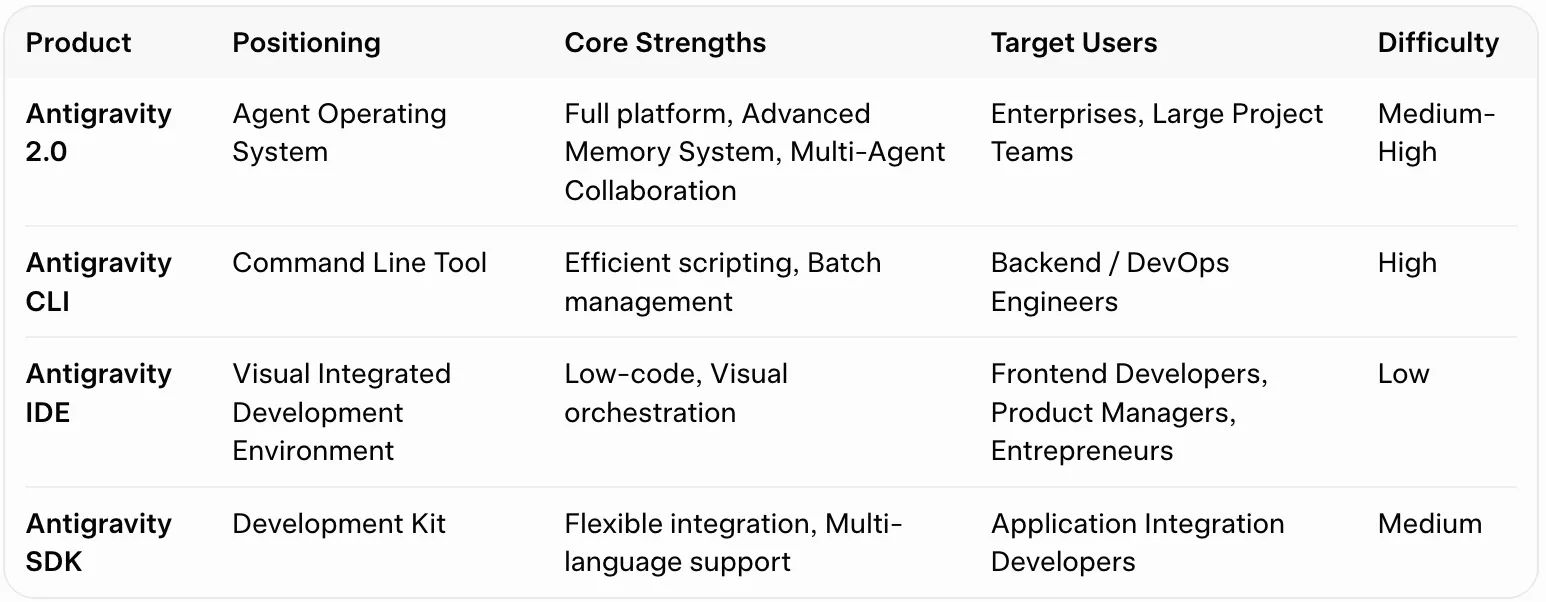
5. Comparison of the Four Products
 6. Strategic Significance and Industry Impact
The launch of the Antigravity series marks Google’s completion of an end‑to‑end layout from models to platforms in the Agentic AI track. By providing development tools at different layers, Google aims to build an open agent ecosystem similar to Android, lowering the barrier to agent development and accelerating adoption across enterprise services, personal assistants and industry automation.
This move also has deep implications for industry competition. Compared with OpenAI’s GPTs platform and Anthropic’s Claude Agent framework, Antigravity shows distinctive strengths in long‑term memory, multi‑agent collaboration and enterprise security governance. Going forward, ease of use and ecosystem completeness for agent development tools will become new competitive focal points.
Developer recommendations:
- Individual developers/beginners: start with the Antigravity IDE.
- Professional engineers: combine the CLI + SDK for deep development.
- Enterprise users: build internal agent systems with the Antigravity 2.0 platform as the core.
The Antigravity release signals that 2026 may be a pivotal year for large‑scale commercial adoption of AI agents. With this toolchain, Google is working to move Agentic AI from concept to real‑world productivity.
▶️ Enjoyed this article? Creating great content takes effort!
Subscribe to our YouTube channel:
AI Rosetta
Your likes, subscriptions and shares mean the world to us! 🙏
For more AI news, visit:
https://www.airosetta.com