
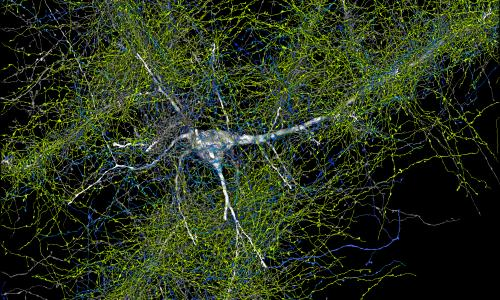
 A year ago, in a pioneering study, Google Research and Harvard University collaborated to map the complete connectome of one cubic millimeter of human cortical tissue at unprecedented precision. The result was published in Science in 2024 and represents the most detailed reconstruction of a human brain neural network to date.
Minute volume, astonishing complexity
This tissue came from cortical tissue removed from a 45‑year‑old woman during epilepsy surgery. The volume was only about 1 mm³ (roughly half the size of a grain of rice), yet it contained approximately 57,000 cells (including about 16,000 neurons, 32,000 glial cells, and 8,000 vascular cells), 150,000,000 synaptic connections, and approximately 230 mm of vascular length.
The team used multi‑beam scanning electron microscopy to cut the tissue into more than 5,000 sections, each only 30–34 nanometers thick, producing an enormous set of two‑dimensional images. The imaging took nearly 326 days ( Google Research ). Google‑developed AI algorithms then performed automated stitching, segmentation, identification, and 3D reconstruction to produce the final connectome. The entire dataset reached 1.4 petabytes, roughly equivalent to 14,000 4K movies.
The deepest cortical layers contain cell clusters that are often arranged in mirror orientations. This image shows a particularly symmetric pair of cell clusters. Image credit: Google Research and the Lichtman Lab at Harvard University. Illustration by D. Berger, Harvard University.
Key discoveries unlocking microscopic brain structure
- Extremely strong synaptic connectivity: While over 96% of synapses are typically single connections, the study found up to more than 50 synapses concentrated between the same pair of neurons—far higher than conventional expectation.
- Mirror‑structured neurons: Some pyramidal cells exhibit symmetric mirror distributions; dendritic morphologies oriented in opposite directions appear to pair up, possibly revealing a new organizational principle.
- Axonal “vortex” structures: Some axons form complex knot‑like coils, producing previously unseen microstructures whose functions are not yet understood.
Project lead Jeff Lichtman commented: “We found so many textbook‑defying phenomena in this dataset, which shows how much we still don't understand about the brain.”
Ten years of engineering, technology and collaboration
The achievement is the result of a decade‑long collaboration between Harvard and Google. The Lichtman Lab at Harvard previously worked on connectomes for fruit flies, rats, and zebrafish, while Google provided core technical support for AI reconstruction, data storage, and interactive visualization.
Google developed advanced algorithms and storage systems—such as flood‑filling networks, SegCLR, and TensorStore—to efficiently process and explore massive voxel datasets. These tools have been widely used in this project and across the AI community.
The study released open data and the interactive Neuroglancer tool so researchers worldwide can proofread and analyze the data. Thousands of scientists around the globe have already participated in proofreading parts of the map.
Scientific significance: from structure to future applications
The micro‑topological map of the human brain carries multiple values:
- It sets a benchmark in connectomics and provides a foundation for understanding how neurons connect and how signals propagate;
- Insights into rare but important strong connections may reveal mechanisms for learned behaviors, such as highly automated motor responses;
- Rare forms like mirror structures and axonal vortices may reflect previously overlooked organizational rules of neural tissue;
- Open data will greatly accelerate research in neuroscience, AI‑inspired model development, and studies of mechanisms behind neurodegenerative diseases.
Nevertheless, reconstructing an entire human brain remains far beyond reach. The team predicts that even scaling up to a whole brain would likely take many years and enormous storage resources, making it currently impractical.
Next steps: larger samples and cross‑sample expansion
Next research will focus on larger animal samples and functional mapping, for example combining a whole mouse‑brain connectome with activity responses. The MICrONS project has already achieved initial results integrating function and structure, laying groundwork for future brain–behavior correlation studies.
The team also plans to use brain samples from more human individuals to validate structural consistency and individual differences, gradually pushing the map toward greater scale and diversity.
Summary
The Google–Harvard one‑cubic‑millimeter human connectome project is a milestone in neuroscience. Using ultra‑fine sectioning, tens of millions of automatically stitched images, and AI‑driven 3D reconstruction, the study mapped a highly precise neural network containing 57,000 cells and 15 billion connections. Although the volume is tiny, the map is rich in detail and reveals previously unknown brain structural features. This achievement is both a major breakthrough in connectomics and a source of new directions for exploring neural structure, behavior mechanisms, and AI inspiration.
Sources:
Scientists find 57,000 cells and 150m neural connections in tiny sample of human brain May 10, 2024
2、WIRED
This Is the Most Detailed Map of Brain Connections Ever Made