
June 3, 2026, Google DeepMind officially released Gemma 4 12B as an open‑source large model. The model is the latest member of the Gemma family, centered on the "Unified encoder‑free multimodal architecture" as its core innovation, marking an important breakthrough for on‑device (On‑Device) full‑modal AI. Google says this architecture overturns the traditional design path of multimodal models that rely on separate visual and audio encoders, making it realistically possible to run powerful multimodal AI locally on laptops and high‑end phones.
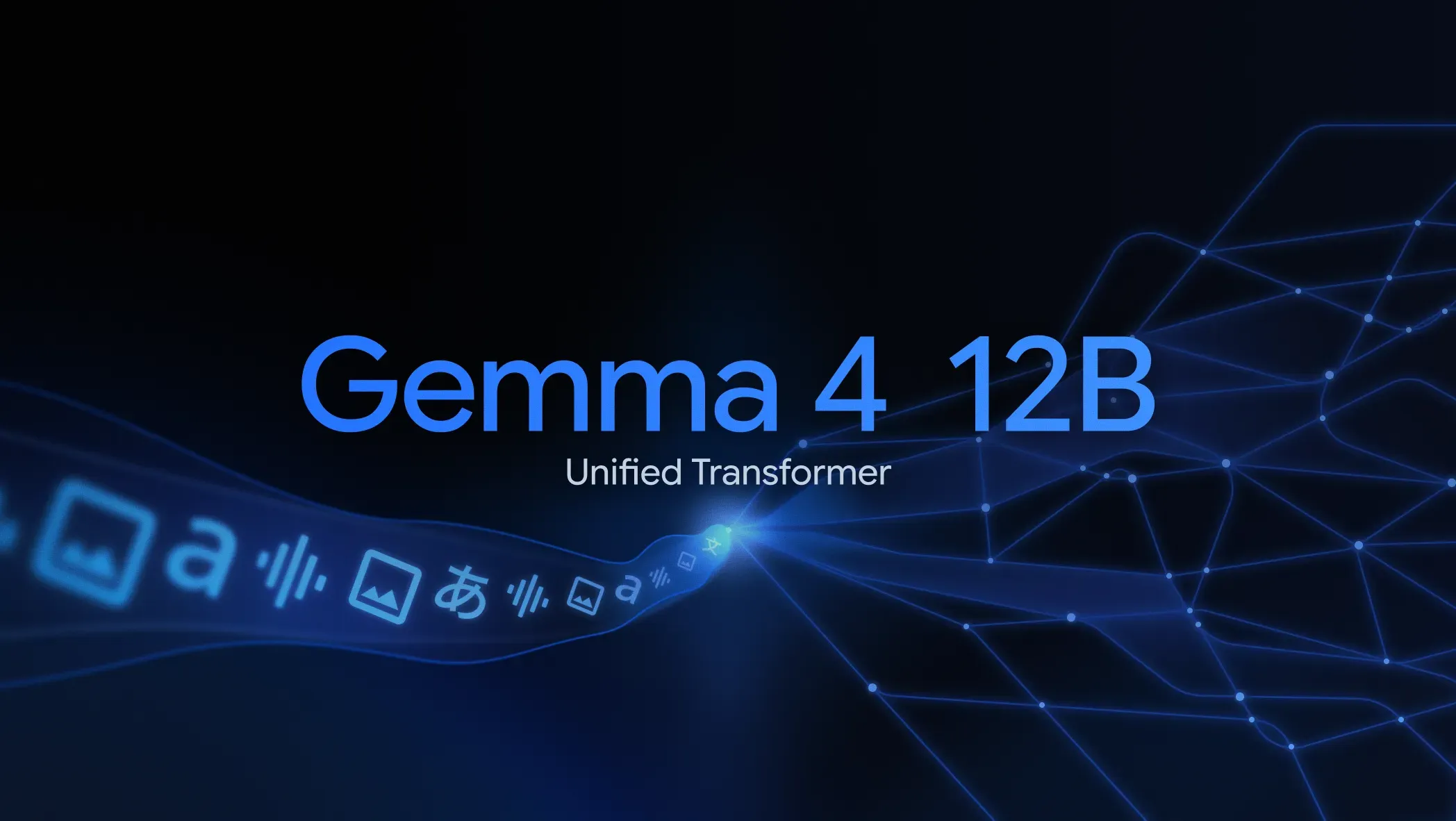
Gemma 4 12B adopts a Unified Encoder‑Free architecture that projects raw image patches and audio waveforms into the model's backbone via lightweight linear projection layers, with all modal information processed jointly in the same Transformer decoder. This design significantly reduces model complexity, memory footprint and latency while improving the naturalness and efficiency of cross‑modal understanding.
Core technical innovations
Traditional multimodal models typically require separate visual encoders (such as CLIP) and audio encoders, then use fusion modules for interaction, resulting in parameter redundancy, higher latency and difficulty aligning modalities. Gemma 4 12B's Unified architecture achieves true "native fusion":
- Direct projection mechanism: image and audio inputs do not require separate encoders and are projected directly into the backbone in raw form.
- Unified decoder processing: all modalities are jointly modeled in the same Transformer, enhancing cross‑modal consistency and depth of understanding.
- Efficient memory management: combined with an E2B (Edge‑to‑Brain) hybrid inference strategy, the model can run efficiently on devices with 16GB of memory and supports context windows up to 256K tokens.
The Google DeepMind research team states that this architecture improves the overall on‑device multimodal inference efficiency by about 2.8× while maintaining high performance.
Performance
According to Google's official benchmarks and Hugging Face community tests, Gemma 4 12B demonstrates strong performance across multiple multimodal tasks:
- Visual understanding: ranks near the top on the Vision Arena leaderboard, with notable image captioning, OCR and visual reasoning capabilities.
- Multimodal interaction: supports mixed image+text inputs to generate coherent outputs, performing well on screen understanding and GUI operation tasks.
- Local deployment efficiency: on RTX 4060 laptops and flagship phones powered by Qualcomm Snapdragon 8 Gen 4, generation speed reaches 35–50 tokens per second, far exceeding traditional multimodal models of similar scale.
- Open‑source friendly: the model is fully open‑sourced under the Apache 2.0 license, and developers can download the weights directly from Hugging Face.
Industry significance and impact
The release of Gemma 4 12B has important demonstrative significance for the AI industry as a whole:
- On‑device AI accelerates adoption Historically, multimodal large models have been difficult to deploy on mobile devices due to heavy computation. Gemma 4 12B shows that through architectural innovation, even a 12B‑parameter model can run efficiently on consumer devices, which will greatly promote AI applications in offline scenarios such as education, healthcare and assistive tools.
- Developer ecosystem benefits Google simultaneously released an accompanying Edge SDK and example code so developers can quickly build local multimodal agent applications. This is expected to spawn innovative products such as real‑time image translation, offline video editing, smart photo management and desktop automation assistants.
- Open‑source and closed‑source balance As an important part of Google's open‑source strategy, the Gemma series further strengthens the open AI community. At the same time, Google also offers commercialized versions through Gemini Cloud, creating a healthy model of open‑source and closed‑source co‑development.
- Changing competitive landscape Gemma 4 12B presents direct competition to open‑source models like Meta's Llama series and Mistral, as well as on‑device solutions such as Apple's MLX framework. In the future, on‑device multimodal AI performance will no longer be an exclusive advantage of closed‑source giants.
Conclusion
The release of Gemma 4 12B represents an important breakthrough for Google in open‑source multimodal AI. Centered on the Unified encoder‑free architecture, it significantly lowers the deployment threshold for on‑device multimodal AI and opens new paths for intelligent experiences on mobile devices.
With the full open‑sourcing of model weights and improved developer tools, 2026 may become the year when "on‑device multimodal AI" truly lands. Google's move not only enhances its competitiveness in the open‑source AI track but also provides developers worldwide with more powerful, easier‑to‑use local AI tools.
▶️ Enjoy this article? Content creation is hard!
Follow our YouTube channel:
AI Rosetta
Your likes, subscriptions and shares are our greatest support! 🙏
More AI news at: https://www.airosetta.com