
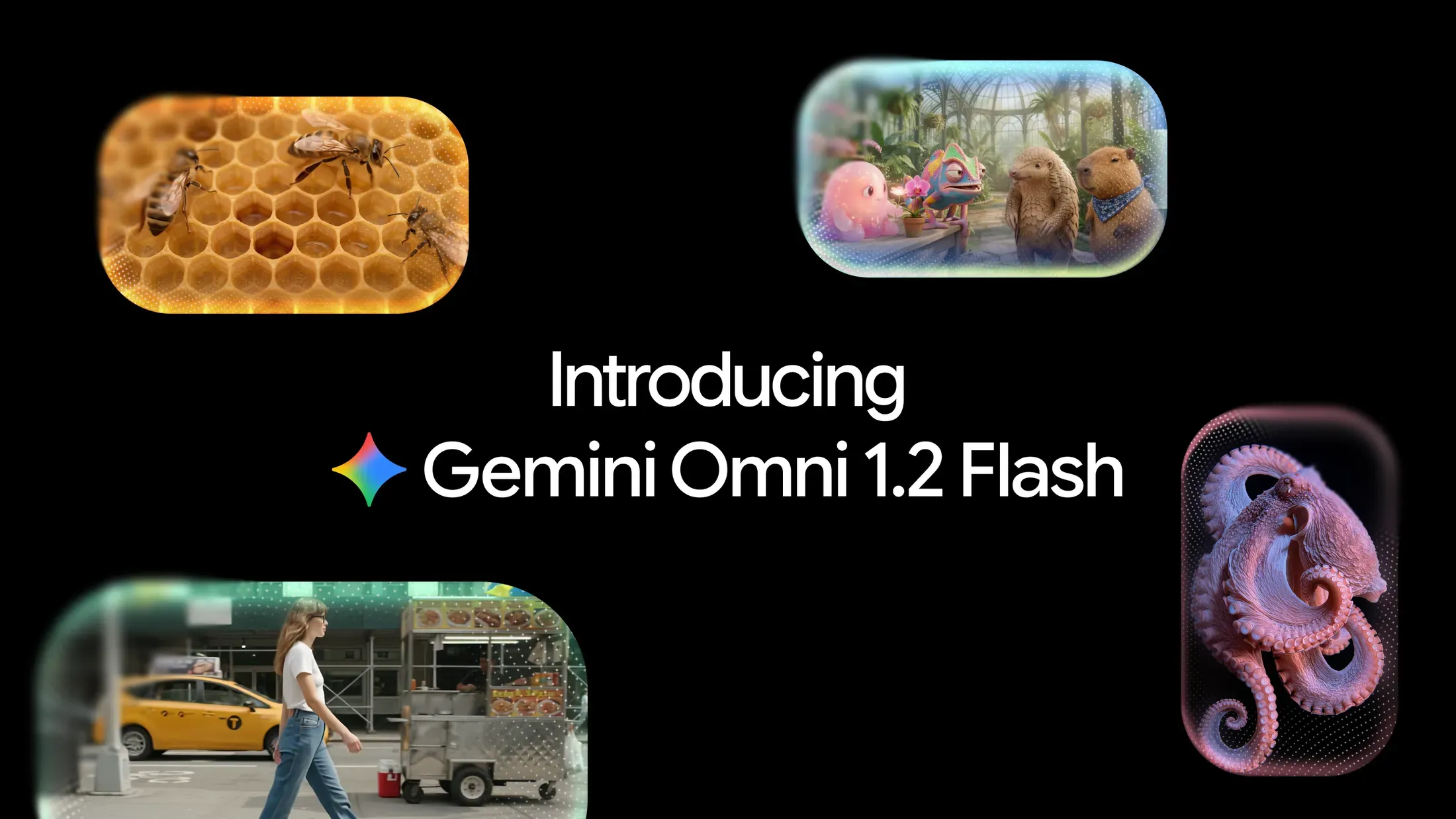
November 5, 2026, Google officially announced Gemini Omni 1.2 Flash is generally available (Generally Available). This is the latest version of Google's video generation and editing model family, aimed at developers, enterprise users, and content creators, with key improvements in video length, reference consistency, conversational editing capabilities, and a significant reduction in usage cost.
The Gemini Omni series is positioned as a multimodal generation model capable of combining text, image, video, and audio inputs to produce videos with native synchronized audio. 1.2 Flash is an important iteration at the Flash tier, primarily targeting high‑frequency, large‑scale short‑form video production scenarios such as product showcases, virtual try‑ons, advertising assets, and social media clips.
Core upgrades: length, consistency and cost
Compared with the previous Omni 1.1 Flash, the most obvious change in 1.2 is video length. Users can now natively generate and edit videos up to 15 seconds (previous limit was 10 seconds), and can precisely specify duration in 1‑second increments (3 to 15 seconds). This allows the model to cover more complete narrative segments or product demonstrations without frequent stitching.
Reference‑following capability has also been strengthened. Users can provide role, product, or style reference images, motion clips up to 3 seconds, and audio cues. Google states the model better maintains consistency of faces, clothing, packaging text, and brand colors across an entire clip, which is especially useful for brand content requiring multiple camera angles or continuous shots.
Conversational editing is another practical feature. Users can use natural‑language multi‑turn interactions to make local edits to an already generated video—such as changing the background, adjusting lighting, replacing the subject, or altering camera movement—without regenerating from scratch. This lowers trial‑and‑error costs and more closely matches real creative workflows.
On the audio side, the model's handling of multi‑speaker dialogue is more natural and lip‑sync accuracy has improved. Shot control is also smoother, reducing jarring cuts.
Pricing adjustments are an important commercial signal in this release. 720p video generation is priced at $0.07 per second, about a 30% decrease from Omni 1.1. Users can draft quickly at 360p or 720p, then upsample satisfactory results to 1080p or 4K to further control costs. Google has also added a SynthID watermark to outputs and offers enterprise‑grade Provisioned Throughput support.
Availability and positioning
Gemini Omni 1.2 Flash is available via the Gemini API, Google AI Studio, Google Cloud, Gemini for Business, Google Vids, and other channels. Some features, including the 15‑second duration, are also available to Gemini app subscribers (particularly Ultra tier users). Google plans to automatically route API requests pointed at version 1.1 to version 1.2 starting December 3, 2026.
In terms of positioning, Omni 1.2 Flash does not pursue the longest durations or the highest cinematic quality, but emphasizes speed, cost control, and sufficiently good consistency, making it suitable for enterprise marketing, e‑commerce, and content teams that need to produce short videos at scale. It complements models aimed at longer, higher‑quality creation and together forms Google's product matrix in generative video.
Industry impact and objective assessment
The generative video market is highly competitive. OpenAI, ByteDance, Black Forest Labs, and others are advancing models with longer durations and stronger controllability. Google's choice to prioritize the Flash tier combination of "adequate duration + lower cost + better reference consistency" reflects a judgment about scalable commercial applications: many real‑world use cases do not require videos longer than 30 seconds, but do require fast, repeatable, and controllable 15‑second assets.
It should be noted that the official improvements were mainly demonstrated through internal evaluations and examples. Independent third‑party comprehensive comparison data on complex motion, fine text rendering, and extreme consistency scenarios remains limited. In actual user experience, the degree of improvement in reference following and lip‑sync may vary depending on specific prompts and source material. In addition, the audio reference feature is currently in an allowlist stage and not yet broadly available.
Overall, Gemini Omni 1.2 Flash is a pragmatic iteration. It does not claim disruptive breakthroughs but makes clear improvements in duration, cost, editing experience, and consistency while rolling to production. For enterprises and developers needing high‑frequency short‑video output, it is a more deployable and cost‑calculable tool. Its real value in commercial scenarios will be further validated as more practical use cases and independent evaluations emerge.
▶️ Enjoy this article? Creating content is hard!
Follow our YouTube channel:
AI Rosetta
Your likes, subscriptions, and shares are our greatest support! 🙏
For more AI news visit: https://www.airosetta.com