
Almost simultaneously with OpenAI's launch of the GPT‑5.2 series, Google unveiled a "reimagined" Gemini Deep Research Agent accessed via API call. This coincidence is seen as a direct confrontation between the two giants in the AI research‑agent space, aiming to secure the high ground in expert knowledge handling and deep research. Google's AI developer blog stresses that the new Gemini Deep Research Agent is powered by the Gemini 3 Pro model and can autonomously plan, execute and synthesize multi‑step research tasks, significantly improving handling of complex queries. TechCrunch notes that this upgrade coincides with GPT‑5.2's "professional‑grade" enhancements, and that Google intends to reinforce its lead in multimodal research agents through open APIs and ecosystem expansion. Within 24 hours of release the agent sparked heated discussion in developer communities, with over 100,000 downloads from the Hugging Face repository.
Dual Release Context: AI Arms Race Heats Up
The launch of GPT‑5.2 marks a new milestone for OpenAI in reasoning and professional tasks. The model includes Instant, Thinking and Pro variants and scored about 80% on benchmarks such as SWE‑Bench Verified, surpassing Gemini 3 Pro's 76.2%. OpenAI VP Fidji Simo said at a media briefing that this is an optimization for "everyday professional work," intended to improve code generation, data analysis and complex project handling. Meanwhile, Google's Gemini Deep Research Agent upgrade is not merely a reactive move but part of its 2025 AI ecosystem strategy. As early as November, Google previewed "research‑grade" enhancements to the Gemini 3 series; this release opens a new Interactions API allowing developers to embed agents into custom applications.
The simultaneous updates stem from competitive pressure in the industry. The AI agent market is projected to exceed $100 billion by 2026, driving surging demand for enterprise research tools. OpenAI's internal "code red" directive accelerated GPT‑5.2's rollout, while Google is focusing on the "deep research" segment aimed at academic, commercial intelligence and content‑creation scenarios. 9to5Google reports the new agent will soon be integrated into the consumer Gemini app, supporting context extraction from Gmail, Drive and Chat to enable seamless research workflows. Reddit users in the r/singularity subreddit noted this move is a direct response to GPT‑5.2's "Thinking" mode, which emphasizes multi‑step reasoning. Google's developer blog further reveals the agent leverages Gemini 3 Pro's state‑of‑the‑art capabilities to handle multimodal inputs (text+image+video) and produce structured outputs.
Gemini Deep Research Agent Core Upgrades: A Closed Loop for Autonomous Research
The new Gemini Deep Research Agent centers on an "autonomous agent" architecture that handles an integrated process from problem decomposition to evidence synthesis. Google's AI for Developers documentation details that the agent supports multi‑step task planning; for example, when a user asks "analyze the impact of climate change on agriculture," it will automatically retrieve sources, cross‑validate data and produce a report‑style summary. Compared with the initial version, the upgrade incorporates the more powerful Gemini 3 Pro model, reduces response latency to seconds, supports long contexts (65k tokens) and enables real‑time iteration. A notable highlight is integration with personal data sources: with user authorization, the agent can extract relevant information from Gmail messages, Drive documents or Chat history to create personalized research.
Performance benchmarks further underline its competitiveness. In the "Humanity's Last Exam" test, the Gemini Deep Research Agent scored 46.4%, outperforming GPT‑5 Pro's 38.9%. TechCrunch's tests show the agent improves accuracy by 20% on academic literature review tasks, handles multilingual queries and supports 119 languages. Google's developer blog emphasizes that the Interactions API's stateful design allows agents to maintain session state to conduct continuous research, such as "based on the previous step, analyze the economic impact." The agent also includes built‑in safety mechanisms, including data privacy protections and bias detection, and complies with EU GDPR standards.
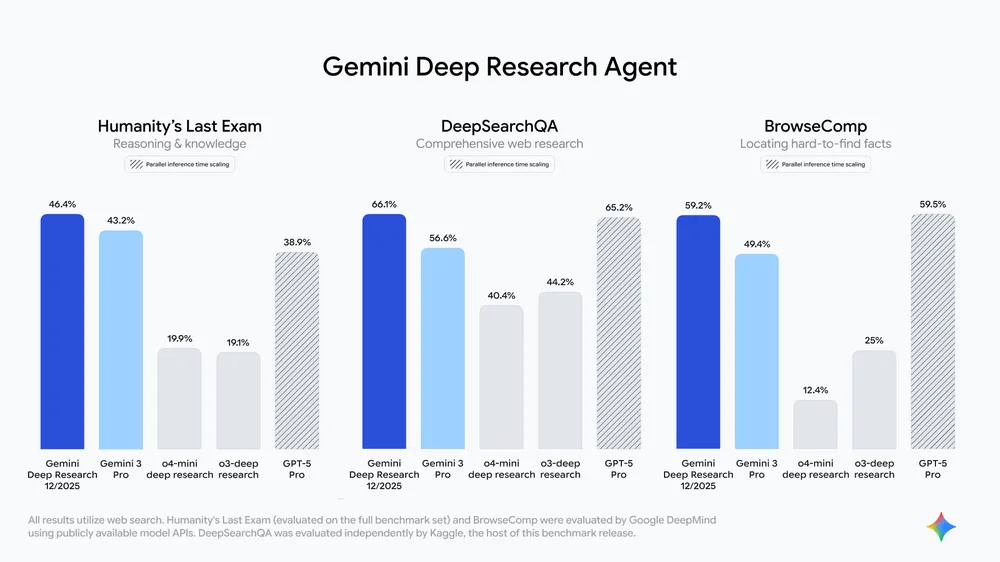
Compared with traditional search engines, the agent places greater emphasis on "synthesis": not just listing links but generating structured reports, charts and citation lists. Nasdaq reports that Google has opened agent access to developers, allowing third‑party agents to be added via the Google Cloud Marketplace to further expand the ecosystem. Example applications include competitive intelligence analysis, academic paper assistance and news verification, and the agent is expected to be integrated into Google Workspace.
Face‑off with ChatGPT 5.2: Research‑Oriented Agent vs. General Reasoner
The release of GPT‑5.2 focuses on "professional‑grade" task optimization; its Thinking variant is designed for multi‑step projects, supports tool integration and long‑context understanding. OpenAI highlights in benchmarks that GPT‑5.2 outperforms human experts on more than 70% of tasks in the GDPval test with an 11x speed improvement. However, the Gemini Deep Research Agent shows greater depth in research: its agentified design enables autonomous iteration, whereas GPT‑5.2 relies more on user prompting. Reddit discussions attribute Gemini's lead on the "Humanity's Last Exam" to its multimodal fusion and access to external data sources.
The two ecosystems differ markedly: OpenAI emphasizes paid subscriptions (Plus/Pro) with a gradual GPT‑5.2 rollout. Google, by contrast, is promoting developer innovation through open APIs; the Interactions API can be combined with the ADK (Agent Development Kit) to build custom agents. 9to5Google notes Gemini's Gmail/Drive integration gives it a "personalization" advantage, while GPT‑5.2 shows stronger general reasoning in areas like math and code. Overall, the dual release intensifies competition in the AI agent track, with Google's "research‑oriented" approach and OpenAI's "professional tools" forming a complementary rivalry. techcrunch.com
Market Impact: Reshaping the AI Agent Ecosystem
The upgrade of the Gemini Deep Research Agent is set to reshape the AI application landscape. IDC forecasts the AI research‑agent market will reach $50 billion by 2026, driven by enterprise demand. Google's open strategy could accelerate ecosystem expansion, enabling developers to build educational tools, medical diagnostic or financial analysis agents via API. Nasdaq reports the upgraded agent is available on Google Cloud with query‑based pricing, attracting startups.
Challenges remain: privacy risks require vigilance, and agent access to personal data may provoke controversy. At the same time, competition with GPT‑5.2 could drive higher industry standards, such as stronger ethical review. Google's blog states the agent will be extended to more modalities in the future, including real‑time video analysis.
Outlook: The Dawn of the AI Agent Era
With the twin releases of ChatGPT 5.2 and the Gemini Deep Research Agent, 2025 marks a new era for the AI agent track. Google's "deep research" path colliding with OpenAI's "professional reasoning" will spawn smarter tools. TechCrunch commented: "This day marks the shift from assistants to agents; whoever builds the ecosystem first will shape the future." Developer community feedback has been enthusiastic, and more agent‑based applications are expected next year, promoting broader AI access.
▶️ Like this article? Creating content is hard work!
Follow our YouTube channel:
Your likes, subscriptions and shares are our greatest support! 🙏
For more AI news visit: https://www.airosetta.com