
On October 28, 2026, Google officially announced its latest cutting‑edge large model Gemini 4 Carbon. This follows the release of Gemini 4 Argon two weeks earlier and represents another rapid iteration in the Gemini 4 series. Google DeepMind Senior Vice President and Google’s Chief AI Architect Koray Kavukcuoglu wrote on the official blog that Carbon is currently the company’s strongest model, delivering significant gains in cybersecurity defense, long‑horizon coding and agent tasks.
Unlike prior broad rollouts, Carbon uses a more cautious, phased release strategy. It is initially available only to selected cybersecurity defense organizations, and will be gradually expanded to more trusted partners through the Fairwind program before being made available to developers, enterprises and general users. Google says this approach is intended to collect feedback and完善 safety measures before broader deployment of the model’s stronger capabilities.
Core capabilities and benchmark performance
According to Google’s published data, Gemini 4 Carbon ranks first with a score of 59 in the latest v5.0 update of the Artificial Analysis Intelligence Index, ahead of Claude Opus 5.5, GPT‑6 Astra and the previous Argon. The updated index raises the evaluation difficulty.
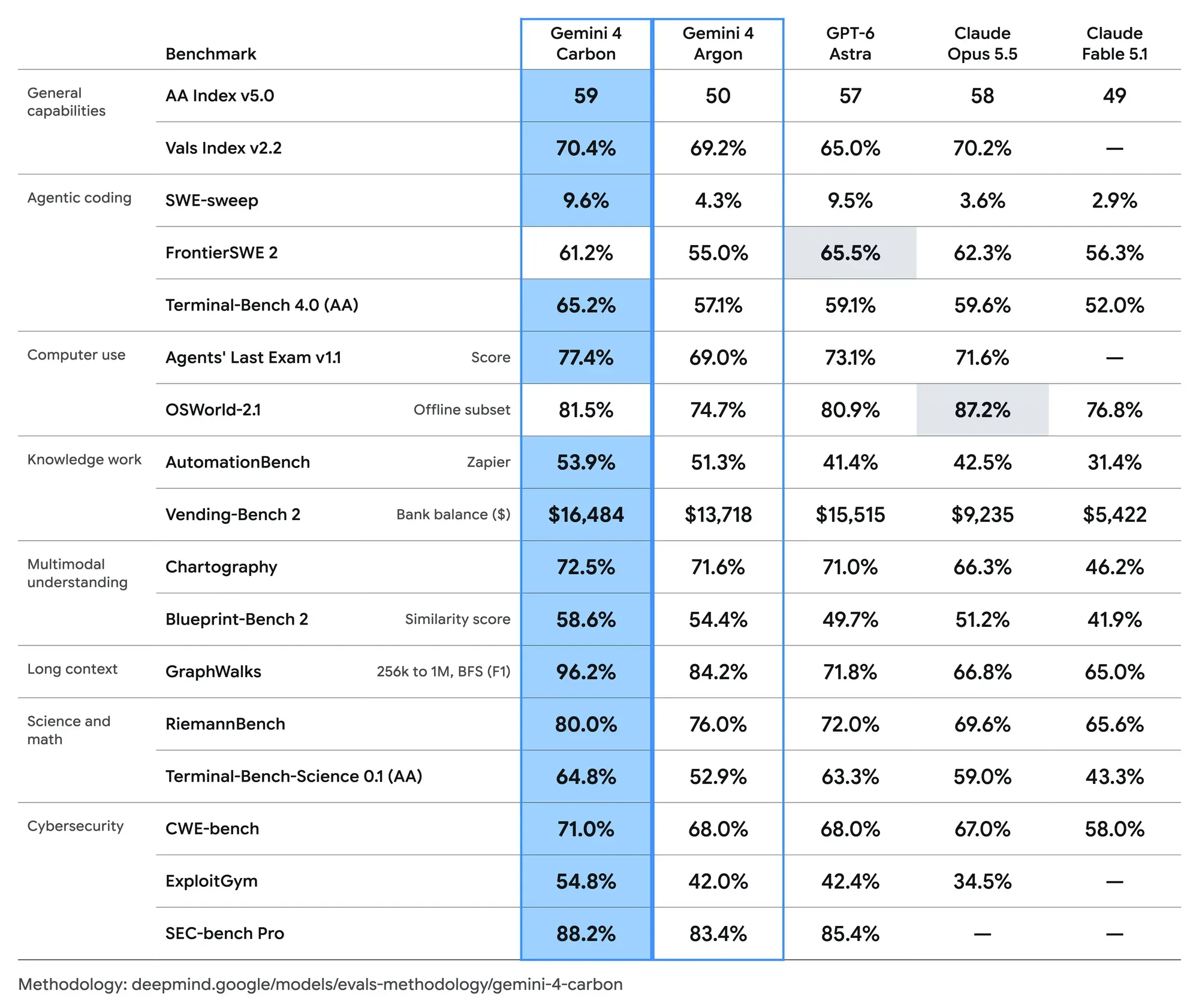
Carbon is especially strong on security‑related benchmarks:
- SEC‑bench Pro (vulnerability discovery) reached 88.2%;
- ExploitGym (vulnerability exploitation) reached 54.8%;
- CWE‑bench (patch generation) reached 71.0%.
Google’s internal tests show Carbon’s success rate for generating secure code is more than double that of Argon. The Chrome team reported that its performance generating high‑quality patches is about ten times higher than other leading lab models. In indirect prompt injection attack tests, Carbon reduced attack success to 0%, outperforming Argon’s 0.7% and some competitors.
For coding and long‑horizon tasks, the model has been optimized for complex, multi‑day autonomous development workflows and shows clear improvements in web development evaluations such as WebDev Arena. Google emphasizes that Carbon reduces unsupported assertions, hallucinations and misaligned behaviors, making outputs more transparent and reliable overall.
It should be noted that most of the benchmark data above come from Google’s own reports or partnered evaluations; full independent third‑party reproduction will take time. The Artificial Analysis composite index is relatively more informative, but the model’s stability and generalization in real production environments still require broader user validation.
Release strategy and pricing
Google states that, given Carbon’s strong capabilities in cybersecurity and autonomous programming, the company is participating in the U.S. government’s voluntary pre‑release testing framework and is following a “defense‑first” openness path. From this week, some security defenders can access the model; broader enterprise and developer access will follow once safeguards are in place. A precise date for full public availability has not been announced; based on Argon’s timeline, wider rollout may occur over the coming weeks.
On pricing, Carbon matches Argon’s entry rates: $2 per million input tokens and $10 per million output tokens, with cached input tokens enjoying a 95% discount. After the introductory period, prices will adjust to $4 per million input tokens and $20 per million output tokens. This pricing strategy aims to lower the barrier for early trials while leaving room for later commercialization.
Industry context and competitive landscape
The release of Gemini 4 Carbon comes as frontier large models enter a phase of rapid iteration. Companies such as OpenAI and Anthropic have recently increased investments in coding, agent and security capabilities. Google’s emphasis on cybersecurity reflects both attention to deployment risks and the tension between advancing AI capabilities and safety governance.
Technically, Carbon is not merely a parameter‑scale expansion; it includes targeted optimizations for long‑horizon planning, tool use, secure code generation and alignment. Google positions it as a model that “supports multi‑day autonomous engineering and cyber defense,” indicating the industry’s shift from single‑turn Q&A toward agent capabilities closer to real workflows.
A balanced view: progress and open questions
The launch of Gemini 4 Carbon marks a notable acceleration in Google’s flagship model iterations. The two‑week gap from Argon to Carbon shows highly parallel internal R&D and evaluation processes. If the security advantages are validated in real defense scenarios, Carbon could provide new tools for protecting critical infrastructure.
At the same time, a measured perspective is necessary:
- Many high scores still rely on vendor reports; independent, reproducible evaluations remain limited;
- Phased release means ordinary developers and many enterprises cannot experience it directly in the short term, so productization timing is uncertain;
- Stronger vulnerability discovery and exploitation capabilities are inherently double‑edged; ensuring the model is used for defense rather than attack will be a key regulatory and industry challenge.
Overall, Gemini 4 Carbon represents another capability leap for Google’s frontier models, raising the bar particularly for cybersecurity and long‑horizon coding tasks. Whether it can truly change how developers and security teams work will depend on rollout progress, real‑world feedback and whether its safety mechanisms withstand practical tests. For now, it reads as a “capabilities‑first, cautiously open” release rather than a fully general‑available product.
▶️ Enjoyed this article? Creating it takes real effort!
Follow our YouTube channel:
AI Rosetta
Your likes, subscriptions and shares are our greatest support! 🙏
For more AI news visit: https://www.airosetta.com