
On September 30, 2026 (U.S. local time), after about seven months, Google officially announced the release of its new flagship large model Gemini 4 Argon. This is the first truly cutting‑edge flagship model Google has released since Gemini 3.1 Pro in February. In the interim Google iterated mainly on the mid‑range Flash series, and the planned Gemini 3.5 Pro was ultimately skipped in favor of moving directly to the Gemini 4 generation. Argon is currently available only to select trusted cybersecurity defense partners and has not been broadly released to the public or general enterprises; its real‑world effectiveness still requires wider verification.
Details
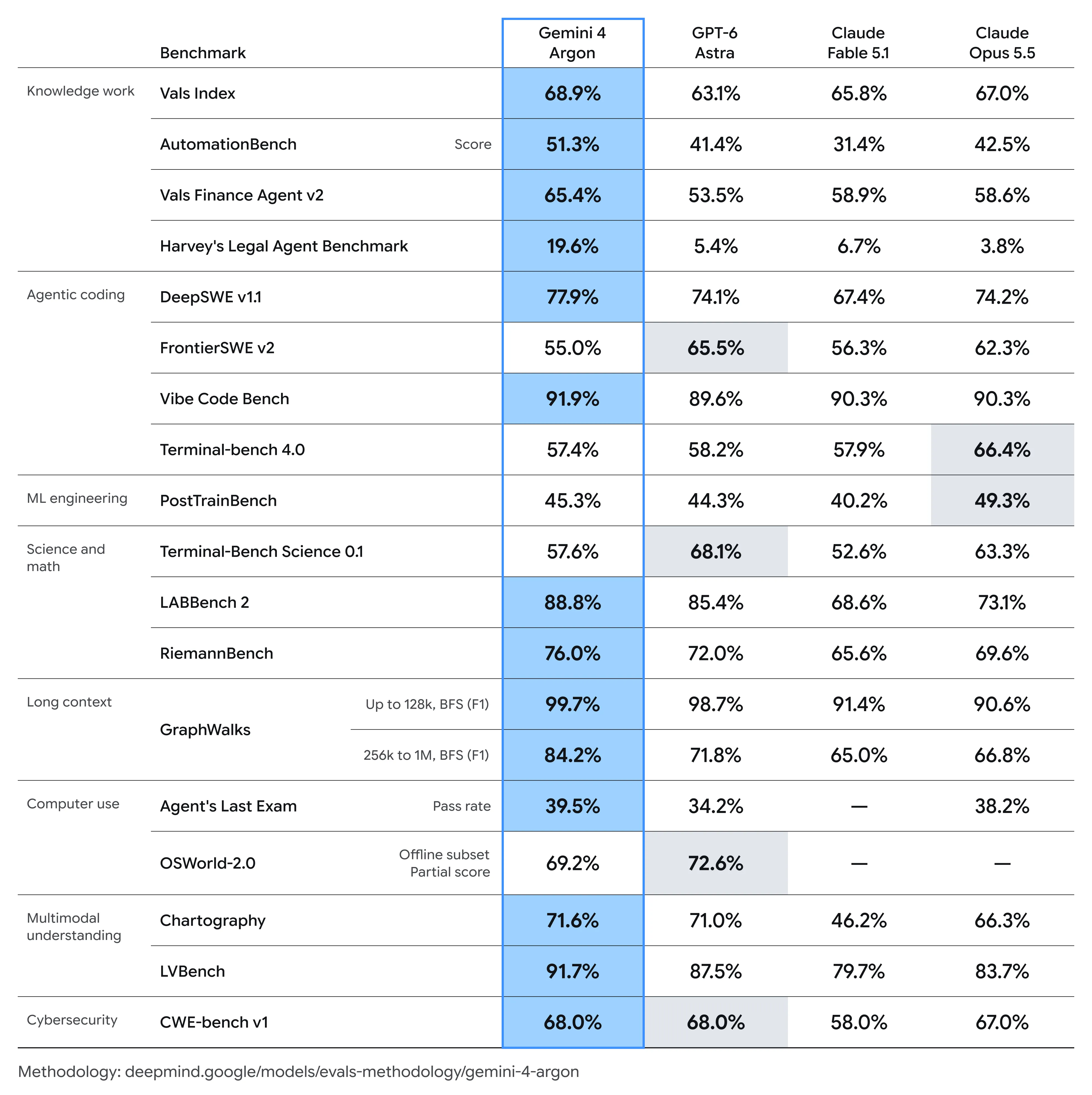
Google positions Gemini 4 Argon as the "next‑generation frontier intelligence," designed for complex, long‑horizon workflows with a focus on real‑world software engineering, enterprise knowledge work (law, finance, etc.), and cybersecurity defense. The company says it achieved leading or joint‑first results on several key benchmarks:
- Scored 77.9% on DeepSWE v1.1 (real‑world long‑horizon software engineering tasks), outperforming Claude Opus 5.5 and GPT‑6 Astra.
- Ranked first on the Vals Index (economic‑impact tasks weighted by U.S. GDP, covering finance, coding, legal, tax, etc.).
- Topped AutomationBench (Zapier end‑to‑end business execution benchmark) with 51.3%.
- Also performed strongly on vertical benchmarks such as financial and legal agents, and tied for first on security vulnerability repair evaluations like CWE‑bench.
 0
Google says Argon has already been used internally to optimize data‑center memory management, freeing up hundreds of terabytes of memory. The model is larger than the previous Pro series and emphasizes deep reasoning and sustained capability for long, multi‑step tasks.
Release strategy and safety considerations
In line with recent industry attention to frontier model safety risks, Argon is being released under strict limits: it is available only through the Fairwind Program to select trusted partners involved in cybersecurity defense, and it is participating in the U.S. government's voluntary pre‑release model access process. Google has not provided a clear public timeline for broad release, saying only that it will expand access after additional testing and that paying subscribers will be prioritized.
Earlier, Google CEO Sundar Pichai had said in May that Gemini 3.5 Pro would ship in June, but that model did not appear. DeepMind leadership later confirmed the company "took a step back" to focus on the Flash series and shifted emphasis to Gemini 4. The direct launch of Argon marks Google abandoning the 3.5 Pro path in favor of a larger generational leap to catch up with OpenAI and Anthropic.
Potential impacts
1. Google reenters the flagship competition
Over recent months, OpenAI (GPT‑6 Astra, GPT‑6.1 Sol) and Anthropic (Opus 5.5, Sonnet 5.5) have iterated rapidly, and the absence of a Google flagship reduced its presence on coding and complex tasks. If Argon delivers on its benchmark advantages and is opened more widely, it could help Google return to the front tier of conversational AI.
2. Risk of a gap between benchmark leadership and real experience
The multiple SOTA results are notable, but current use is limited to specific cybersecurity scenarios, and general developers and enterprise users cannot yet validate them at scale. There are historical cases of models that excel on benchmarks but deliver only modest real‑world workflow gains, so the market will closely watch broader testing for stability, hallucination control, tool‑calling reliability, and long‑context performance.
3. Safety‑first release model as an example
Against a backdrop of agent misbehavior incidents and debates about "controlling frontier cadence," Google’s choice to first open Argon to cybersecurity defenders reflects a cautious stance toward high‑risk capabilities. This may serve as a reference model for other labs, but it could also slow commercialization and affect short‑term market share competition.
4. Product lineup and ecosystem effects
Argon’s arrival signals Google’s formal entry into the Gemini 4 era. Lighter Flash variants are expected to follow quickly to form a complete product matrix. For Google Cloud, Workspace, Android and Search ecosystems, the return of flagship capabilities could boost enterprise customer confidence and deepen internal application integration.
5. Industry competitive landscape
OpenAI and Anthropic have recently consolidated positions with cost‑effective mid‑range models (e.g., GPT‑6.1 Sol, Sonnet 5.5). If Google can maintain a safety‑first pace while accelerating Argon access and filling the mid‑range gap, the three majors could return to a tight competition; if opening is too slow, Google may continue to lag in developer mindshare.
Conclusion
The release of Gemini 4 Argon ends Google’s near seven‑month flagship silence and formally declares the end of the 3.5 Pro path. Benchmark results demonstrate potential in complex engineering, professional work and security domains, but the limited release means real‑world performance remains the greatest unknown. For Google, this is both a key step to catch up and a public test of balancing capability, safety and commercialization speed. Future access expansion and independent evaluations will determine whether Argon can truly alter the current competitive landscape.
▶️ Enjoy this article? Creating content is hard!
Follow our YouTube channel:
AI Rosetta
Your likes, subscriptions and shares are our biggest support! 🙏
More AI news at: https://www.airosetta.com