
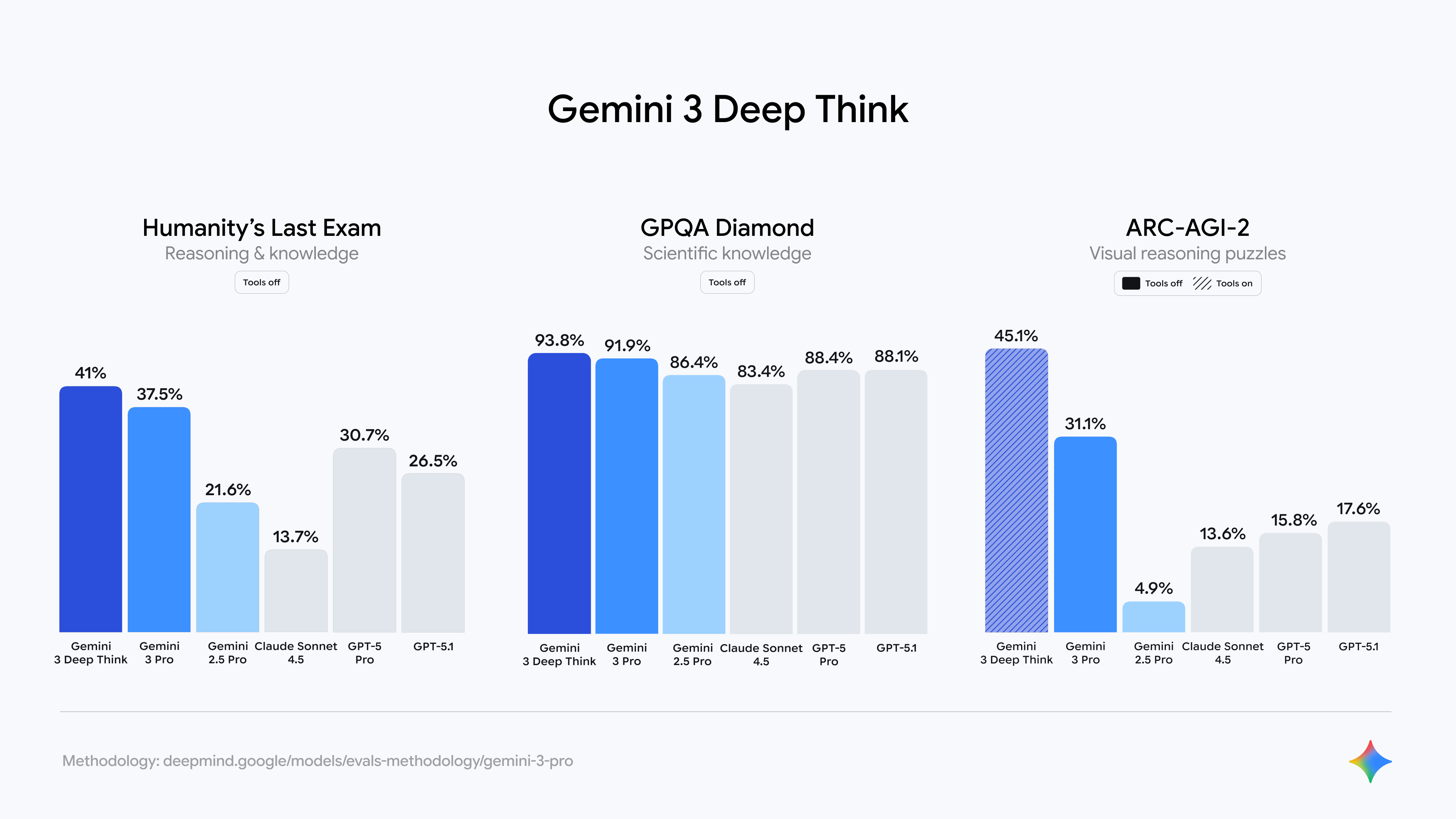
While OpenAI is still racing to catch up with Google’s Gemini 3 Pro, DeepMind on Dec. 4 officially introduced the Gemini 3 Deep Think mode, an instant industry focal point for its powerful reasoning capabilities. As an enhanced variant of the Gemini 3 series, Deep Think improves the model’s performance on complex mathematics, science, coding and logic tasks by exploring multiple hypotheses in parallel; benchmark results show an accuracy of 41% on Humanity’s Last Exam, well above Gemini 2.5 Pro’s 35%. However, the breakthrough is not universally accessible: Deep Think is exclusive to the Google AI Ultra subscription, priced at up to $250 per month, significantly higher than OpenAI ChatGPT Pro’s $200 fee.
Google CEO Sundar Pichai posted on X: 'Gemini 3 Deep Think brings our strongest reasoning capabilities, now available to Ultra subscribers.' Outlets including The Decoder and 9to5Google report that while the move reinforces Google’s lead in high‑end AI, the steep price has drawn developer criticism over accessibility and signals a potential shift from AI democratization toward elitism.
The Gemini 3 story began on Nov. 18, when Google released a preview of Gemini 3 Pro and billed it as 'the world’s most intelligent multimodal model.' The model supports a 1,000,000‑token context window and covers text, images, video, audio and code, and is integrated into Gemini App, AI Studio and Vertex AI. Deep Think, positioned as its 'killer feature,' is designed for 'thorny problems': it uses advanced parallel reasoning to evaluate multiple hypotheses simultaneously, apply iterative logical checks, and produce more refined solutions. DeepMind shared demos on X showing generation of simulated domino‑game code from a single prompt in minutes, and a 3D architectural simulation where the model incrementally optimizes designs while considering time complexity and trade‑offs.
Performance benchmarks further underline its strengths. Gemini 3 Pro tops the LMArena leaderboard with an Elo score of 1501; it scores 91.9% on GPQA Diamond (graduate‑level questions) and 76.2% on SWE‑bench Verified (coding benchmark). Deep Think leads by a large margin on ARC‑AGI‑2 (abstract reasoning) and Humanity’s Last Exam, with accuracy improvements of more than 20%. Compared with competitors, it surpasses OpenAI GPT‑5.1’s 89% GPQA score and matches Anthropic Claude 4.5 on many multimodal tasks. Google emphasizes that Deep Think’s iterative reasoning simulates human thought paths and is suited for scientific research, prototyping and strategic planning—for example, generating interactive simulations for quantum computing queries or producing multi‑angle analyses of Pixel 10 camera features.
The launch is a strategic response to multiple pressures. First, competition is heating up: the open‑source math model DeepSeek V3.2 challenges high‑end reasoning at low cost ($0.28 per million tokens), while OpenAI has reportedly triggered an internal 'code red' to accelerate its Garlic model iterations. The Decoder analyzes Deep Think as a direct counter, filling Gemini’s gaps in complex logic with parallel hypothesis exploration. Second, user demand has evolved: in 2025 AI is shifting from 'chat assistant' to 'problem solver'; the Gemini App has over 650 million monthly active users, with 30% requesting deeper reasoning. Google’s blog says Deep Think’s 'minutes‑long responses' are aimed at these pain points. Finally, the technical foundation is mature: Gemini 3 builds on Gemini 2’s capabilities in thinking, reasoning and tool use, while Deep Think further integrates Veo 3 video generation and the Nano Banana image model to enable a multimodal closed loop.
Pricing strategy is another focus. The Gemini 3 Pro API preview uses tiered billing: within 200k tokens, inputs cost $2 per million tokens and outputs $12 per million; beyond 200k the rates double to $4/$18. Deep Think is restricted to the Google AI Ultra subscription at $249.99 per month (about ¥1,800), which includes Veo 3.16 video generation, Deep Research and a 1,000,000‑token window. That is 25% more than ChatGPT Pro ($200) and reduces Mistral 3’s cost advantage by about 80%. Google defends the pricing as reflecting 'cutting‑edge compute resources'—Deep Think’s parallel reasoning requires multiple times the GPU hours. On X, developers have complained: 'Gemini 3 is powerful, but $250/month is not user‑friendly; open‑source DeepSeek is free and good enough,' a post that received hundreds of likes. The free tier is limited to AI Studio experimental builds, with restricted throughput and no commercial deployment options.
The industry effect is double‑edged. On one hand, Deep Think could accelerate an 'agent era' by enabling Workspace Studio to create automated Gemini agents, potentially boosting enterprise efficiency by 30%. Google’s financials show third‑quarter search revenue of $102.3 billion, with AI contributing 16% growth. OpenAI’s daily active users have fallen 6%, which may prompt Sam Altman to adjust strategy. On the other hand, the high price barrier may deepen inequality: small and mid‑sized developers could migrate to open source, turning Google’s ecosystem into an 'elite club.' The EU’s DSA requires transparent pricing and carries potential fines. In the long run, this model may help standardize 'reasoning‑as‑a‑service,' and the AI market could exceed $500 billion by 2026.
Looking ahead, Deep Think’s rollout is initially limited to English‑speaking users in the U.S., with Google planning expansion within weeks. Users can activate it from the Gemini App tools menu and combine it with the 'Thinking' setting. Google stresses safety first: the pre‑release underwent security testing to mitigate harmful behaviors. In an AI landscape full of powerful new capabilities at the end of 2025, Gemini 3 Deep Think is unquestionably Google’s trump card—but whether it will be embraced depends on balancing innovation with broad accessibility. Developers are watching closely: will the high price deliver truly 'deep thinking' value?