
April 15, 2026, Google DeepMind officially released Gemini 3.1 TTS (Text‑to‑Speech) on its official blog. This is a major upgrade to Google’s TTS product line. The model supports nearly 70 languages and dialects and achieves industry‑leading levels in naturalness, emotional expression, prosody control, and multilingual consistency; Google officially called it "the most powerful TTS model to date." Gemini 3.1 TTS is fully available via the Gemini App, Google Cloud Text‑to‑Speech API and Vertex AI, and enterprise developers can call it immediately.
A Google vice president of product said the core goal of Gemini 3.1 TTS is to make AI voices "sound human," no longer mechanical reading but fluent dialogue with emotion, intonation variation and natural pauses. This marks a shift in TTS technology from "intelligible" toward "trustworthy" and "immersive."
Technical highlights: unified multilingual modeling and deep emotion integration
Gemini 3.1 TTS uses Google’s latest unified multimodal Transformer architecture, jointly modeling text, speech features and emotion labels in a shared space. Unlike traditional TTS models that use a two‑step process of converting to an intermediate representation and then synthesizing speech, Gemini 3.1 TTS generates end‑to‑end, greatly reducing intermediate error.
Key technical breakthroughs include:
- Support for nearly 70 languages: covering English, French, German, Spanish, Chinese (Mandarin, Cantonese), Japanese, Korean, Arabic and other major languages and various dialects. The model performs especially well on low‑resource languages, addressing previous TTS issues of strong accents and weak emotional rendering in non‑English languages.
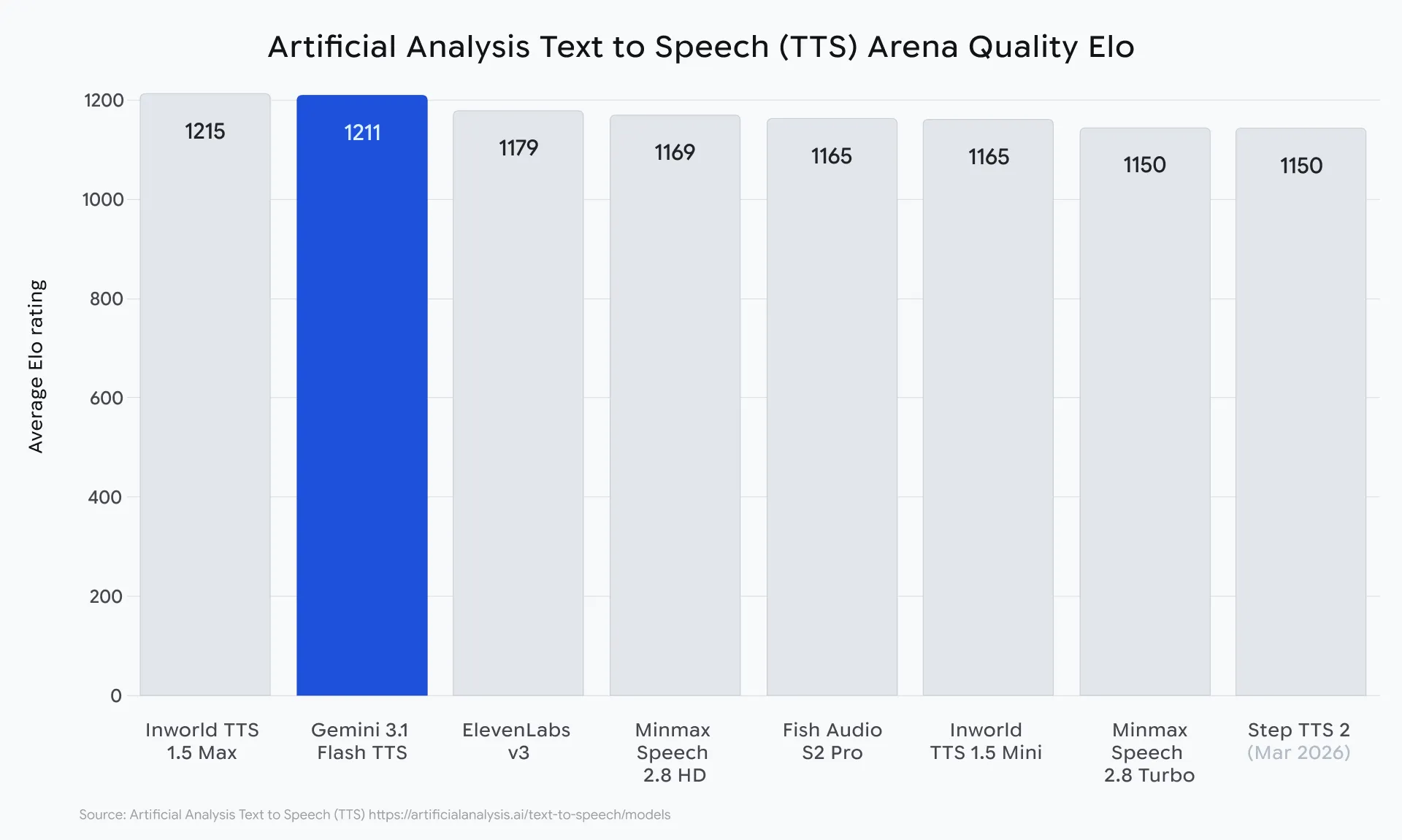
- Emotion and prosody control: supports controlling emotion via natural language prompts (e.g., "excited", "calm", "formal") and automatically generates appropriate speaking rate, pauses and emphasis. Tests show its emotional naturalness exceeded current versions of ElevenLabs and OpenAI TTS in blind evaluations.
- Realtime and low latency: supports streaming output with end‑to‑end latency as low as 300 ms, suitable for real‑time dialogue, virtual presenters and game NPC scenarios.
- Multi‑speaker consistency: can generate consistent speaker voices, supporting voice cloning and style transfer while maintaining the same speaker’s timbre and intonation across different languages.
Google emphasized that Gemini 3.1 TTS was trained on massive multilingual, multi‑emotion real‑dialogue data and optimized with reinforcement learning from human preferences, making it particularly strong in natural conversational scenarios.
Comparison with competitors: Google leads in multilingual support and emotion
The release of Gemini 3.1 TTS directly targets competitors such as ElevenLabs, OpenAI TTS and Microsoft Azure TTS. In multilingual support, Gemini 3.1 TTS leads with nearly 70 languages; ElevenLabs currently supports about 30 languages and OpenAI TTS about 50. Gemini 3.1 TTS also received higher marks for emotional naturalness and long‑text coherence, especially in non‑English languages.
The Google Cloud Text‑to‑Speech API has been upgraded in parallel, allowing users to achieve emotion control and language switching with simple prompts; pricing remains close to the previous generation, offering a clear cost‑performance advantage.
Far‑reaching impact: content creation, accessibility and accelerated global adoption
Upgrading to Gemini 3.1 TTS will have significant effects across multiple fields:
- Content creation and short video: creators can quickly generate multilingual voiceovers, virtual presenters and emotionally expressive narration, substantially lowering production costs. Short videos, podcasts and educational content production will see efficiency gains.
- ** accessibility (assistive services) **: provides more natural voice reading services for people with visual impairments, speech disorders and multilingual learners. Google plans to deeply integrate the technology into Google Assistant and Chrome Reader.
- Education and language learning: natural pronunciation and emotional expression across nearly 70 languages can generate personalized language learning materials and help users worldwide learn foreign languages more effectively.
- Enterprise applications: customer service systems, virtual assistants and game NPCs will gain more humanized voice interactions, improving user experience. Multinational companies can more easily implement unified multilingual customer service.
- Global digital inclusion: support for low‑resource languages will help more users in developing countries and minority communities access AI voice technology benefits.
This technology also pushes AI voice from a "tool" toward an "emotional companion." In the future, Gemini 3.1 TTS is expected to integrate deeply with features like Gemini Notebooks and Agents to form a more complete AI personal assistant ecosystem.
Challenges and outlook
Despite leading performance, Gemini 3.1 TTS still faces challenges such as voice cloning abuse, deepfake risks and data privacy. Google has built in watermarking and detection mechanisms and emphasized lawful use only. Regulatory bodies may impose stricter compliance requirements for high‑fidelity TTS technologies in the future.
Google DeepMind said it will continue iterating on the Gemini TTS series, planning to support more dialects and real‑time emotional fine‑tuning in the coming months to further expand language coverage.
The release of Gemini 3.1 TTS is not only a technical breakthrough for Google in speech generation, but also an important step in extending AI multimodal capabilities into emotional and cultural dimensions. It makes AI speech no longer a cold tool but a true carrier of emotion and a cultural bridge across languages. As AI becomes more integrated into daily life, this upgrade will bring more possibilities to global content creators, educators and ordinary users and set a new benchmark for the AI speech field.
From a single language to nearly 70 languages, from mechanical reading to natural conversation, Gemini 3.1 TTS is propelling speech generation into a new era. As more vendors follow suit, AI voice technology may truly realize the inclusive vision of "voice for everyone."
▶️ Like this article? Creating content takes a lot of effort!
Subscribe to our YouTube channel:
AI Rosetta
Your likes, subscriptions and shares are our biggest support! 🙏
For more AI news visit: https://www.airosetta.com