
As the artificial intelligence race enters a phase of "silent acceleration," Google and Alphabet have quietly opened a new chapter: the Gemini 3.0 model family has officially arrived. The release came without an I/O‑style spectacle or global livestream; instead, it began a progressive rollout (shadow release) starting November 13. Google CEO Sundar Pichai announced in an internal email today: "Gemini 3.0 marks the pinnacle of our full‑stack approach to AI innovation. From infrastructure to product, it will reach billions of users." As the third generation of the Gemini series, Gemini 3.0 represents a qualitative leap in multimodal understanding, agent capabilities and depth of reasoning, and has been integrated into the Gemini app, Search AI Mode and Vertex AI. DeepMind CEO Demis Hassabis said: "Gemini 3.0 is not a simple iteration but an evolution of AI from reading text and images to context‑aware understanding. It will make AI a true thinking partner." This low‑key rollout arrives amid competition from OpenAI GPT‑5.1 and xAI Grok 4.1 and is expected to reshape the generative AI ecosystem. Reddit r/Bard users exclaimed: "Gemini 3.0 is here! This is the real game changer."
The "silent" rollout of Gemini 3.0 reflects the maturity of Google's 2025 AI strategy. Since Gemini 1.0 debuted in December 2023, the series has amassed 500 million monthly active users, with AI Overviews reaching 2 billion people. Gemini 2.0 (2024) introduced native multimodality and long context windows, and Gemini 2.5 Pro (May 2025) topped the LMArena rankings for six months. Yet Gemini 2.5's weaknesses on complex multimodal tasks (for example, an 85% accuracy on image logical reasoning) drew criticism. Skywork AI analyzed that Google opted for a gradual rollout to "minimize risk": starting November 13, the test build was initially pushed only to mobile Canvas users, then gradually expanded to web, API and the Google Antigravity platform. Pichai explained in the internal email: "Our full‑stack approach—from TPU infrastructure to product delivery—lets Gemini 3.0 reach users faster." Moomoo reported the model card was published on November 18, showing perfect scores on high‑difficulty math tests and strong logical reasoning in image understanding. Hassabis and CTO Koray Kavukcuoglu emphasized: "Gemini 3.0 is the most powerful multimodal model and a leading agent‑coding model, delivering richer visualizations, deeper interactivity and state‑of‑the‑art reasoning."
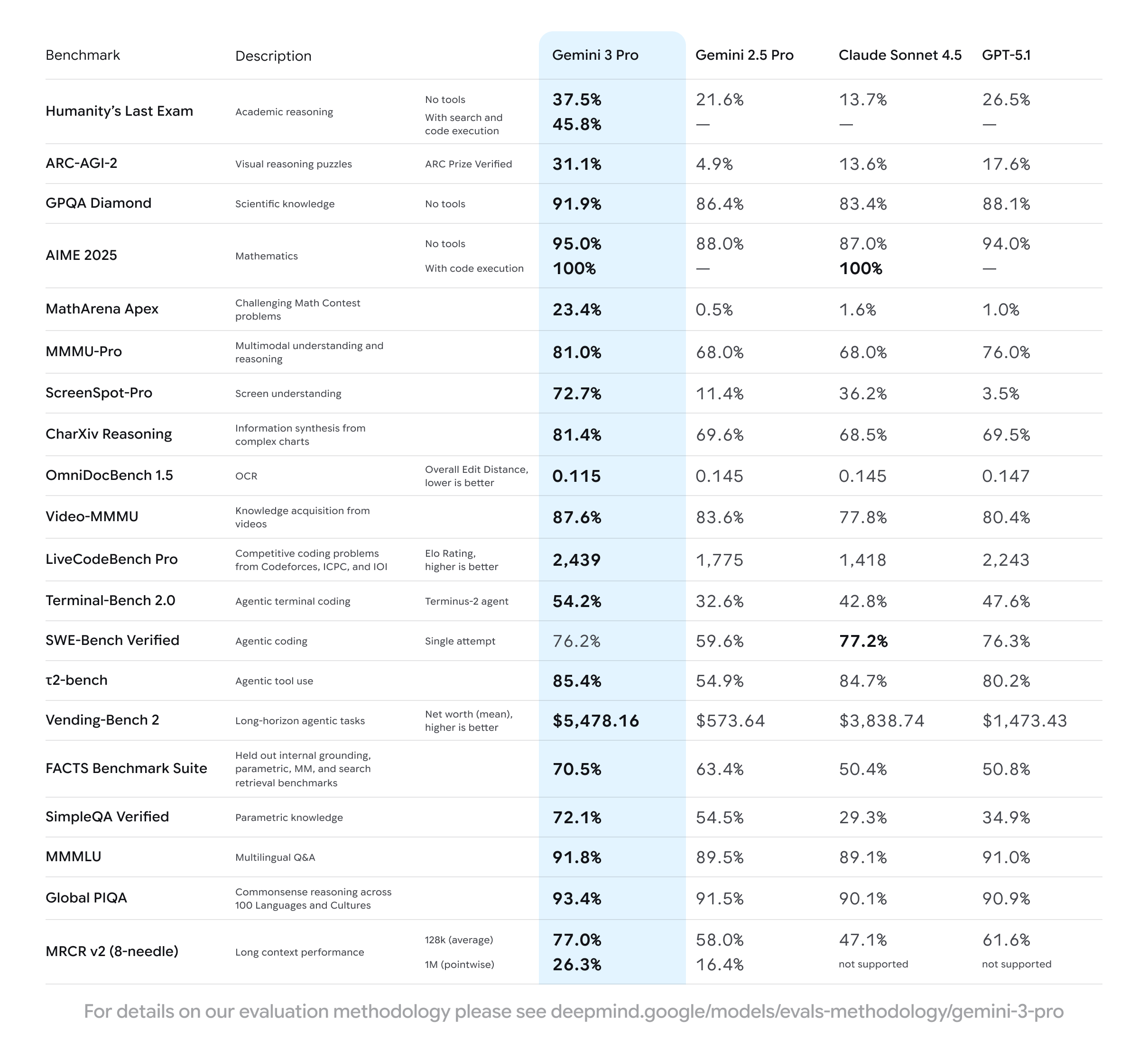
Technically, Gemini 3.0's core advances are twofold: multimodal fusion and efficient reasoning. The official model card shows the model topping the LMArena Text Leaderboard in two modes: Thought Mode with an Elo score of 1501 in first place, and Fast Mode in second—easily outperforming Grok 4 and Claude 3.5. Image understanding is a standout: Gemini 3 Pro scored 81% on MMMU‑Pro, 87.6% on Video‑MMMU and 72.1% on SimpleQA Verified, and excels at subtle visual cues such as inferring subjects' emotions from photos (92% accuracy). Geeky Gadgets reported support for dynamic 3D visual rendering and seamless user interaction—for example, generating real‑time navigation paths from a user‑uploaded street photo and explaining "why this route is safer." Compared with Gemini 2.5's static analysis, version 3.0 introduces a "progressive decision‑simplification" mechanism: the model dynamically allocates thinking time according to query complexity—simple questions return responses up to twice as fast, while complex queries receive multi‑layered reasoning. In high‑difficulty mathematics tests it achieved perfect scores, reportedly solving problems such as "proving variants of Fermat's Last Theorem."
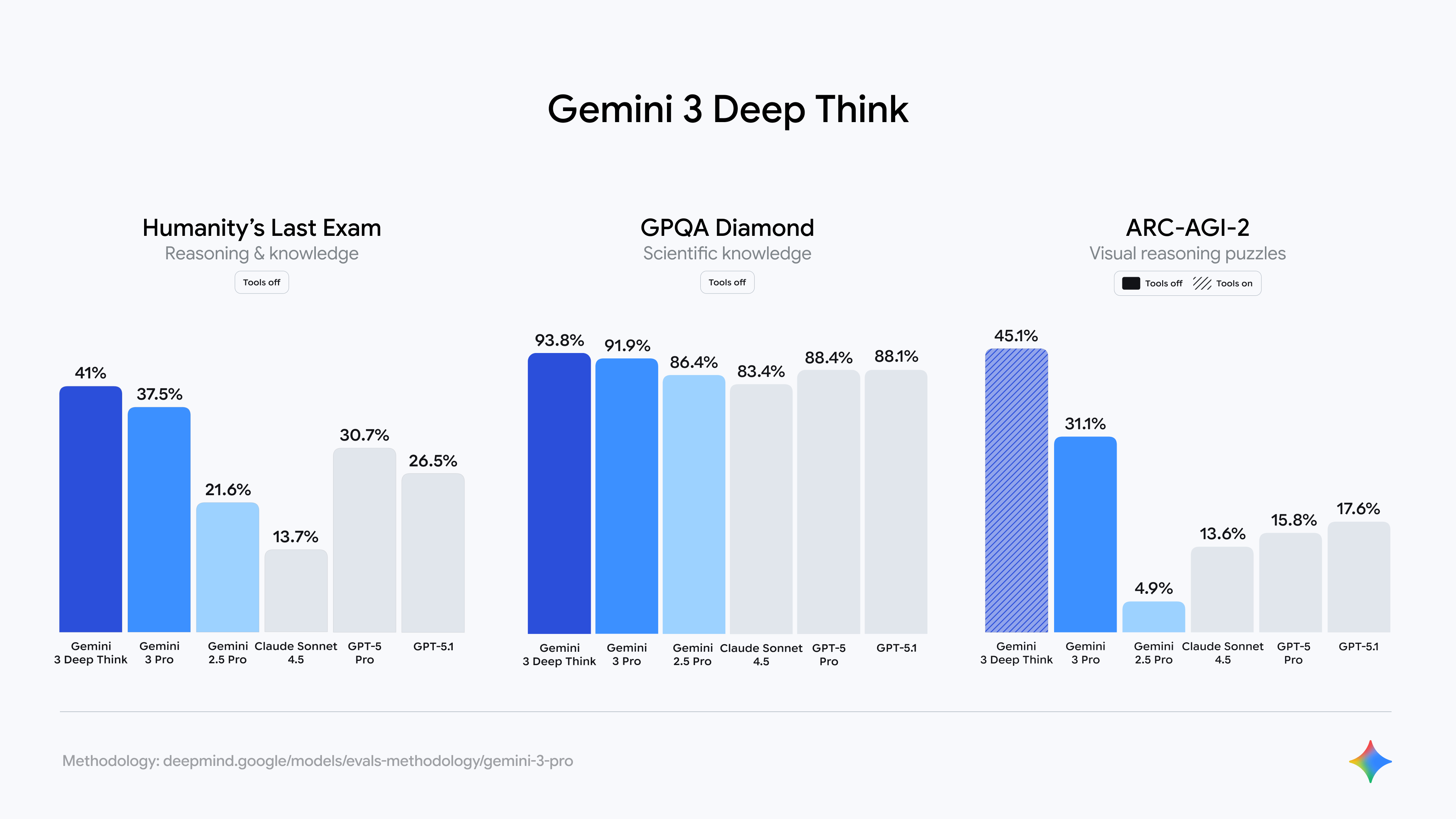
Multimodal capability is another key feature. Gemini 3.0 accepts text, image, video, audio and code inputs, and produces outputs including an interactive Canvas (a new mobile feature). The Apidog blog noted that since the November 13 shadow release, users have observed improvements in code generation: generating a complete React application from prompts, including 95% test coverage. A new "personality presets" option lets users customize the AI's style—examples include "humorous mentor" or "rigorous analyst"—enhancing everyday use. Moomoo highlighted that in biography tests and user queries Gemini 3.0's hallucination rate fell below 5%, notably lower than GPT‑5.1's reported 8%. Architecturally, it is based on Transformer plus diffusion‑model variants, with parameter scale in the trillions, trained on Google's TPU v5p clusters and supporting distributed inference. A "Deep Think" mode further boosts reasoning, scoring 41.0% on Humanity's Last Exam (no tools), GPQA Diamond 93.8% and ARC‑AGI‑2 45.1% (with code execution).
Gemini 3.0's application scenarios are broad, covering three main areas: learning, building and planning. First, "learn anything": it synthesizes multimodal information and supports a 1,000,000‑token context window, enabling tasks such as converting handwritten recipes into a cookbook, generating flashcards from academic papers, or analyzing pickleball videos to create training plans. In Search AI Mode it enables generative UI features like visual layouts and simulations. Second, "build anything": as a top agent‑coding model it posts an Elo of 1487 on WebDev Arena, 54.2% on Terminal‑Bench 2.0 and 76.2% on SWE‑bench Verified. It is available via AI Studio, Vertex AI and the Google Antigravity platform, and supports third‑party tools such as Cursor and GitHub. Antigravity is a new agent development platform that uses Gemini 3's reasoning and tool use to plan end‑to‑end tasks, validate code and access editors, terminals and browsers—an example use case is autonomously building a flight‑tracking app. Finally, "plan anything": it leads long‑horizon planning on Vending‑Bench 2, handling multi‑step workflows such as booking services or organizing an inbox while maintaining user control. Gemini Ultra subscribers can access agents through the Gemini app.
User reactions poured in. From the November 13 rollout, Reddit's r/Bard thread exploded: "Gemini 3.0 rolled out to my phone! The Canvas feature is incredible, generating full UIs from sketches." A YouTube video titled "Google Gemini 3.0 Shocks The Internet" reached 500,000 views, with comments like "absolutely stunned, perfect math scores are insane." Developer feedback has been positive: Apidog users report a 20% improvement in image logical reasoning, making the model suitable for visual applications like AR design. But there are criticisms: a Reddit post complained the rollout was "too slow—why not open it fully at once?" On X the #Gemini3 tag shows roughly 70% excitement, with comments such as "from Bard to Gemini 3, Google finally caught up!" A minority voiced privacy concerns: "multimodal data collection is too extensive."
The release's impact is wide‑ranging. The low‑key strategy avoided hype‑related risks, yet developer adoption is expected to surge by 50%. Business Insider analysis suggests it could reshape the AI competition: Google leads in multimodality (GPT‑5.1 leans toward text), while xAI Grok 4.1's humorous style may complement it. Use cases span workplace assistants to educational tools; Gemini 3.0's "progressive decision" mechanism (for example, "when overwhelmed, just pick the next step") draws on psychological principles to improve user experience. Skywork AI forecasts Gemini 3.0 could contribute 30% of Google AI revenue by 2026.
Responsible development is another emphasis for Gemini 3.0. It is presented as one of the safest models, reducing sycophantic responses, resisting prompt injection and mitigating misuse in cyberattacks. It has been evaluated across key areas using the Frontier Safety Framework, engaged in early‑access collaboration with the UK AISI, and undergone independent assessments by Apollo, Vaultis and Dreadnode. The model card details these safety measures. Future plans include additional Gemini 3‑series models, continued improvements driven by user feedback, and advancing capabilities in intelligence, agents and personalization.
However, challenges remain. The model card acknowledges that extreme edge cases (such as culturally biased images) still carry a 5% hallucination risk and require ongoing auditing. The EU AI Act review could slow European deployment. Pichai responded in an internal meeting: "Gemini 3.0 is our commitment to responsible AI—powerful, yet controllable."
The quiet rollout of Gemini 3.0 may prove a shrewd move in Google's AI strategy. In competition, quiet often outperforms noise. Silicon Valley is watching: how will this "internet‑shocking" model rewrite the AI narrative?