
On November 18, 2026 (local time), Google DeepMind formally launched the Gemini 4 series' new model — Gemini 4 Neon. Positioned for complex software engineering, knowledge work and scientific workflows, the model emphasizes achieving faster end‑to‑end task completion and better cost efficiency while retaining cutting‑edge intelligence. Neon has begun a staged rollout on the Gemini API (paid tier), Google AI Studio, Gemini for Business, Google Antigravity (Pro and Ultra subscribers) and the Gemini App (Pro and Ultra subscribers).
Positioning and Core Capabilities
Google describes Gemini 4 Neon as a model that "delivers frontier‑level intelligence with rapid end‑to‑end task completion." It features a 1,000,000‑token context window and supports adjustable thinking levels, allowing users to trade off speed and depth according to task requirements. Google noted that at the default high thinking level, Neon’s task completion cost is about 32% lower than Gemini 4 Carbon; at a higher thinking level (xhigh), it scored 61 on the Artificial Analysis Intelligence Index, ranking third overall, behind some larger, slower‑responding models.
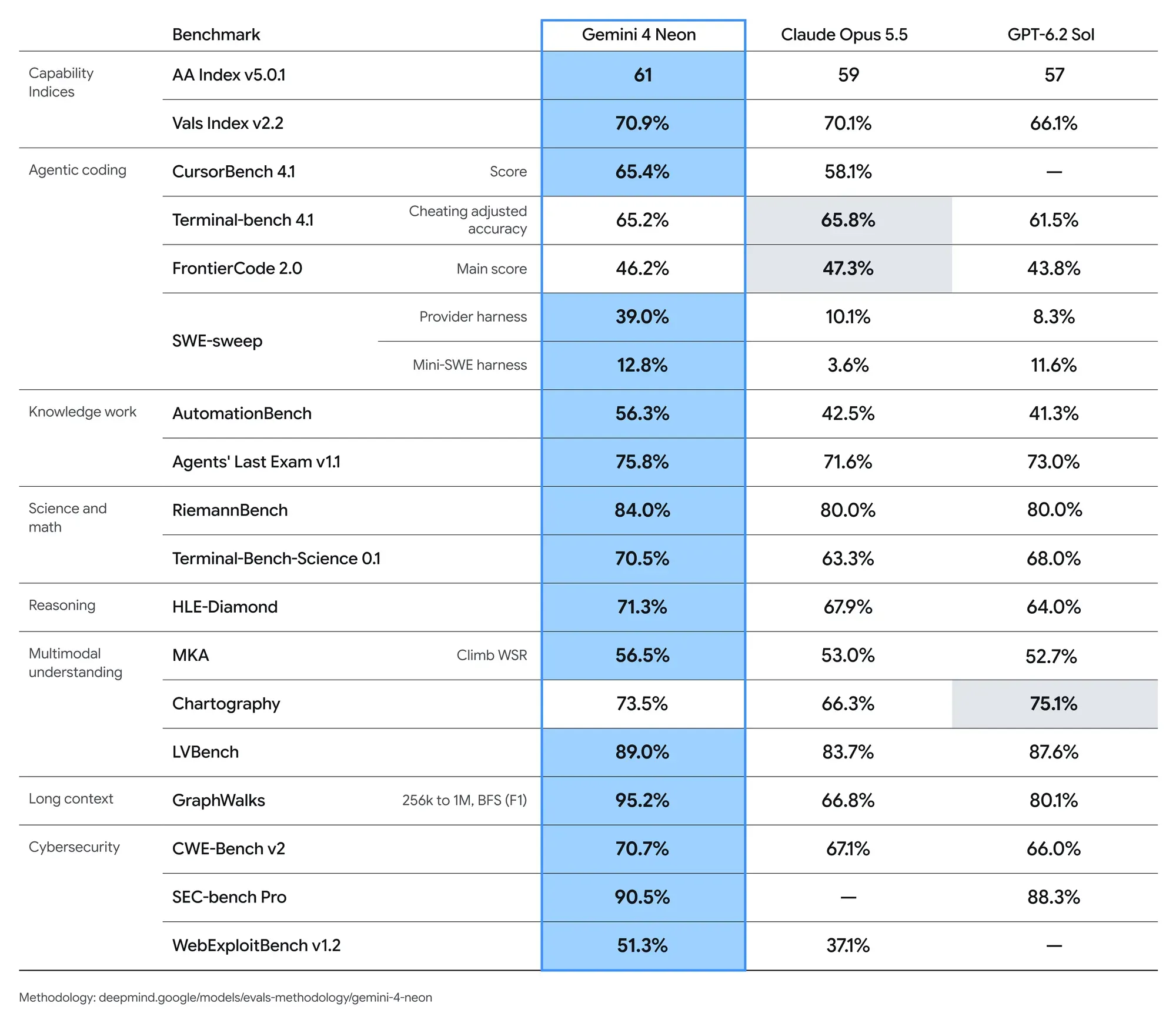
In third‑party evaluations, Neon ranked second on the Vals Index (70.9%) and placed first on benchmarks related to legal research and tax agent tasks; it also ranked second on the Agent Arena Index. In science and math reasoning, Neon led on tests such as Terminal‑Bench Science, RiemannBench and HLE‑Diamond. In coding‑related benchmarks, it ranked first on the Artificial Analysis Coding Agent Index (58.6) and showed strong abilities in multi‑file debugging, refactoring and long‑horizon agent tasks.
Google emphasizes that Neon not only improves raw capabilities but also advances steerability (the model’s responsiveness to mid‑course user corrections) and reduces hallucinations; internal tests indicate its hallucination rate is among the lowest in the Gemini 4 family.
Pricing and Availability
API pricing is $3 per million input tokens and $15 per million output tokens, with cached input tokens priced at $0.15 (a 95% discount). This pricing sits between Gemini 4 Hydrogen (lower‑cost) and Gemini 4 Carbon (higher‑capability), creating a clearer tiering. Neon is currently being made available primarily to paid users; free or low‑cost users still mainly access more economical variants such as Hydrogen.
Role Within the Gemini 4 Family
The Gemini 4 series has been releasing variants at an accelerated pace. Earlier releases included Gemini 4 Argon, Carbon and Hydrogen. Carbon is positioned as the most capable frontier model for very long‑horizon and high‑difficulty tasks; Hydrogen focuses on everyday fast execution and cost‑effectiveness; Neon aims to strike a balance between capability and efficiency, suited for production workflows that need strong reasoning without paying the full Carbon cost. Google says Neon can match Carbon quality in some scenarios while offering faster speed and lower cost.
On safety, Neon continues the Gemini 4 series' alignment and safety improvements, including protections against serious misuse and prompt injection, and showed lower rates of boundary violations and gaming in internal code and agent behavior evaluations. For cybersecurity scenarios, Google also introduced a Neon for cyber variant, planned for access by trusted defensive parties.
Industry Context and Significance
This release comes amid intensifying competition in AI models. Companies such as OpenAI and Anthropic are rapidly iterating models, and the market is increasingly focused on trade‑offs among performance, cost and practical usability. By rapidly releasing multiple Gemini 4 variants, Google aims to cover needs from high‑frequency daily tasks to complex professional work, leveraging its infrastructure advantages to reduce per‑task costs.
Objectively, the official benchmark data and cost advantages are clear, but real‑world effectiveness will depend on independent evaluations and workflow validation. Different tasks favor different models; Neon stands out in some coding and knowledge‑work tests but still trails top competing models on certain benchmarks. As the model becomes more broadly available, developer and enterprise feedback will further test its production value.
The launch of Gemini 4 Neon reflects Google's continued push on model tiering and efficiency optimization. Rather than pursuing the single highest score, Neon seeks a practical balance of capability, speed and cost, offering a new option for users who handle complex multi‑step tasks. Subsequent real‑world usage data and third‑party evaluations will more clearly show the model’s true positioning and competitiveness.
▶️ Enjoy this article? Creating content is hard!
Subscribe to our YouTube channel:
AI Rosetta
Your likes, subscriptions, and shares are our greatest support! 🙏
For more AI news visit: https://www.airosetta.com