
On January 13, 2026, Google Antigravity officially announced support for the Agent Skills feature, marking a significant evolution of its AI‑agent development platform. Launched by Google DeepMind, Antigravity has been a core tool for building autonomous AI agents since its release on November 18, 2025. With Agent Skills, agents are no longer limited to one‑off prompts: they can extend capabilities via reusable knowledge packs to achieve more consistent and efficient workflows. This change not only improves development productivity but also helps shift AI from a "chat assistant" to a "programmable partner." This article, based on Google’s official documentation, developer blogs, and industry analysis, explores the feature details, implementation, and its impact on the AI ecosystem.
Google Antigravity Platform Overview
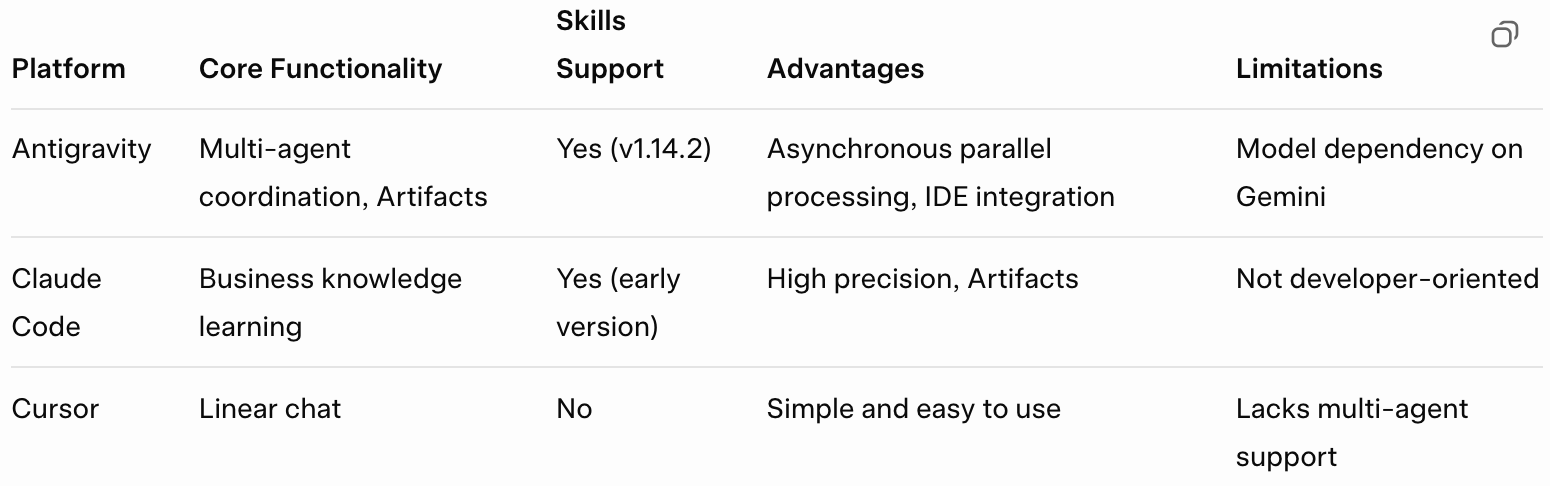
Google Antigravity is an "agent‑first" integrated development environment (IDE) designed to transform a traditional code editor into a management center for AI agents. Unlike linear chat modes in tools such as Cursor or VS Code, Antigravity emphasizes asynchronous, multi‑agent collaboration. Core components include an Editor view (for manual code editing and contextual completion) and a Manager view (for coordinating multiple agents). Developers can use natural‑language prompts to let agents autonomously plan, execute, and verify complex tasks, such as building web applications, debugging code, or integrating external tools.
Antigravity supports multiple models, including Google’s Gemini 3 Pro, Anthropic’s Claude Sonnet 4.5, and OpenAI’s GPT‑OSS. Built on top of the open‑source VS Code foundation, it adds an Artifacts system for producing structured outputs like plans, screenshots, and code diffs to facilitate developer review. The platform is compatible with macOS, Windows, and Linux, is currently in public beta, is free for individuals, and offers relaxed rate limits for Gemini 3 Pro. Since launch, Antigravity has attracted many developers for projects ranging from simple scripts to full‑stack applications.
Detailed Explanation of the Agent Skills Feature
Agent Skills is the core new feature in Antigravity v1.14.2, launched on January 13, 2026. This open standard allows developers to package specific knowledge into reusable bundles that extend an agent’s abilities without reissuing prompts each time. Skills are essentially "knowledge packs" that include task descriptions, best practices, scripts, and resources to help agents handle repetitive or specialized workflows.
The implementation of Skills is simple and efficient: each Skill is a folder centered on a SKILL.md file, which uses YAML front‑matter metadata to define the name and description. The description field is critical: it guides the agent in deciding when to activate the Skill—agents automatically scan available Skills and evaluate relevance at the start of a conversation. The folder can include scripts, templates, and other auxiliary resources; agents can invoke a ‑‑help command to call these resources instead of ingesting full source files, optimizing context management.
Skills come in two types: global Skills (stored at ~/.gemini/antigravity/skills/ and applicable to all projects) and workspace‑specific Skills (stored at <workspace>/.agent/skills/ for project‑specific use). Activation proceeds in three steps: Discovery, Activation, and Execution. Agents can apply Skills autonomously based on context without explicit user direction. For example, a "code review" Skill can define a checklist covering correctness, edge cases, and performance optimizations; the agent will automatically generate feedback and alternative suggestions.
Best practices emphasize that each Skill should focus on a single purpose, provide decision trees for complex scenarios, and encourage scripting as black boxes. This design is model‑agnostic and supports Gemini, Claude, and others, ensuring cross‑provider compatibility. A community of shared Skills has already emerged, including official Anthropic packages and offerings on platforms like Skillsmp. However, users should beware of "poisoning" risks: verify sources before installing unknown scripts.
Comparison with Competitors: Antigravity’s Unique Advantages
Agent Skills are not entirely novel—Anthropic’s Claude introduced similar capabilities in 2025, and OpenAI’s GPT‑OSS also supports tool integration. Antigravity’s implementation, however, places greater emphasis on openness and IDE integration. Claude Skills focus on business‑knowledge learning and suit non‑developer scenarios; Antigravity emphasizes multi‑agent coordination and Artifacts auditing, targeting software engineering use cases.
Compared with other agentic IDEs like Cursor or Windsurf, Antigravity offers more advanced parallel workflows and in‑editor testing. It also supports the Model Context Protocol (MCP), which allows agents to connect to external tools and improve data grounding. Developer feedback indicates Skills reduce repetitive prompting and increase task stability, although Claude still slightly outperforms in code precision and Artifacts features.
Industry Impact and Potential Challenges
The launch of Agent Skills is expected to accelerate the adoption of AI agents in software development. It fundamentally shifts the development paradigm: developers transition from coders to architects while agents handle routine tasks, boosting productivity. At the enterprise level, Skills can standardize team workflows and reduce errors. Google highlights the openness of the standard, which may drive industry convergence, such as extensions to MCP.
Challenges include privacy controls (v1.14.2 added a history‑off feature) and security risks such as malicious Skills. In the future, Antigravity may integrate more models and tools and support advanced workloads like quantum optimization.
Outlook: A "Antigravity" Era for AI Development
Google Antigravity’s support for Agent Skills signals a leap forward in AI‑agent development—moving from linear to autonomous, from repetitive to reusable. This update not only strengthens Google’s leadership in the AI tooling landscape but also opens a new era of efficiency and innovation for developers. As community contributions grow, Skills could become an ecosystem standard, driving broad adoption from startups to enterprises. Developers can apply for trial access on the official website to experience the change firsthand.
▶️ Enjoyed this article? Creating great content takes effort!
Subscribe to our YouTube channel:
AI Rosetta
Your likes, subscriptions and shares mean the world to us! 🙏
For more AI news, visit:
https://www.airosetta.com