
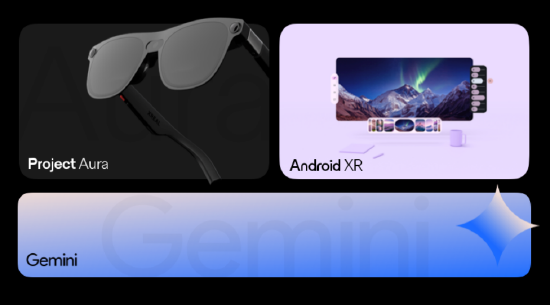
As the wave of artificial intelligence sweeps the globe, smart glasses—as the next‑generation computing interface—have become a new battleground among technology giants. On December 8 (U.S. time), Google made a major appearance at "The Android Show | XR Edition" livestream, announcing that its first AI glasses will launch in 2026 and unveiling a Project Aura prototype co‑developed with Chinese AR company XREAL. The move is seen as a clear signal of Google’s return to the head‑worn smart device arena, aiming to confront leaders such as Meta through the Android XR operating system and the Gemini AI model.
Google’s strategy is not rushed but stems from a decade of reflection. Back in 2012, the first‑generation Google Glass was hailed as an AR pioneer, but its $1,500 price tag, limited functionality and poor battery life led to a disappointing consumer debut in 2014, and it ultimately became an industry footnote. Today, Google has shifted to an "AI‑native" approach, positioning glasses as a seamless lifestyle interaction point rather than merely a head‑mounted camera. Google XR VP and GM Shahram Izadi emphasized during the event, "For AI and XR to truly work, hardware must fit seamlessly into users’ lives and match personal style. A single device type cannot meet everyone’s needs, so we are committed to making the Android XR platform support diverse devices, allowing users to choose by weight, style and immersion level."
Specifically, Google plans two types of AI glasses: one "screenless" voice‑assistant model integrating speakers, microphones and cameras, enabling natural conversations with Gemini, photo capture and instant assistance; the other with lens displays that privately project navigation, real‑time translated captions and other information without disturbing the surrounding environment. These glasses will be developed on the Android XR platform, designed for the smart era to support multiple form factors such as headsets and glasses and to provide powerful visual understanding—AI that can "see" a user’s environment and intelligently execute tasks. Google also debuted a "Likeness" technology that uses sensors to capture facial micro‑expressions and hand gestures to generate high‑fidelity virtual avatars in video calls, easing the social friction of headsets.
Of particular note is Project Aura, the first wired XR device developed in deep collaboration with XREAL. It can run independently without a phone connection but requires an external battery. It features XREAL’s in‑house X1S spatial computing chip and a dual‑chip design with Qualcomm Snapdragon, achieving a field of view (FOV) greater than 70°, which is the highest level among current optical see‑through (OST) solutions. XREAL founder and CEO Xu Chi stated, "An agent should not just be software; it should be a 'hardware‑ized agent' to fully unleash AI’s capabilities. Glasses, being the device closest to people, are a natural carrier for the next‑generation intelligent terminal." The product marks the first time Gemini AI gains a "spatial eye," integrating XREAL’s optics, chips and spatial algorithms natively with Android XR and Gemini to form a "see → understand → interact" closed loop. It is worth noting that Project Aura’s core hardware development was almost entirely completed by a Chinese team, including the X‑Prism optical system and a full supply chain rooted in the Yangtze River Delta to enable efficient iteration.
In the competitive landscape, Google is targeting Meta, which currently dominates the market. According to Counterpoint Research’s "Global Smart Glasses Model Shipments Tracker," in the first half of 2025 the Meta and Ray‑Ban co‑branded AI glasses accounted for 73% of shipments, validating the commercial potential of the "wearable + AI" route. Meta’s success lies in vertically integrating hardware and software, while Google is pursuing a "software‑first" strategy by empowering industry partners such as Samsung, Qualcomm and XREAL through open‑source Android XR to build ecosystem barriers. This approach resembles Google’s Android model in smartphones, aiming to connect high‑frequency services like Maps, Search and Translate and bring AI from the cloud into the real world to prevent control of traffic entry points from being cut off. Google has also collaborated with Warby Parker and Gentle Monster to design fashionable, lightweight frames, with initial products expected in 2026.
The smart glasses industry is poised to explode. AR glasses have long been constrained by optical module size, battery life and thermal limits, but generative AI large models are revitalizing the sector: with holographic displays not yet mature, early wins come from voice, camera recognition and lightweight displays to create edge‑side products. Multiple institutions are optimistic about edge AI prospects in 2026. A Dongguan Securities research note noted that the Ray‑Ban Meta blockbuster effect has made AI glasses a fiercely contested market domestically and internationally, with shipments expected to grow rapidly. Guotou Securities believes 2026 could be a breakthrough year for AIoT, with Apple, OpenAI and Meta already布局ing the edge and hit consumer devices imminent.
Market data further supports this trend. IDC predicts global smart glasses shipments will exceed 23.687 million units in 2026, a year‑on‑year increase of more than 60%, with China alone reaching 4.915 million units and hitting a scale inflection point. Counterpoint data shows global shipments surged 110% YoY in the first half of 2025, with AI glasses accounting for 78%. In China, Q2 2025 shipments exceeded 1 million units, or 26.6% of the global total, as domestic manufacturers accelerate overseas expansion leveraging supply chain advantages. Recently, new‑energy vehicle maker Li Auto and Alibaba‑owned Quark both launched smart glasses products, and component supplier GoerTek has benefited from the AI glasses boom, bringing revenue back to the billion‑yuan level.
Despite the promising outlook, the industry still faces three major hurdles: privacy protection, fashionable appearance and a lack of killer apps. IDC China analyst Ye Qingqing pointed out that balancing weight, battery life, performance and price remains challenging, and manufacturers are optimizing experiences through scenario trade‑offs. "The market has yet to see truly irreplaceable, must‑have applications, but proactive decision‑making and service‑oriented directions have potential to drive glasses from novelty to daily tools," Ye added. As AI evolves, high‑frequency scenarios such as office work, travel and health monitoring will spawn paid applications and enable the shift from auxiliary to indispensable use.
Hardware vendors, experienced in design and supply chains, can efficiently integrate with phone and car ecosystems; internet giants excel at AI algorithms and content services, advancing voice assistants and information retrieval. Looking ahead, through cross‑sector cooperation, Chinese manufacturers are expected to capture about 45% of the global share and deploy diverse strategies to expand into North America and Europe.
Google’s return not only ignites the AI glasses race but also signals a reshaping of the next‑generation computing platform. With rivals such as Meta, Apple and Snap circling, the first to build a robust ecosystem will control the user’s "spatial eye." In 2026, this battleground will intensify, and smart glasses may become the new benchmark of the AI era.