
November 22–23, 2026, Zhipu AI (Z.ai) officially released the next‑generation flagship large model GLM‑5.4. This is the company’s first model using the Loop Transformer (looping Transformer) architecture. The developer says that on a roughly 750B‑parameter base, a set of shared‑weight layers is executed in loops to achieve deeper reasoning, bringing the model’s intelligence to the level of 2–3T‑class models. The model is available to all GLM Coding Plan users and has been deployed on multiple coding platforms; API access will open after security evaluation, and the weights are planned to be open‑sourced responsibly.
Architecture innovation: from “parameter stacking” to “computational depth”
In traditional Transformer architectures, each layer typically executes once during forward computation. GLM‑5.4 introduces the Loop Transformer and runs two rounds of looping over 28 layers in the GLM‑5 base. Each round refines the hidden states produced by the previous round, thereby achieving effectively greater network depth without significantly increasing parameter count. Official figures indicate the model’s design corresponds to about 78 actual layers; after layer sharing and looping, a single token experiences a substantially increased effective depth.
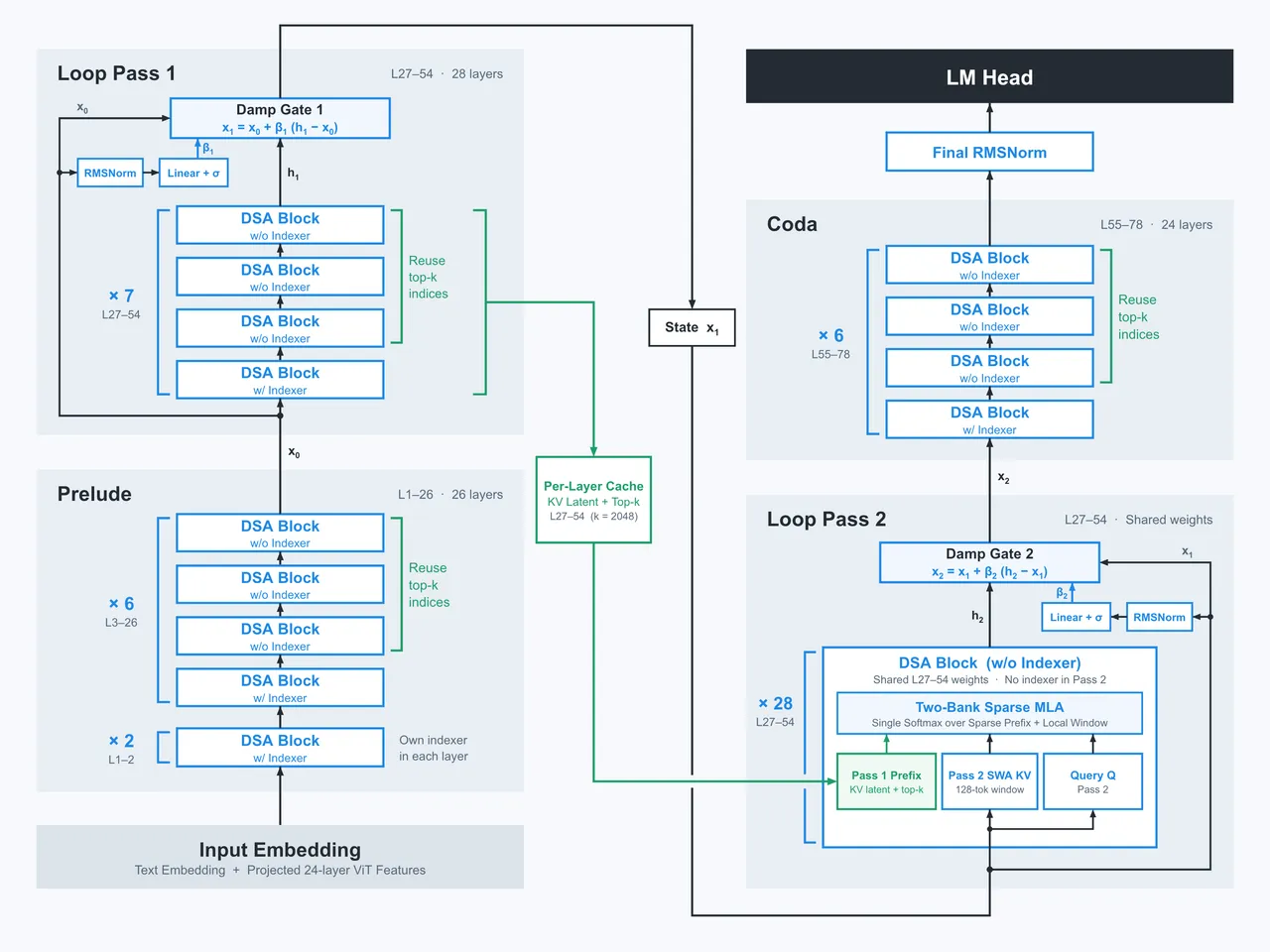
To balance performance and deployment cost, the team introduced three key optimizations: gated progressive updates (the first pass establishes global context, the second pass refines and enables write‑back), global KV cache sharing with sliding‑window independence (multiple loop rounds add almost no extra memory overhead), and sparse‑attention index reuse. Zhipu says it validated the architecture progressively at scales from 1B, 4B, 30B up to 750B. In a 30B controlled experiment using the same 750B‑base architecture, with unchanged parameter count and only about a 10% increase in total training compute, the Loop version showed clear improvements across multiple benchmarks and reduced average output length by 10%–14%, with most of the reduction coming from shorter chain‑of‑thought outputs.
The company notes that the longer the required reasoning chain, the greater the benefit from Loop; improvements are most evident in mathematical reasoning, long‑context understanding, and code‑related tasks. These capabilities are considered core to the “Pan‑Coding” concept.
Capability expansion: from traditional programming to “Pan‑Coding”
GLM‑5.4 adds visual understanding and supports video, image, text, and file inputs, producing text outputs. The model supports a 1M context window and a maximum output of 128K. The developer positions this release as the starting point for “Pan‑Coding,” where code becomes a universal interface connecting creative ideas and professional engineering.
In internal practical evaluations covering 200 real programming scenarios, Zhipu reports that GLM‑5.4 ranks among the top domestic models for overall coding experience, especially in visual coding, visual replication, and long‑range tasks. Demo scenarios include generating and processing video motion effects via code, building complete games, and performing 3D spatial modeling and mechanical engineering design (for example, modeling a six‑axis robotic arm in FreeCAD and visualizing its motion). In tool‑enabled environments, developers can provide storyboards, reference images, or design requirements for the model to write code, call professional software, and iterate based on runtime results.
On inference speed, Zhipu’s data shows peak non‑peak throughput can reach about 200 token/s, while peak‑period throughput remains around 70–80 token/s. For a multi‑round looping architecture, this throughput depends on coordinated optimization between model structure and inference infrastructure.
Availability and product deployment
Effective immediately, GLM‑5.4 is available to all GLM Coding Plan users. Users with weekly quotas will see their available quota increased to 1.5× that of GLM‑5.3; V2/V3 and team‑tier users also receive quota increases. The model has been rolled out on coding platforms including ZCode (Zhipu’s native Pan‑Coding terminal), Trae, WorkBuddy, and Qoder, and can be accessed through official products such as z.ai, Zhipu Qingyan, and AutoClaw. Several partners have also completed initial integrations.
Metered standard APIs will open after security assessment, and model weights are planned to be open‑sourced responsibly after necessary security hardening. Public documentation does not yet provide full per‑token pricing or detailed model ID information.
Evaluation and observations
It should be noted that the company has so far publicly released the 30B‑scale controlled experiment results and internal 200‑scenario coding evaluations, but has not yet published a complete scorecard of the GLM‑5.4 flagship on mainstream public benchmarks (such as SWE‑bench). Preliminary third‑party tests (for example, some programming challenge rankings) indicate competitive performance, but observers also note the model can produce long reasoning steps and incur extended runtimes in complex tasks, a “marathon‑style thinking” phenomenon. Zhipu itself acknowledges that the Loop architecture is an early exploration; questions remain about adaptive compute (assigning different compute to tokens of different difficulty) and how benefits scale with increased loop counts and model size.
From an industry perspective, GLM‑5.4 represents a domestic vendor’s attempt at architectural innovation: moving away from sole reliance on parameter scaling toward a balance of computational depth and efficiency. Its “Pan‑Coding” narrative extends coding ability into video, games, 3D, and engineering design, reflecting AI’s shift from pure text dialogue toward executable, interactive professional workflows. Follow‑up attention will focus on the user experience once APIs are fully open, the timing of open‑source weight releases, and independent third‑party validation on more standardized benchmarks.
Overall, the release of GLM‑5.4 introduces a new technical direction to Zhipu’s flagship lineup and offers developers another tooling option. Its ultimate impact will need ongoing assessment in real‑world applications.
▶️ Enjoy this article? Creating it takes a lot of effort!
Welcome to follow our YouTube channel:
AI Rosetta
Your likes, subscriptions, and shares are our greatest support! 🙏
For more AI news, visit: https://www.airosetta.com