
On August 26, 2026, Z.ai officially confirmed that the mysterious model previously tested anonymously on platforms such as OpenRouter as "Ox Alpha" (commonly nicknamed "Niu Lai" in Chinese communities) is its new‑generation GLM‑5.3‑Flash. The same day, Z.ai released and open‑sourced the model weights under an MIT license, and OpenRouter updated its official entry to z‑ai/glm‑5.3‑flash. The revelation ended about a week of community speculation and further reinforced the competitiveness of domestic open‑source models in efficient inference and multimodal capabilities.
Details: From Stealth Testing to Official Release
Ox Alpha appeared around August 20 under the "stealth/ox‑alpha" identity on OpenRouter and OpenCode, offering free calls with specifications including an approximately 1,048,000‑token context window and a maximum output of 131,000 tokens, supporting text, image and video inputs. The model quickly gained popularity, recording 23.2T calls on OpenRouter in the past seven days (ranked first) and about 44T cumulative calls on OpenCode, topping the charts for several days. Early few‑shot results on software engineering benchmarks like DeepSWE were notable and sparked wide discussion. Community probes based on tokenizer fingerprints, API characteristics and video encoder behavior pointed strongly to Z.ai's GLM series.
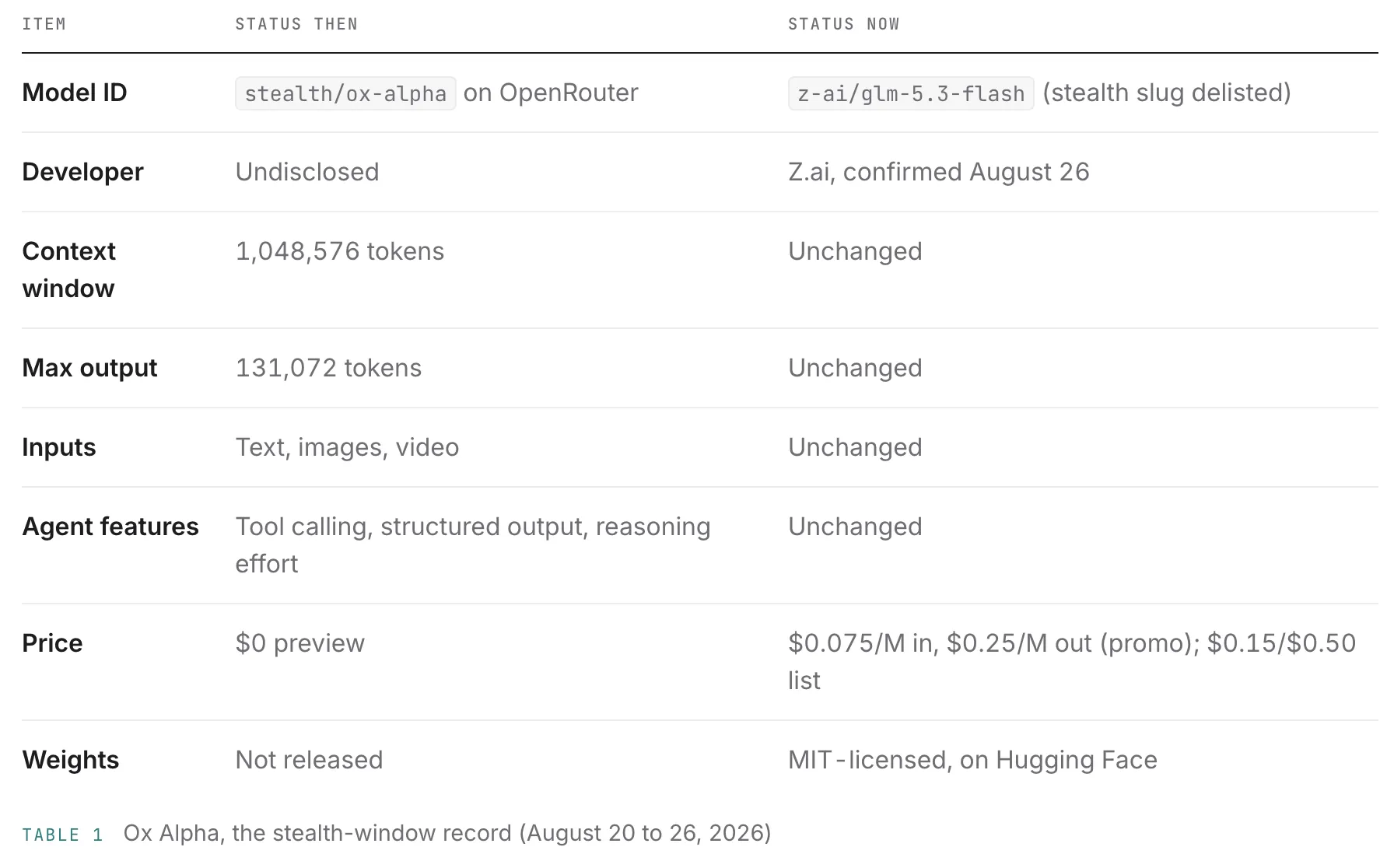
On August 26, Z.ai confirmed to Bloomberg that Ox Alpha is a new iteration of the GLM series and then officially released GLM‑5.3‑Flash. Key specifications disclosed by the company include:
- Parameter scale: 320B total parameters, with only 18B activated parameters (MoE architecture).
- Architectural innovations: The first open‑source cutting‑edge model to adopt a hybrid sparse and linear attention architecture, reducing attention computation and KV cache by approximately 3.01x and 4.44x respectively, significantly lowering the cost of long‑context serving.
- Multimodal: The first native multimodal model in the GLM‑5 series, supporting text, image and video inputs.
- Performance: Outperforms the larger‑parameter GLM‑5.2 on multiple encoding and agent benchmarks, approaching Claude Opus 4.8 level; in comprehensive evaluations such as the Artificial Analysis Intelligence Index, its performance reached the global cutting‑edge range.
- Pricing: Official API pricing is about 1/10 of GLM‑5.3 (with time‑limited discounts even lower), emphasizing extreme cost‑effectiveness.
- Compute: All inference traffic during testing was supported by domestic AI chips.
Z.ai said the stealth testing aimed to collect real user feedback, and peak traffic was handled entirely by domestic chips, showcasing software‑hardware collaborative capability.
Technical and Market Background
GLM‑5.3‑Flash continues Z.ai's path of efficient MoE and post‑training optimizations, using a leaner activated parameter set and mixed attention design to greatly reduce inference costs while maintaining strong intelligence. Compared with the previously released text‑focused GLM‑5.3, the Flash version fills in native multimodal capabilities and is optimized for agents, office tasks and long‑range tasks. The MIT open‑source license further lowers the barrier for enterprises and developers.
This release comes as domestic large models continue to push in the open‑source and cost‑performance lanes, forming differentiated competition with vendors like DeepSeek.
Potential Impacts: Dual Demonstration of Stealth Strategy and Efficient Open‑Sourcing
1. Impact on developers and the open‑source ecosystem
After official open‑sourcing, developers can download the weights for local deployment or secondary development. Million‑level context and multimodal support make it suitable for long‑document analysis, video understanding and complex agent workflows. Its very low‑cost positioning is likely to accelerate adoption among SMEs and individual developers.
2. Impact on the domestic model competitive landscape
The stealth viral success of Ox Alpha demonstrates the effectiveness of a "test‑first" strategy: free, high‑spec testing quickly accumulates real load and reputation, so the product already has market heat at official launch. Domestic chips supporting high concurrency throughout also strengthen industry confidence in independent compute. Z.ai achieving stronger performance with smaller activated parameters further validates the "efficiency‑first" route.
3. Impact on industry release paradigms
Anonymous testing is becoming a choice for more labs, allowing them to avoid early expectation‑management risks while obtaining real user data. Aggregation platforms like OpenRouter played a key distribution role and saw their own value further highlighted.
4. Potential challenges and observation points
- User retention and actual production performance after formal pricing still need continuous verification.
- The community ecosystem building around the open weights and the speed of subsequent iterations will determine long‑term influence.
- Gaps with leading closed‑source international models in complex reasoning and safety remain a focus.
Industry Takeaway: A Full Loop from Stealth Testing to Open‑Source Delivery
The transition from Ox Alpha to GLM‑5.3‑Flash demonstrates a mature path for domestic large models from "stealth trials" to formal open‑sourcing. The combination of efficient architecture, added multimodal capability, domestic compute support and extreme cost‑performance makes it not only a model upgrade but a strong response to the trend of "achieving stronger intelligence with fewer resources."
For the entire open‑source AI ecosystem, this event reinforces the value of transparent testing and community feedback. With weights public and APIs launched, GLM‑5.3‑Flash could become an important option for developers in efficient multimodal scenarios and encourage more labs to explore similar release and optimization strategies.
Z.ai closed its "mystery test" successfully and officially opened a new multimodal chapter for the GLM‑5 series. Subsequent real‑world performance and ecosystem building will determine whether it can continue to hold a top position in efficient open‑source models.
▶️ Like this article? Creating takes a lot of effort!
Follow our YouTube channel:
AI Rosetta
Your likes, subscriptions and shares are our greatest support!🙏
More AI news at: https://www.airosetta.com