
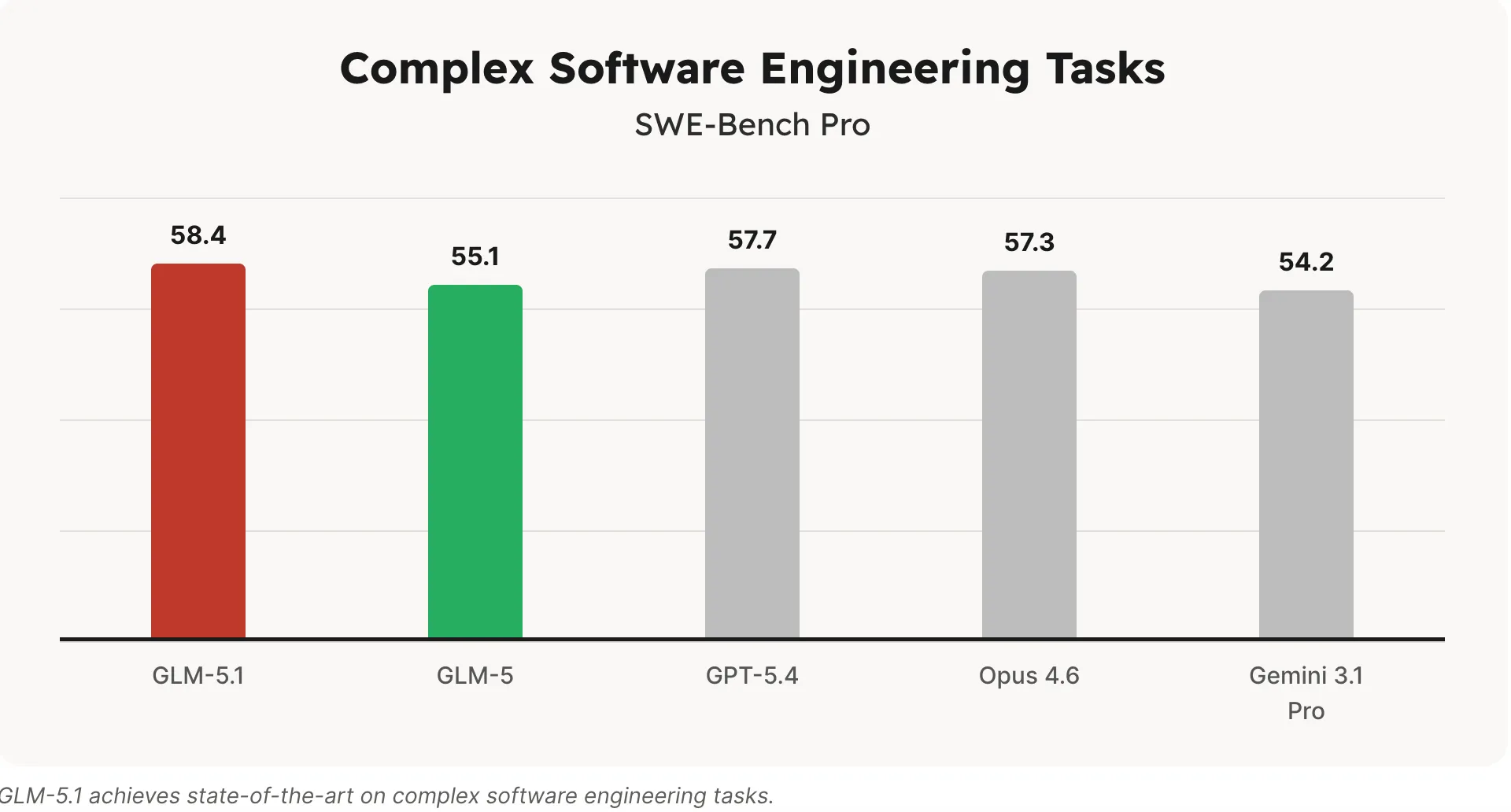
On April 7, 2026, Zhipu AI officially released and open‑sourced its new flagship model GLM‑5.1. The model achieved a global top score of 58.4 on SWE‑Bench Pro, a benchmark dubbed the “touchstone for software engineering capability,” surpassing Claude Opus 4.6's 57.3 and GPT‑5.4's 57.7. It is the first open‑source model to outperform current closed‑source top models on this core coding metric. In the Claude Code coding evaluation, GLM‑5.1 scored 45.3, trailing Opus 4.6's 47.9 by 2.6 points (94.6%). The result quickly sparked discussion across the global AI community and is seen as a landmark instance of Chinese open‑source AI achieving a “corner overtaking” in coding capability.
GLM‑5.1 is fully open‑sourced under the MIT license, and model weights are publicly available for download on Hugging Face and ModelScope, with support for local deployment on mainstream inference frameworks such as vLLM and SGLang. This allows developers, companies and researchers to freely download, fine‑tune and commercialize the model without paying high API fees. Zhipu AI says GLM‑5.1 is designed for "agentic engineering" and long‑horizon tasks, aiming to enable open‑source models to compete directly with leading closed‑source models.
Technical details: efficient architecture and long‑range capability breakthroughs
The core highlight of GLM‑5.1 is its MoE (Mixture of Experts) architecture with 744B total parameters and 40B active parameters, combined with the DeepSeek Sparse Attention mechanism, which significantly reduces inference cost while preserving long‑context capability. The model supports a 200K context length and 128K output length, and includes advanced features such as a thinking mode, real‑time streaming output, function calls, context caching and structured outputs.
On coding benchmarks, GLM‑5.1 made notable gains:
- SWE‑Bench Pro: 58.4 points, a new global best, surpassing Claude Opus 4.6 (57.3) and GPT‑5.4 (57.7).
- NL2Repo (generating complete code repositories from natural language): 42.7 points, ahead of the previous GLM‑5's 35.9.
- Terminal‑Bench 2.0 (real terminal coding tasks): 56.2 points, demonstrating strong agentic capabilities.
- Claude Code evaluation: 45.3 points, reaching 94.6% of Opus 4.6's score and improving 28% over GLM‑5's 35.4.
These results stem from extensive post‑training optimizations by Zhipu AI, including the asynchronous reinforcement learning infrastructure "slime" and targeted alignment for agentic tasks. GLM‑5.1 performs well on long‑horizon tasks and can operate autonomously for over eight hours, marking an open‑source shift from "vibe coding" to genuine "agentic engineering." The model was entirely trained on Huawei chips, showcasing breakthroughs in China's autonomous compute stack.
Open‑source strategy: from weight release to ecosystem co‑creation
The GLM‑5.1 open‑source release is comprehensive, covering base model weights, distilled models, super‑resolution models, and complete inference code and training scripts. This approach contrasts with the closed or semi‑open models typical for many video and coding models. Zhipu AI says the aim of open‑sourcing is to accelerate community iteration and enable developers to rapidly build vertical applications and agent tools based on GLM‑5.1.
After open‑sourcing, GLM‑5.1 is compatible with major agent frameworks such as Claude Code and OpenClaw, enabling seamless migration for developers. Community feedback indicates very high cost‑effectiveness in local deployment scenarios, with inference costs far below comparable closed‑source models, offering small and medium enterprises and individual developers a high‑performance coding tool option.
Far‑reaching impact: open‑source AI coding capability approaches closed‑source, reshaping the global landscape
The release and open‑sourcing of GLM‑5.1 have multiple far‑reaching impacts on the global AI ecosystem:
- Open‑source models' coding capability nears closed‑source top levels for the first time: Previously, open‑source models lagged closed‑source models by more than 10 points on engineering benchmarks like SWE‑Bench Pro. GLM‑5.1's 58.4 not only sets a new open‑source record but actually overtakes closed‑source models on practical software engineering tasks, showing that an efficient MoE architecture plus targeted post‑training can reach front‑line closed‑source performance within a controlled parameter budget. This greatly boosts confidence in the open‑source community and supports the "small beats big" trajectory promoted by Chinese AI development.
- Accelerates restructuring of AI coding tool ecosystems: With open‑sourcing, GLM‑5.1 is expected to be quickly integrated into agent frameworks such as OpenClaw, Cline and Aider, driving the evolution of AI coding from "assistive completion" to "autonomous engineering." Developers can run high‑performance coding models locally, significantly reducing reliance on closed‑source APIs while improving data privacy and customization.
- Enhances China's AI competitiveness internationally: GLM‑5.1 was trained entirely on Huawei chips, demonstrating China's model development capability under an autonomous compute stack. This achievement further consolidates China's leadership in open‑source AI and provides a cost‑effective alternative for global developers, potentially attracting more international teams to participate in ecosystem co‑creation.
- Pressure on closed‑source giants: Closed‑source models such as Anthropic's Claude Opus 4.6 and OpenAI's GPT series now face direct competition from high‑performance open‑source models. Closed‑source vendors may need to further improve capabilities or adjust pricing to maintain an edge.
Challenges and outlook
Despite impressive results, GLM‑5.1 as a new model still has room for optimization in extremely long contexts, complex multilingual tasks and long‑term stability. After open‑sourcing, balancing community contributions with commercialization and addressing potential safety risks will be new challenges for Zhipu AI.
The open‑sourcing and high performance of GLM‑5.1 represent not only a technical breakthrough for Zhipu AI but also a major milestone in the 2026 open‑source AI wave. It demonstrates that with autonomous compute, data accumulation and engineering optimization working together, open‑source models can match or even surpass closed‑source frontiers on key benchmarks. This event may accelerate a global shift from "closed‑source dominance" toward a coexistence of "open‑source ubiquity + high‑end competition."
Going forward, as the GLM‑5.1 community iteration accelerates and larger‑scale versions are released, Chinese AI products are expected to continue leading in coding and agentic engineering fields. The open‑sourcing of GLM‑5.1 not only delivers tangible tool benefits to developers but also injects new vitality and possibilities into the global AI ecosystem.
▶️ Enjoyed this article? Creating content is hard work!
Follow our YouTube channel:
AI Rosetta
Your likes, subscriptions and shares are our greatest support! 🙏
More AI news at: https://www.airosetta.com