
Introduction
On January 20, 2026, Chinese AI company Zhipu AI officially released and open‑sourced its next‑generation lightweight large language model GLM‑4.7‑Flash, and announced a free API on Zhipu's BigModel.cn platform. The move quickly sparked discussion in the developer community and has been described as a candidate for a “truly free code model API” and the “ultimate local AI coding assistant guide.” The model has 30B total parameters and only 3B activated parameters at inference (A3B). It adopts a Mixture of Experts (MoE) architecture and a Multi‑head Latent Attention (MLA) mechanism, achieving both performance and efficiency gains among its peers. GLM‑4.7‑Flash will progressively replace the previous free model GLM‑4.5‑Flash (which will be retired on January 30; requests will be migrated automatically), providing developers with a low‑barrier, high‑performance cloud+local hybrid solution. Official announcements and multiple media reports confirm this release as an important iteration following the GLM‑4 series, aimed at shifting AI from a “parameter race” toward “efficiency‑first.”
Model Architecture and Key Highlights
GLM‑4.7‑Flash uses a MoE (Mixture of Experts) architecture with 30B total parameters and only 3B activated parameters during inference, greatly reducing compute requirements. A key innovation is the first‑time introduction of Multi‑head Latent Attention (MLA)—an approach previously validated by DeepSeek‑v2 and now adopted and optimized by Zhipu to significantly improve inference efficiency and long‑context stability. The model supports a 200K‑token context window, is compatible with mainstream inference frameworks such as vLLM and SGLang, and has been adapted to Huawei Ascend NPU. Quantized versions (4‑bit/8‑bit) are also released to facilitate deployment on consumer hardware.
The official positioning is a “same‑tier SOTA lightweight model” optimized specifically for local coding, agent assistants, and coding tasks, while also supporting general tasks such as Chinese writing, translation, long‑text processing, sentiment/role‑play. Zhipu emphasizes that the model is not a simple “shrunken version,” but rather leverages architectural innovations to achieve “small but strong”: maintaining high performance while minimizing inference cost. Developer tests show the model can reach 43 token/s on Apple M5 chips (32GB unified memory), outperforming peers in local performance.
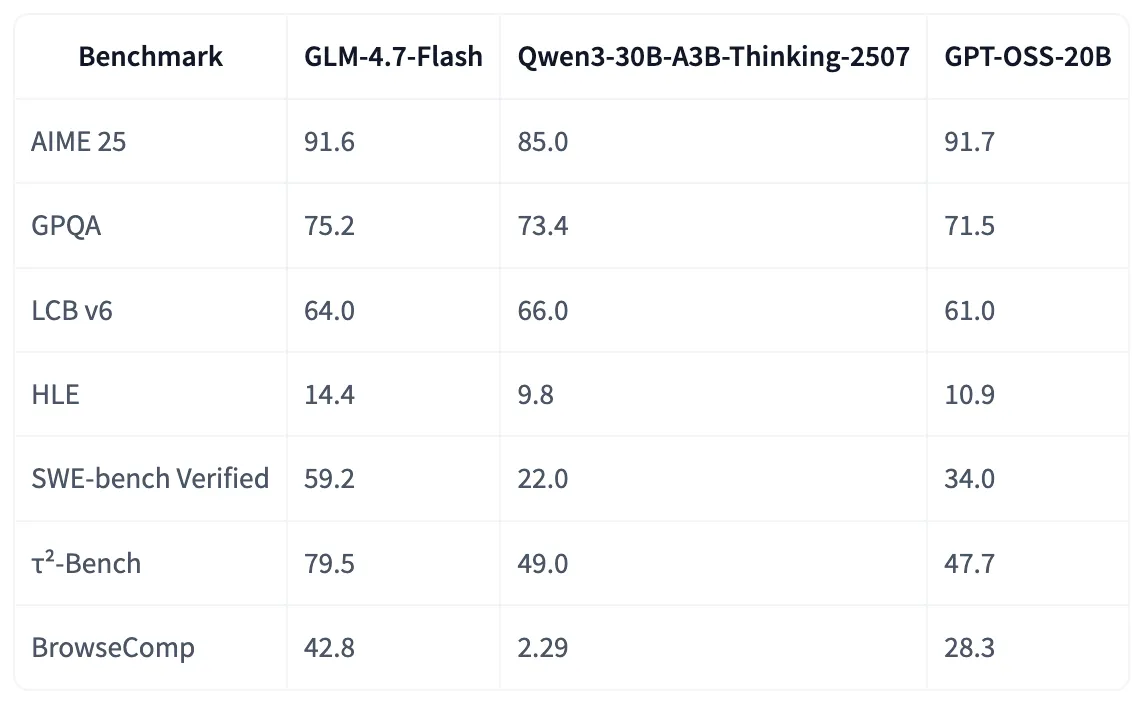
Benchmarks and Community Feedback
GLM‑4.7‑Flash performs well on mainstream benchmarks:
- SWE‑bench Verified: open‑source same‑tier SOTA, surpassing gpt‑oss‑20b and Qwen3‑30B‑A3B‑Thinking‑2507.
- τ²‑Bench: leading composite scores, with strong internal programming results in both front‑end and back‑end tasks.
- Other: balanced performance on Chinese writing, translation, long‑context handling, and role‑play scenarios.
MarkTechPost reported the model “balances performance and efficiency” in lightweight deployment scenarios; community tests show particular strengths in UI generation, tool calling and agentic coding. Pandaily added that GLM‑4.7‑Flash has been integrated into toolchains like Claude Code, Cline, and OpenCode, becoming a low‑cost alternative. Hugging Face and Reddit users noted the model offers the “best experience below 70B,” and that free API access plus open weights greatly lower the entry barrier.
Free API Access and How to Use
Zhipu's BigModel.cn platform offers a free base tier for GLM‑4.7‑Flash (limited to 1 concurrency); a higher‑performance GLM‑4.7‑FlashX is available as a low‑cost paid option. The API is compatible with OpenAI‑style Chat Completions API, supporting streaming responses, tool calls, and more. The official documentation includes a playground, user guides, and API references.
Usage steps (brief):
- Register/login to BigModel.cn and obtain a free API key.
- Python example (compatible with the openai library):
from openai import OpenAI
client = OpenAI(
    api_key="your_api_key",
    base_url="https://open.bigmodel.cn/api/paas/v4"
)
response = client.chat.completions.create(
    model="glm-4.7-flash",
    messages=[{"role": "user", "content": "写一段Python爬虫代码"}],
    stream=True
)
for chunk in response:
    print(chunk.choices[0].delta.content or "", end="")
- Local deployment: download weights from Hugging Face (zai‑org/GLM‑4.7‑Flash) or ModelScope and run with vLLM/SGLang.
GLM‑4.5‑Flash will be retired on January 30; old requests will be migrated automatically to the new model.
Market Significance and Impact
The release of GLM‑4.7‑Flash further consolidates Zhipu's leading position in the Chinese AI ecosystem. The open‑source plus free API strategy greatly reduces barriers for SMEs and individual developers, promoting a shift from “cloud monopoly” toward “local inclusivity.” OSCHINA and Zhihu communities have praised it as a typical example of the engineering trend in AI: lightweight models are better suited for embedding in agents, toolchains and edge devices. Competing with open models such as DeepSeek and Qwen, Zhipu differentiates through the MLA architecture and a free‑access strategy.
Challenges remain: the free tier's concurrency limits may affect high‑frequency use cases, and the community still needs more third‑party benchmarks to confirm long‑term stability. Overall, this release marks a significant breakthrough for China in lightweight, high‑efficiency models and provides global developers a cost‑effective option.
Conclusion
Zhipu AI's GLM‑4.7‑Flash, with a 30B MoE architecture, 200K context window and free API, exemplifies a “small but strong” model. It excels in coding and agent scenarios and, through an open‑source ecosystem, lowers the barrier to AI adoption—pushing the industry toward efficiency and inclusivity. Developers can immediately try it for free at BigModel.cn or deploy locally to explore further potential. With ongoing community optimization and iterations, this model may become the benchmark local AI coding assistant in 2026.
▶️ Enjoy this article? Content creation is hard work!
Please subscribe to our YouTube channel:
AI Rosetta
Your likes, subscriptions and shares are our greatest support! 🙏
More AI news at: https://www.airosetta.com