
After decades of efforts to achieve a truly glasses‑free 3D viewing experience, a China‑originated innovation has emerged: a research team from Shanghai Artificial Intelligence Laboratory and Fudan University has developed the EyeReal system. This AI‑driven glasses‑free 3D display uses only three stacked standard LCD panels and an eye‑tracking sensor to deliver a wide viewing range of over 100 degrees and high‑definition 3D on desktop‑sized screens. The result was published on Dec 3, 2025 in Nature under the title "Glasses‑free 3D display with ultrawide viewing range using deep learning," DOI: 10.1038/s41586‑025‑09752‑y. Lead author Weijie Ma said, "EyeReal maximizes the effective use of available optical information through continual computational optimization, achieving the practical coexistence of large image size and wide field of view within existing physical limits." The breakthrough addresses the display field's "space‑bandwidth product" (SBP) bottleneck and opens new paths for consumer electronics, AR/VR and medical imaging, drawing wide coverage from global tech media. CGTN called the technology "bringing immersive experiences closer to reality," while GIGAZINE emphasized its "convenience without special glasses." In the AI wave of 2025, EyeReal highlights China's global competitiveness in display innovation.
Glasses‑free (autostereoscopic) 3D display concepts date back to the mid‑20th century. Early consumer attempts such as the Nintendo 3DS and some phones attracted attention but were limited by narrow viewing angles (typically <30°) and small screens, preventing wide adoption. The core obstacle is the SBP physical law: spatial resolution (pixel density) and viewing angle trade off against each other—large screens struggle to provide wide viewing angles and vice versa. Prior solutions relied on complex optics like lenticular lenses or gratings, which are costly, prone to distortion, and unable to overcome the SBP limit. A Nature commentary noted that earlier attempts "advanced the field but did not break the trade‑off." EyeReal's innovation is to work within those limits: instead of trying to expand physical capacity, it uses AI to intelligently allocate limited optical resources, precisely projecting the light field to viewers' eyes and avoiding "wasted light." This idea grew from Shanghai AI Lab's computational imaging research combined with Fudan University's display materials expertise. The team emphasizes that deep learning acts as a "light‑field director," computing optimal patterns in real time so the 3D effect adapts as the viewer moves their head.
The EyeReal system's hardware and algorithms are straightforward yet effective. The core hardware is a three‑layer LCD stack: a bottom layer serves as a backlight, a middle layer generates light‑field patterns, and a top layer fine‑tunes pixel modulation. An embedded eye‑tracking sensor (similar to a phone front camera) monitors the viewer's head and eye positions at 60 Hz, ensuring latency <10ms. AI plays a central role: a hybrid model combining convolutional neural networks (CNNs) and Transformers infers binocular gaze from sensor data and then computes the light field—that is, the distribution of ray directions, intensities and colors. Concretely, the AI network inputs the current image x_t and time step t (simulating a noise‑adding process inspired by diffusion models) and outputs an optimized light‑field pattern ε_θ used to inversely reconstruct a clean 3D view x_0. The paper describes a loss function L = E[||x_0 ‑ x_θ(x_t, t)||^2], augmented with a perceptual loss to improve visual fidelity. Unlike traditional approaches, EyeReal requires no additional optical elements (such as holographic plates) and achieves an SBP utilization exceeding 90% through software‑driven iterative optimization. Weijie Ma explained: "AI acts as a precise 'ray scheduler,' aligning limited pixels to the viewer's eyes to create a seemingly boundless view." The system currently supports single‑user mode and can be extended to multiple users via multi‑sensor fusion.
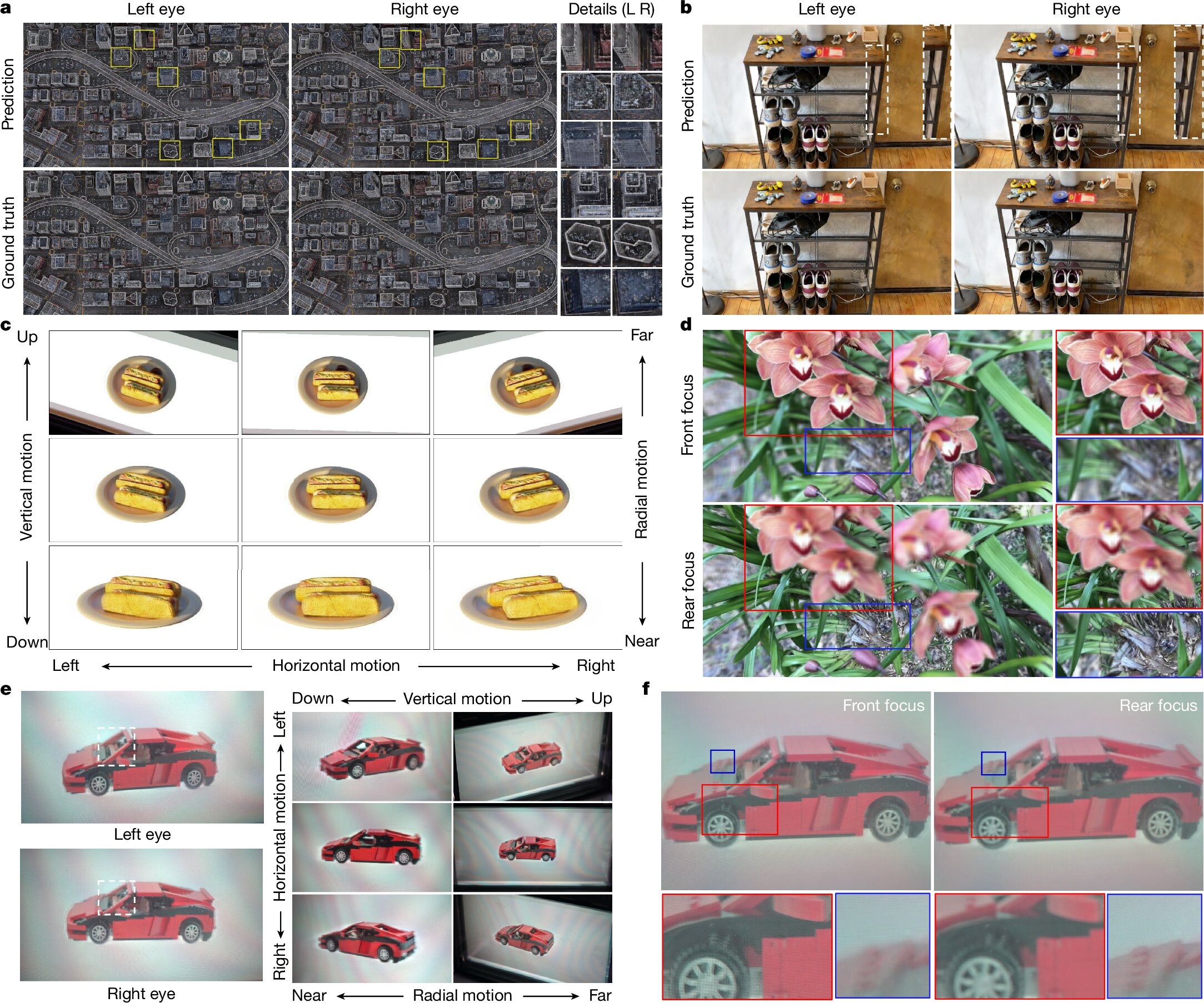
Experimental validation showed EyeReal's advances. The prototype was tested on a desktop‑sized screen (about 24 inches) with computer‑generated scenes (e.g., 3D architectural models) and real photographs (e.g., portraits). Results indicate a field of view exceeding 100° (well above the typical 30–50°), full HD resolution (1920×1080), and support for parallax adjustment—the perceived 3D depth responds in real time as viewers move forward and backward. In qualitative evaluations, participants reported an "immersion comparable to IMAX," with no noticeable distortion or crosstalk. Quantitative metrics included light‑field fidelity (PSNR > 35 dB) and angular consistency (>95%). Compared with baselines under SBP constraints, EyeReal increased imaging size threefold and doubled viewing angle while consuming only about 70% of the power of conventional lenticular displays. The paper's appendix includes multi‑angle video samples that show seamless transitions when viewed from the side, demonstrating the glasses‑free advantage. GIGAZINE noted that "EyeReal concentrates limited optical information at the viewer's eye positions rather than fighting physical limits." The team also tested dynamic scenarios, such as walking viewers, and found that the AI's real‑time adaptation maintained stability.
The breakthrough was achieved by overcoming multiple challenges. The SBP law has long deterred labs from practical solutions; earlier prototypes—such as an MIT 3D cinema screen from 2014—offered wide angles at lab scale but were not commercially viable. EyeReal's AI optimization had to process massive light‑field data (millions of dimensions per frame), and the team used distributed training (based on PyTorch) and edge‑computing compression to reduce latency. Another difficulty is multi‑viewer support: the current single‑user mode relies on precise eye tracking to avoid ghost images. Fudan University plans to integrate multi‑camera setups for multi‑user operation. Cost control is a highlight: prototype hardware is about $500, far below holographic displays that cost tens of thousands of dollars. A Nature commentary (DOI: 10.1038/d41586‑025‑03828‑5) observed that this approach "paves the way for consumer‑grade 3D."
EyeReal's application prospects are broad. In consumer electronics it could upgrade smart TVs and laptops to offer "always‑on 3D" viewing—imagine watching an Avatar sequel at home without glasses and moving freely. E‑commerce livestreams could use 3D product displays to boost conversion rates by over 20%, and medical imaging could benefit from improved depth perception for surgical simulation. In AR/VR, eye‑tracking AI could integrate with devices like Meta Quest to reduce motion sickness. The Brew News reported that "EyeReal's 100° field of view and high resolution make it ideal for consumer tech." The innovation could also accelerate industry upgrades: traditional LCD makers such as BOE or Samsung could adapt quickly, and the market is projected to exceed $50 billion by 2027. Shanghai AI Lab has received national funding, and the Fudan team is pursuing patents. Remaining challenges include optimizing AI computation for power (currently <5W) and addressing privacy concerns in multi‑user scenarios.
Looking ahead, EyeReal could become the "iPhone moment" for 3D displays. Weijie Ma said in an interview, "We are working with companies to commercialize prototypes, targeting a 2026 consumer product." A Phys.org video commented that "EyeReal brings 3D from science fiction into the living room." In the AI era, this Chinese innovation not only loosens physical shackles but also reshapes the visual frontier—the glasses‑free 3D world is approaching.