
In April 2026, Google officially launched the Gemini Notebooks feature, deeply integrating NotebookLM into the Gemini App — a key step in AI's shift from “one‑off conversations” to “persistent personal knowledge bases.” At the same time, Andrej Karpathy shared on X a detailed workflow for building a personal knowledge base using LLM agents + Obsidian. Though arriving by different paths, both point to the same trend: LLMs are evolving from “instant assistants” into “long‑term knowledge partners”, and personal knowledge management and agentic capabilities will be central to LLM development for the foreseeable future.
Gemini Notebooks lets users create dedicated “notebooks” inside the Gemini App to centralize chat histories, files, custom instructions, NotebookLM notes and other resources into a personalized knowledge base. Users can use NotebookLM notes directly as context for Gemini conversations, enabling cross‑app knowledge reuse. Google says the feature is designed as a “personal knowledge database” for complex projects and long‑term research, supporting more upload sources, persistent conversations and cross‑notebook querying. Google AI Ultra, Pro and Plus subscribers can access it first on the web, with mobile and free‑user availability coming in the following weeks.
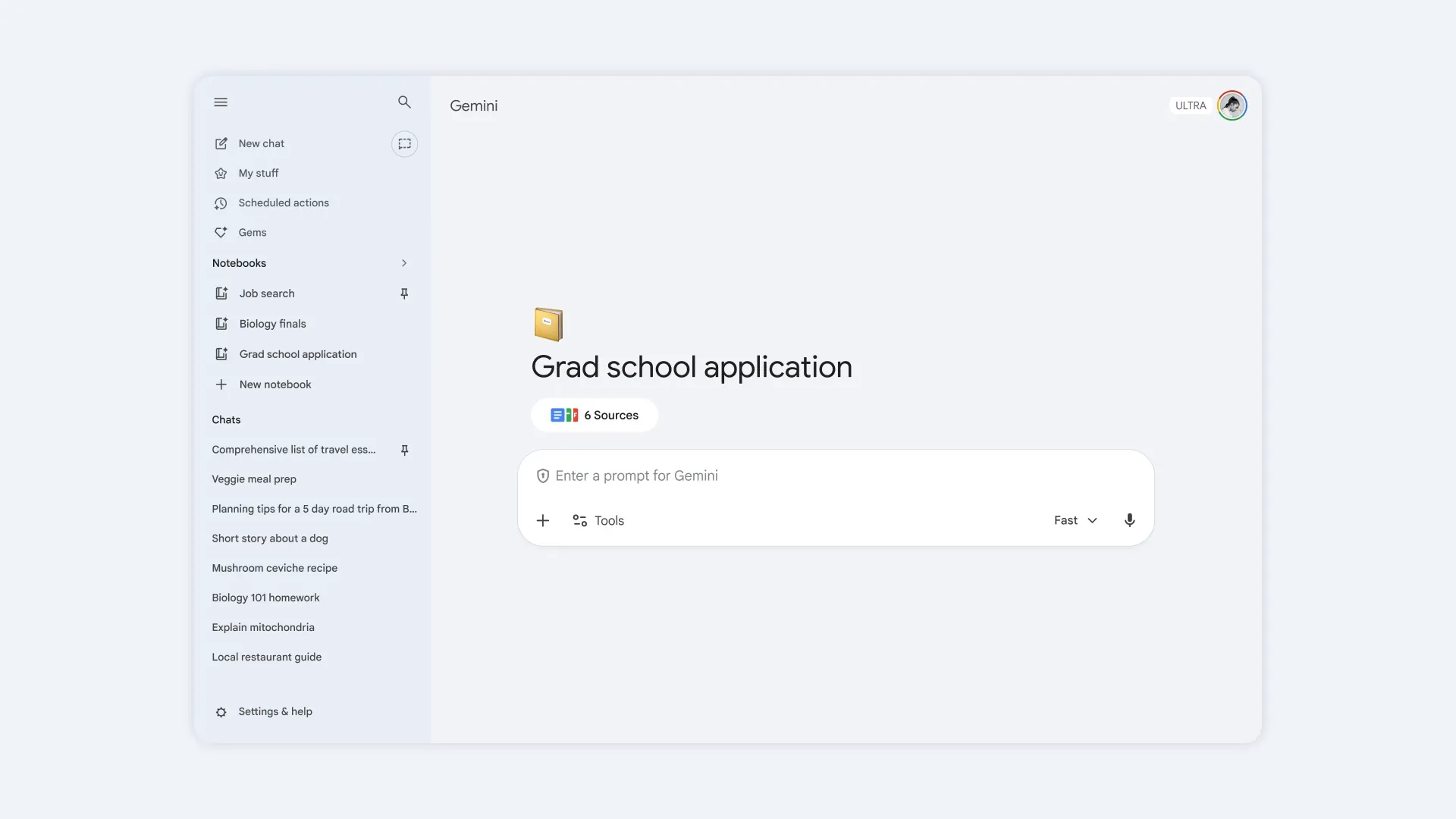
This update directly removes the barrier between NotebookLM and Gemini. NotebookLM, known as an “AI research partner,” can generate summaries, audio overviews and mind maps from user‑uploaded documents; Gemini Notebooks upgrades that capability into a persistent, queryable knowledge store where users can call NotebookLM content for deep analysis and generation tasks. This means AI no longer starts each conversation from scratch but gains “memory” and cumulative context, significantly improving efficiency for long‑term research and productivity scenarios.
Karpathy workflow: Agent + Obsidian to build a self‑maintaining knowledge base
Almost simultaneously, Karpathy detailed his personal knowledge base practice on X. He places raw research materials (papers, web pages, code, images) in a “raw/” directory and uses LLM agents to automatically “compile” them into a structured Markdown wiki. The wiki contains document summaries, backlinks, concept categorization and topical articles, and it automatically maintains indices and interlinks. Karpathy uses Obsidian as the frontend IDE to view raw data, the compiled wiki and derivative visualizations (slides, charts, etc.).
The whole process is highly automated: LLM agents read instructions, modify code, run experiments, evaluate results and archive new knowledge back into the wiki, achieving “knowledge compounding.” Karpathy emphasizes that this approach bypasses complex RAG workflows; at a scale of about 100 articles and 400,000 words, LLMs can efficiently handle complex queries without an additional vector database. The core tools in this workflow include agent frameworks such as Claude Code, with humans setting direction while the AI executes, maintains and iterates.
Shared trend: from “conversations” to “persistent knowledge partners”
Although Gemini Notebooks and Karpathy's workflow come from different approaches, both indicate the same direction: LLMs are upgrading from disposable chat tools to persistent, evolvable personal knowledge management systems. The former relies on Google's cloud infrastructure for cross‑app knowledge sync, while the latter achieves highly personalized, self‑maintaining knowledge bases through local Agent+Obsidian setups. Both address the traditional LLM problem of “context forgetting,” enabling AI to have long‑term memory and knowledge accumulation.
This trend is no accident. Between 2025 and 2026, discussion in the AI community around “personal knowledge bases,” “long‑term memory” and “agentic knowledge management” surged. The popularity of NotebookLM, Karpathy's public practices, and multiple vendors adding “Projects” or “Notebooks” features all suggest personal knowledge management is becoming a key track for the next phase of LLMs. It not only increases user stickiness and productivity but also lays the foundation for more complex agentic and embodied intelligence applications — only when AI has reliable, persistent knowledge stores can it truly plan autonomously, perform multi‑step reasoning and carry out long‑term tasks.
Strategic impacts on LLM development
This trend has strategic implications for LLM development:
- Technical: It drives models from “stateless chat” toward “stateful knowledge systems.” Future LLMs will need better support for persistent context, knowledge graph construction and adaptive updates; RAG, agents and memory management will become standard components.
- Product: Major vendors are accelerating deployments. Google links NotebookLM through Gemini Notebooks, OpenAI is iterating Projects, and Anthropic's Claude Managed Agents focuses on hosted agent workflows. Personal knowledge bases will become a core competitive advantage for AI assistants.
- Ecosystem: New developer tools will emerge. Karpathy's workflow has inspired community development of more Obsidian+LLM plugins, while Gemini Notebooks lowers the barrier for enterprises to build internal knowledge stores. Open‑source and commercial products will be complementary, fostering a thriving AI knowledge management ecosystem.
- User impact: Ordinary users' research, learning and work efficiency will improve significantly. AI will no longer be a “temporary assistant” but a “long‑term partner,” enabling true knowledge compounding.
Of course, challenges remain: data privacy, knowledge accuracy and long‑term maintenance costs need to be addressed. But overall, personal knowledge bases and agentic capabilities have become one of the key focus areas for LLM development in the near term. This shift is not just a technical upgrade but a crucial step in AI's transformation from “tool” to “cognitive partner.”
From Gemini Notebooks' cloud integration to Karpathy's local agent practices, both map out the next growth point for LLMs: enabling AI to truly “remember” and “manage” a user's knowledge world. In this wave, whoever best balances usability, privacy protection and intelligent depth will lead the personal productivity track. The era of AI knowledge management has quietly begun.
▶️ Enjoy this article? Creating it is hard work!
Subscribe to our YouTube channel:
AI Rosetta
Your likes, subscriptions and shares are our greatest support! 🙏
More AI news at: https://www.airosetta.com