
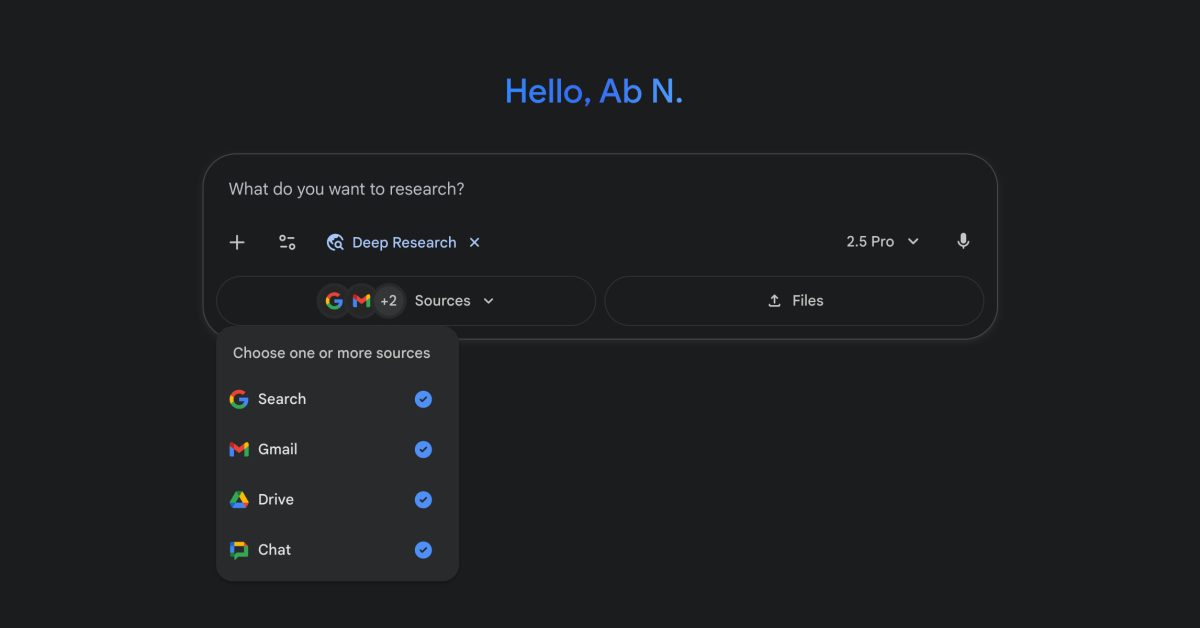
November 5, 2025, 9to5Google reported that Google’s Gemini Deep Research, after adding PDF support in May 2025, has been further expanded to directly access Gmail messages, Google Chat conversations, and files in Google Drive with the user's consent.
The feature is not enabled automatically: when using Deep Research, the interface will present a permission prompt showing the scopes requested, such as reading specific messages, viewing a Drive folder, or accessing chat history. Only after the user grants access via OAuth can the model reference these private data to generate answers or perform document analysis.
9to5Google's report emphasized several typical use cases: generating summaries based on email attachments, extracting key points from multiple Drive documents to produce briefing materials, or using Chat conversation context to provide more coherent recommendations. For content creators and professionals, this means the model can offer more specific writing advice or decision support based on "information you already have" without manual file uploads.
At the same time, the report noted that visibility of permissions and the ability to revoke them are core concerns. Google’s implementation will list granted access in account security and privacy settings, and users can revoke Deep Research access at any time. Privacy researchers and corporate security teams are focused on balancing convenience with data minimization and preventing permission abuse in third‑party extension or integration scenarios.
From a product rhythm perspective, Deep Research has gradually expanded supported data types since May (starting with PDFs) and in November connected email and cloud files, reflecting Google’s strategy to combine large‑model capabilities with personal and enterprise data: supporting structured documents first, then introducing real‑time conversation and email context, progressively turning "models that can read user files" into a controllable tool.
For a broad user base, this change has two effects: on one hand, it enables faster consolidation of scattered content in Gmail and Drive into usable outputs with fewer steps — for example, synthesizing course notes, project emails, and presentation fragments into an outline; on the other hand, it requires users to spend a few minutes confirming permission scopes before use to avoid exposing long‑term sensitive content to features they may not fully understand.
9to5Google's report did not indicate the feature is widely rolled out to all accounts and suggests it is still being pushed in stages or limited by product tiers (such as premium subscriptions or testing channels). The report advises businesses and individual users to check account permission management interfaces and read permission descriptions before enabling new features.
This update marks another step in Gemini Deep Research's deeper integration with personal cloud content: it shifts the model's role from passive Q&A to directly analyzing and generating from users' existing materials, while foregrounding users' privacy and authorization choices. For efficiency‑seeking young professionals, choosing between convenience and security will become a recurring topic in the months ahead.