
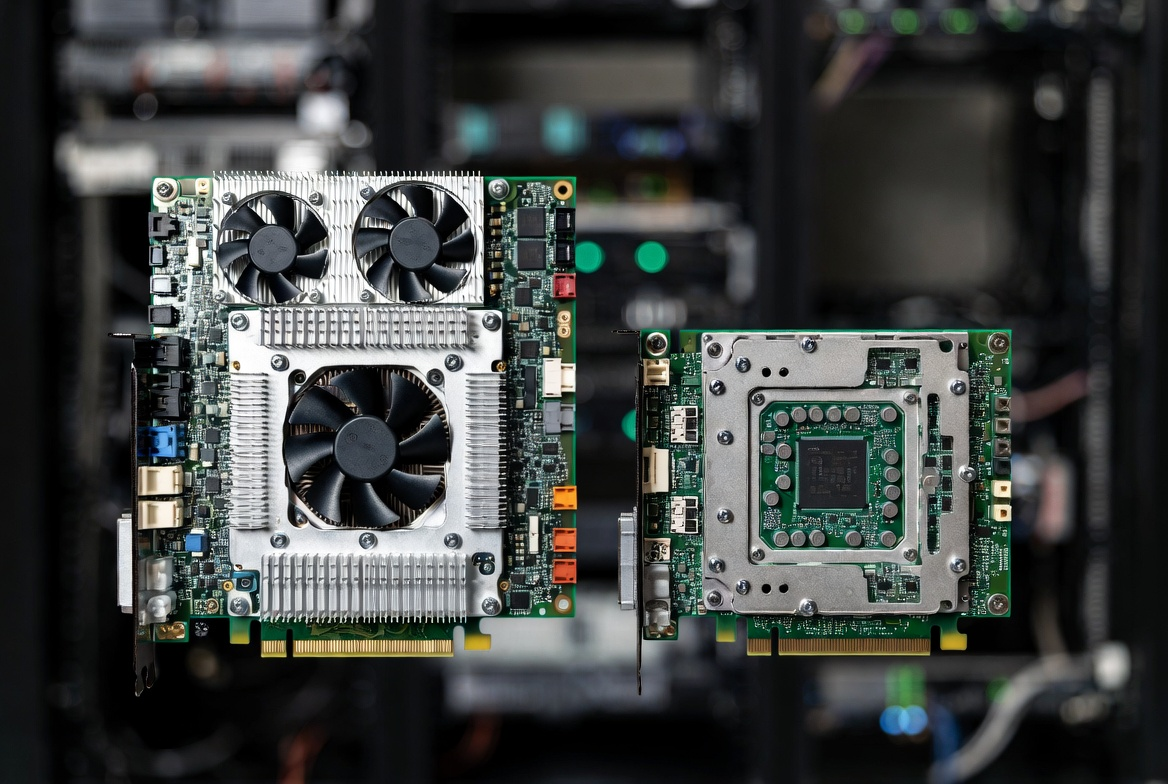
In November 2025, with the striking debut of Google’s multimodal AI model Gemini 3, the long‑running rivalry in AI hardware — NVIDIA‑led GPUs (Graphics Processing Units) versus Google’s TPUs (Tensor Processing Units) — heated up again. Gemini 3, one of the world’s leading large language models, was trained entirely on TPU v7 (codename Ironwood), not only setting new multilingual understanding and reasoning benchmarks but achieving this feat with lower cost and energy consumption. This event highlighted TPU’s potential in AI training and inference, challenging NVIDIA’s decade‑long dominance. According to a SemiAnalysis report, Gemini 3’s success "proved TPU’s absolute competitiveness in large model training," and short‑term fluctuations in NVIDIA’s stock reflected market sensitivity to this "TPU moment." This article draws on authoritative sources, including Google’s official blog, Seeking Alpha analysis and CNBC hardware reviews, to provide a comprehensive comparison of GPUs and TPUs and a deep analysis of future directions.
1. Comprehensive comparison: architecture, performance and ecosystem
Although GPUs and TPUs are both AI accelerators, they follow different design philosophies: GPUs originated in graphics rendering and evolved into general‑purpose parallel compute platforms; TPUs were designed from the outset specifically for deep learning tensor operations. This difference became increasingly apparent in the Gemini 3 era, with the latter fully leveraging TPU matrix multiplication optimizations to reduce training time by over 20%. The following compares multiple dimensions (data based on 2025 benchmarks from sources including CloudOptimo and Forbes):
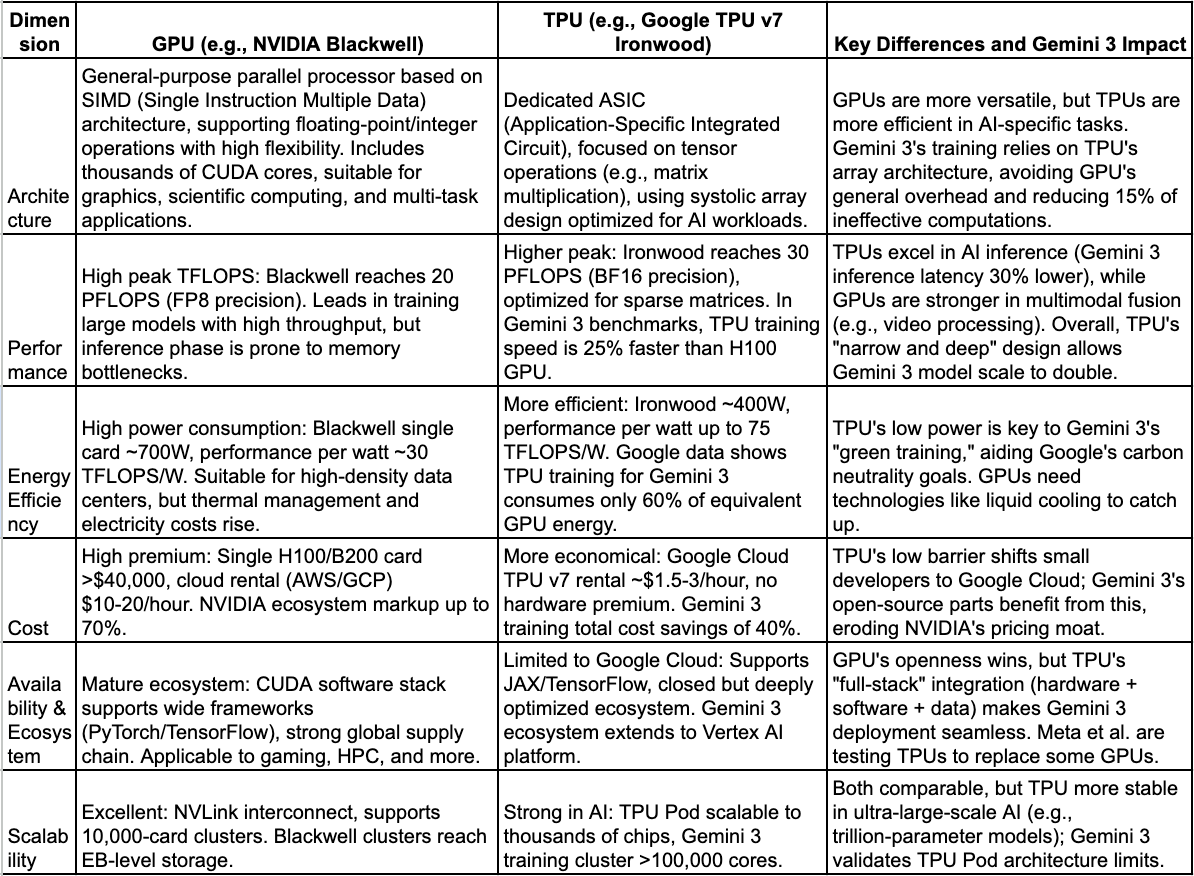
As the table shows, GPUs’ "jack‑of‑all‑trades" nature still accounted for more than 70% of AI infrastructure in 2025, but TPUs are eroding share in pure AI scenarios due to better cost‑effectiveness. In Hacker News discussions, former Google engineer Jaak noted: "TPUs are not replacing GPUs; they target NVIDIA’s pricing pain points and offer an ‘AI‑specialized’ alternative." Gemini 3’s release widened this gap further: its multimodal capabilities (text+image+video) trained on TPUs required only two‑thirds of the time of traditional GPU clusters.
2. In‑depth analysis: competitive landscape under Gemini 3
TPU training success for Gemini 3 is not an isolated case but the culmination of Google’s decade‑long strategy. Since the first TPU in 2015, TPUs have evolved to v7, focusing on the full stack from training to inference. By contrast, NVIDIA’s GPUs, despite integrating more AI acceleration (such as the Transformer Engine) in the Blackwell architecture, remain general‑purpose, which some argue is "overkill" for Gemini‑scale models. Seeking Alpha suggests Alphabet (Google’s parent company) leveraging the TPU ecosystem is positioning itself toward a $4 trillion market cap, and NVIDIA should beware the risk of hardware commoditization.
However, the contest is not zero‑sum. Forbes reports that Google itself adopts a "two‑track strategy": using NVIDIA GPUs for flexible tasks (such as edge computing) while TPUs focus on core training. This reflects an "hybrid future" for AI hardware — although Gemini 3 was trained exclusively on TPUs, its inference deployment may be cross‑platform. CNBC evaluations show the rise of AWS Trainium and Google TPU is forcing NVIDIA to shift from "monopolist" to "ecosystem custodian," maintaining leadership through software updates (such as CUDA 12.x).
Challenges remain: TPU’s closed ecosystem limits third‑party adoption; although Gemini 3 open‑sourced model weights, hardware remains tied to Google Cloud; GPUs face supply‑chain bottlenecks (such as TSMC capacity) and geopolitical risks (US‑China trade). Tom's Hardware notes Meta’s exploration of TPUs indicates interest, but NVIDIA responded: "No one can match our platform’s ecosystem."
3. Future trajectory: specialization wave and ecosystem convergence
Looking beyond 2025, the GPU–TPU contest will shift from a "performance arms race" to competition over "ecosystem and sustainability." A WTW report forecasts that as AI shifts from training (accounting for 80% of computation) to inference (expected to reach 60% by 2028), specialized chips like TPUs will dominate the market: their energy‑efficiency advantages could reduce global data center carbon emissions by 20%. Trio Dev’s AI hardware trend analysis indicates that 2025 will see innovations like neuromorphic computing and photonic TPUs, and Google may release a v8 that integrates quantum assistance to overcome the trillion‑parameter barrier for Gemini 4.
NVIDIA will not remain idle: after Blackwell, its Rubin architecture (2026) will emphasize an "AI factory" model combined with software‑as‑a‑service (SaaS) to counter TPU’s cloud lock‑in. Tailscale forecasts future trends including:
- Specialization acceleration: more ASICs such as AWS Trainium and Qualcomm AI chips will emerge; TPU share may rise from 15% to 30%, challenging NVIDIA’s 85% dominance.
- Hybrid and open‑source: Gemini 3 will drive cross‑hardware frameworks (such as ONNX); GPU+TPU clusters will become standard, lowering switching costs.
- Sustainability and regulation: EU AI rules will favor low‑power TPUs, forcing GPUs to optimize for greener designs. The global AI hardware market is expected to reach $500 billion, with energy efficiency becoming a new KPI.
- Geopolitical impact: under US–China decoupling, TPU’s "US‑aligned" supply‑chain advantages stand out, while NVIDIA’s global distribution remains more robust.
Overall, TPUs represent the future of vertical integration, while GPUs defend horizontal scalability. Gemini 3 acted as a catalyst, signaling that AI hardware will move from a "GPU era" to a "multi‑ecosystem era" — winners will not be sole but those balancing cost, innovation and inclusivity. Capital markets have already reacted: investor attention has shifted toward Alphabet, and NVIDIA must accelerate transformation to continue its legacy.