
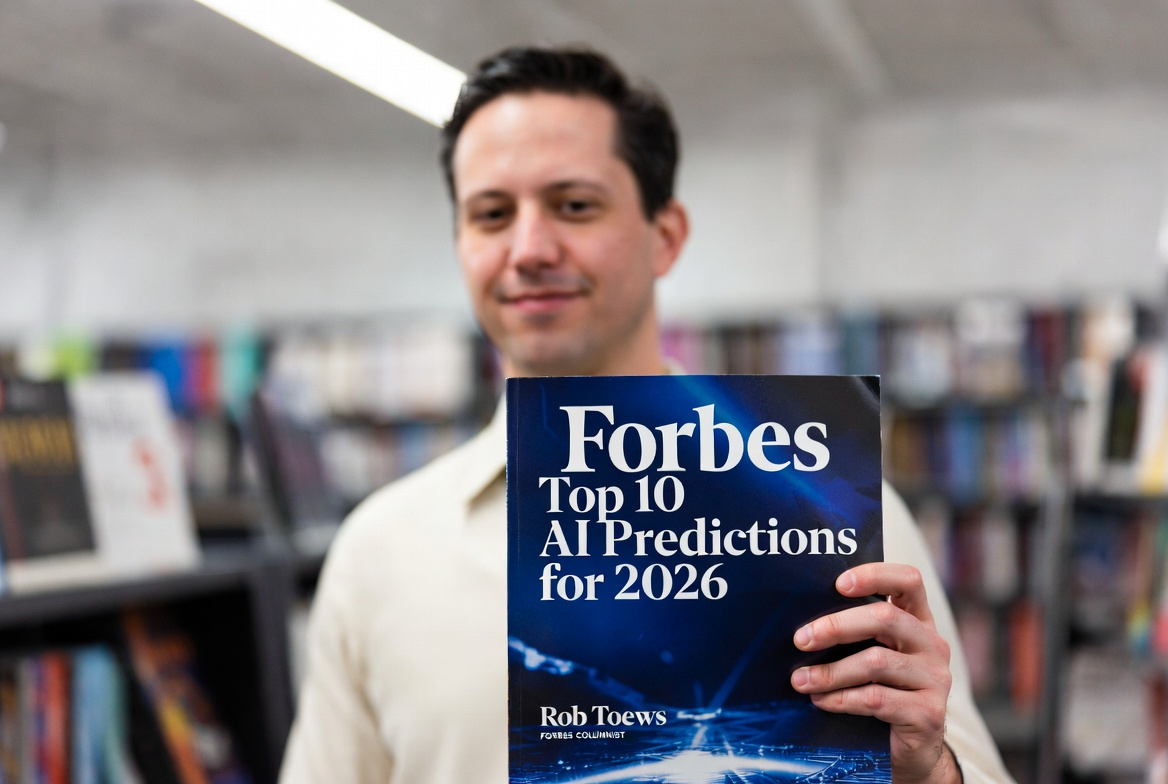
On December 22, 2025, Forbes columnist and venture capitalist Rob Toews published his annual major piece, "10 AI Predictions For 2026." A well‑known observer in the AI field, Toews offers bold and penetrating perspectives on the technical, commercial, and geopolitical trajectories for AI in 2026. His predictions cover IPO dynamics among leading AI labs, chip competition, a cooling of AGI debate, infrastructure challenges, and breakout areas, sketching a shift from rapid expansion toward maturation in the AI industry. Below is a brief interpretation of the ten predictions.
Prediction 1: Anthropic will go public; OpenAI will not.
Toews argues that both Anthropic and OpenAI face enormous capital needs as fast‑growing AI labs. He cites Anthropic's revenue jumping from $1 billion to $9 billion in 2025 and OpenAI's growth from $6 billion to $20 billion. Market enthusiasm for AI will push Anthropic toward an accelerated IPO process—it has reportedly hired specialist lawyers and a former Airbnb CFO—and could become one of the largest IPOs in history. OpenAI, under Sam Altman, is portrayed as more adept at private fundraising (valuation possibly reaching $750 billion) and is diversifying into hardware and robotics; its complex structure and regulatory pressures will likely delay a public listing.
Prediction 2: Research and technical details from Safe Superintelligence (SSI) will leak, forcing major labs to revise roadmaps.
Founded by former OpenAI chief scientist Ilya Sutskever, SSI is known for extreme secrecy. Toews predicts that in 2026 its research details will become public, potentially revealing innovation paths beyond the current large‑model paradigm (such as recursive self‑improvement or continual learning), which would compel giants like OpenAI, Anthropic, and Google DeepMind to adjust their R&D strategies.
Prediction 3: China's domestic AI chip industry will make major advances, sowing seeds for a decline in Nvidia's global dominance.
U.S. export controls have accelerated China's chip self‑sufficiency. Government investment of $70 billion is supporting companies such as Huawei and Cambricon. By 2026 Chinese chips will show significant progress—not necessarily full catch‑up, but enough to demonstrate a credible narrowing of the gap and a long‑term threat to Nvidia's monopoly.
Prediction 4: AGI and superintelligence discussions will become less fashionable.
Hype around AGI in 2025 (for example, claims of near‑term human‑level AI) is cooling as model improvements become more incremental. Toews expects the industry focus in 2026 to shift toward enterprise applications, geopolitics, and employment impacts; AGI will be discussed less prominently, though not disappear entirely.
Prediction 5: Depreciation schedules (an accounting concept) will become a key issue for AI infrastructure.
AI infrastructure requires huge investment (estimated $3.25 trillion in 2025, rising to $67 trillion by 2030), with chips accounting for about half the cost. Traditional five‑year depreciation no longer fits; next‑generation chips iterate so rapidly that a 1–2 year depreciation schedule may be appropriate, materially affecting profit and loss statements and amplifying debt risk. In 2026 this accounting detail will spark intense debate and could even trigger "impairment bombs."
Prediction 6: More AI companies will start designing custom chips.
The reliance on general‑purpose chips from suppliers like Nvidia will shift. As AI moves into the physical world (e.g., robots, glasses), custom chips can optimize efficiency and cost. OpenAI has partnered with Broadcom, and reinforcement learning will accelerate chip design. Toews predicts 2026 will be the year many companies launch custom‑chip initiatives.
Prediction 7: Sam Altman will step down as OpenAI CEO.
OpenAI's dominance is under strain and business expansion (into hardware and brain–computer interfaces) is distracting focus. Facing pressure from an Anthropic IPO, a public offering would require more specialized leadership. Toews forecasts an orderly transition in which Altman may hand over the CEO role—potentially to current consumer‑app CEO Fidji Simo—and move into research or other projects.
Prediction 8: AI will become a central issue in the 2026 U.S. midterm elections, complicating politics.
The midterms will involve jobs, security, and energy. AI could displace an estimated 11.7% of the workforce, fueling populist reactions. Republicans will emphasize deregulation and competition with China, while Democrats will stress regulation and social impact; job losses will entangle both parties' positions.
Prediction 9: A global pharmaceutical giant will acquire a leading protein‑AI startup.
Protein‑AI breakthroughs in 2025 (for example, Chai Discovery and Latent Labs generating high‑quality antibodies) could expand the antibody market from $250 billion to $750 billion. Pharma companies will pursue acquisitions to integrate technology and talent; a wave of M&A is expected in 2026, potentially involving giants such as AbbVie or AstraZeneca.
Prediction 10: Brain–computer interfaces will move from a niche field to mainstream technology, threatening Neuralink's lead.
In 2026 brain–computer interfaces will attract mainstream investment and attention. Non‑invasive technologies (like ultrasound and EEG) will advance rapidly, while the invasive space will see challengers—many founded by former Neuralink team members, such as Precision Neuroscience. Although Neuralink is well funded, increased competition will erode its advantage.
Toews's predictions reflect a shift in the AI industry from "frenetic expansion" to "pragmatic deployment": commercial pressures, geopolitical competition, infrastructure bottlenecks, and technological divergence will set the tone. While bold, these forecasts are persuasive given current trends. AI will continue to reshape the world in 2026, but the path will be more tortuous and realistic.
▶️ Enjoy this piece? Creating it takes real effort!
Subscribe to our YouTube channel:
AI Rosetta
Your likes, subscriptions, and shares are our greatest support! 🙏
For more AI news visit: https://www.airosetta.com