

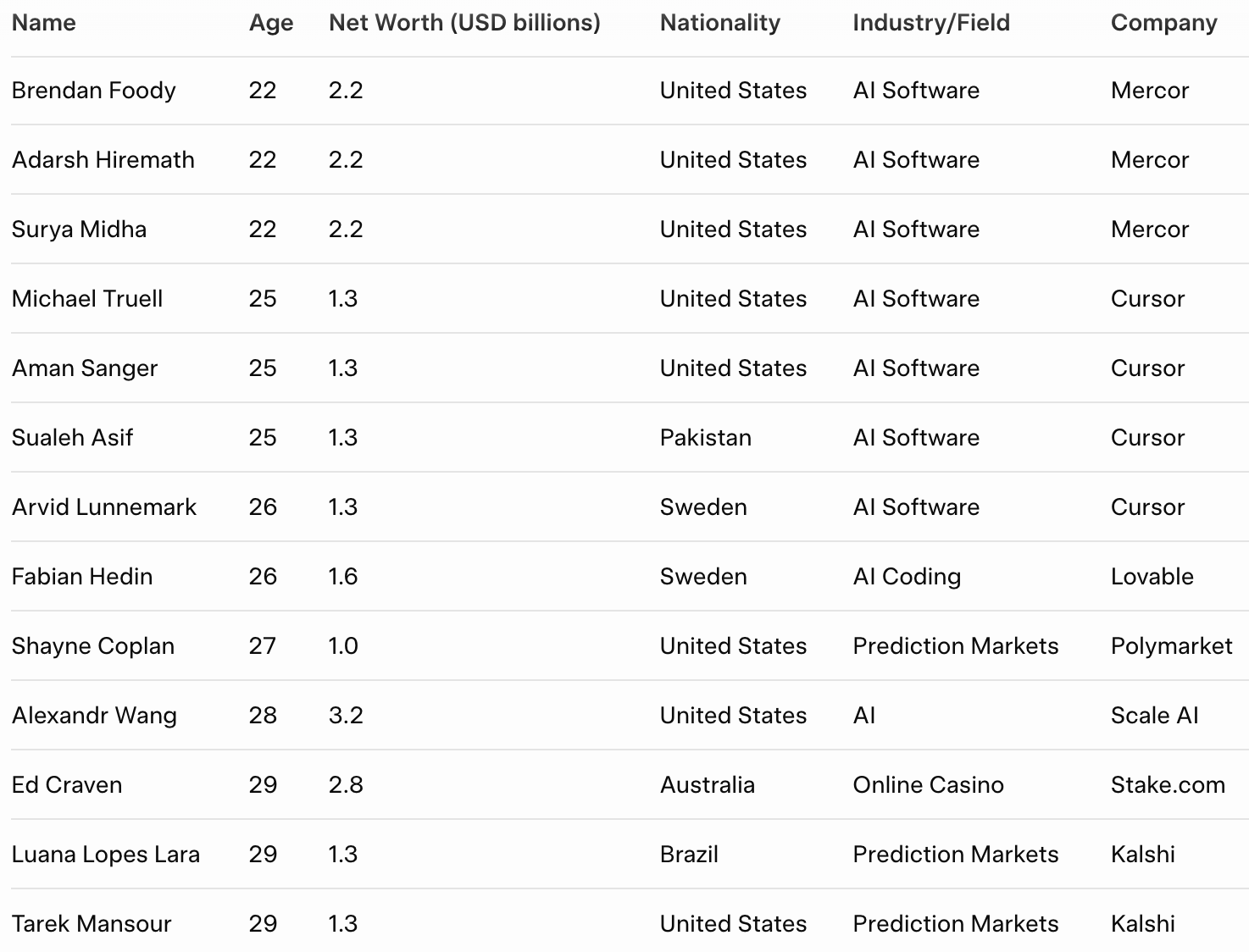
In 2025, the number of self‑made billionaires worldwide reached a new high, particularly among those under 30. This phenomenon is not accidental but the result of technological innovation intersecting with market opportunity. According to Forbes, as of December 2025 there were 13 self‑made billionaires under 30, a sharp rise from the 2022 peak of seven, with 11 created in the past three months. This wave is primarily driven by the boom in artificial intelligence (AI), prediction markets and online gambling — sectors that have moved from the margins to the mainstream over the past decade, creating unprecedented rapid paths to wealth. Authorities such as Yahoo Finance and Entrepreneur note that AI has not only accelerated wealth accumulation but also reshaped the opportunity landscape for young founders, even as it squeezes entry‑level employment. This special report examines the causes, representative figures and potential impacts of the trend, drawing on reliable data from Forbes, Bloomberg and CNBC to reveal how technology has created "instant" billionaires in a short time.
AI Boom: From Data Labeling to Intelligent Tools as Wealth Accelerators
The rapid growth of the AI industry is the core driver behind the surge in young billionaires. In 2025, AI startup valuations skyrocketed, with some companies moving from seed rounds to unicorn status in months. Forbes data shows a marked rise in AI‑related billionaires; these young founders often monetize quickly by developing data‑labeling, code‑generation or recruiting tools. For example, post‑pandemic AI demand surges spurred the rise of niche markets such as data labeling and automated coding. A LinkedIn report indicates the global AI market exceeded $500 billion in 2025, and young founders have benefited from low‑barrier startup tools like open‑source frameworks and cloud services that accelerate the cycle from idea to IPO. This trend is not isolated: Nature Index reported record citation counts for AI papers in 2025, reflecting technological maturity that young entrepreneurs have directly benefited from. Meanwhile, venture capital's enthusiasm for AI further magnified the wealth effect, with AI investments totaling $200 billion in 2025, far exceeding prior years. However, this fast‑wealth model has sparked controversy: critics argue it exacerbates income inequality, benefiting a small elite among younger cohorts while leaving many facing the risk of job displacement by AI.
Prediction Markets and Online Gambling: Platform‑Based "Betting" Paths to Wealth
Beyond AI, the rise of prediction markets and online gambling platforms has also created several young billionaires. These sectors benefited in 2025 from regulatory loosening and digital transformation. Prediction markets allow users to bet on elections, sports or event outcomes; during the 2024 U.S. election cycle platforms like Polymarket saw trading volumes surge into the billions. Forbes analysis notes that the low barriers to entry and viral growth potential enabled founders to rapidly accumulate users and valuation. Similarly, online gambling exploded during the pandemic via livestreaming and creator‑driven models, with the global online gambling market reaching $150 billion in 2025. CNBC reported that these platforms used blockchain and AI algorithms to optimize user experience, driving a shift from traditional casinos to digital ecosystems. Yet this path to wealth carries risks: regulatory uncertainty and ethical concerns, such as gambling addiction, have prompted legislative debates in multiple countries. Overall, these emerging digital platforms demonstrate how digitization can rapidly amplify individual wealth while exposing potential market bubbles and social harms.
Profiles: From a Trio of 22‑Year‑Olds to AI Pioneers
The wave's representatives are diverse in nationality and background. Among Forbes' young billionaires, the most striking are the three 22‑year‑old Mercor founders—Brendan Foody, Surya Midha and Adarsh Hiremath—each with a net worth of $2.2 billion. They founded Mercor in 2023 to use AI to match job seekers and employers; in October 2025 the company was valued at $10 billion. Foody said in an interview, "It feels surreal…far beyond what we imagined two years ago." Another notable figure is 27‑year‑old Shayne Coplan, founder of Polymarket, with a net worth of $1 billion; the platform received $2 billion in investment in 2025 and was valued at $9 billion, becoming a leader in prediction markets.
Female representative Luana Lopes Lara (29, Kalshi founder) is the world's youngest self‑made female billionaire, with a net worth of $1.3 billion. A former ballet dancer from Brazil turned MIT graduate, she and partner Tarek Mansour founded Kalshi, specializing in event betting and securing significant funding in 2025. AI leader Alexandr Wang (28, Scale AI founder) has a net worth of $3.2 billion after his company sold a 49% stake to Meta in 2024 for $14 billion, driving an AI data‑labeling revolution. Online gambling representative Ed Craven (29, Stake.com founder) has a net worth of $2.8 billion; Stake.com reported $4.7 billion in revenue in 2024 and attracted young users through livestreaming formats. Others, such as Fabian Hedin (26, Lovable founder, net worth $1 billion), profited from AI coding tools. Many of these figures are non‑U.S. citizens (six in total), reflecting the global diversity of tech entrepreneurship.
Data Trends and Global Impact: Opportunities and Challenges Coexist
According to Forbes statistics, 287 new billionaires were added globally in 2025, of whom 70% were self‑made, and the share of younger cohorts rose. A Skybound Wealth report shows Gen Z millionaires are reshaping finance, though billionaires remain predominantly inherited (17 under‑30 heirs). This trend benefited from low interest rates, venture capital momentum and the democratization of technology: cloud computing and open‑source AI lowered startup barriers and allowed rapid product iteration. Brand Vision's 2025 list of young self‑made billionaires shows AI accounting for more than half, underscoring its dominance. However, challenges remain: Bloomberg warns of potential market bubbles, and prediction platforms may face regulatory crackdowns. The double‑edged nature of AI is evident: Entrepreneur notes that while AI creates wealth, it also deepens employment inequality and intensifies competition for entry‑level positions among Gen Z. From a global perspective, the phenomenon has spurred innovation but also renewed debates about wealth concentration and social equity.
In short, the surge of young self‑made billionaires in 2025 marks a tech‑driven era of accelerated wealth. AI and related technologies have not only sped up wealth creation but reshaped economic patterns. As regulation tightens and markets mature, the trend may stabilize, yet the potential of young entrepreneurs to drive global innovation is likely to persist.
▶️ Enjoyed this article? Creating great content takes effort!
Subscribe to our YouTube channel:
AI Rosetta
Your likes, subscriptions and shares mean the world to us! 🙏
For more AI news, visit:
https://www.airosetta.com