
September 11, 2026, including Terence Tao, Peter Scholze, Maryna Viazovska and Deng Yu, 25 Fields Medalists jointly released an open statement titled "A Severe Misalignment of AI in Mathematics." The statement says AI companies are treating the solution of famous mathematical problems as benchmark tests and PR demonstrations, and that this goal is "severely misaligned" with the aims of the mathematical community, harming the science of mathematics and its transmission. The statement was posted on Terence Tao's blog and on the dedicated website mathandai.org, and remains open for additional signatures.
Details: core claims and background
The statement acknowledges that in recent months the mathematical abilities of large language models have "rapidly improved," and that they have been able to solve significant open problems across several areas 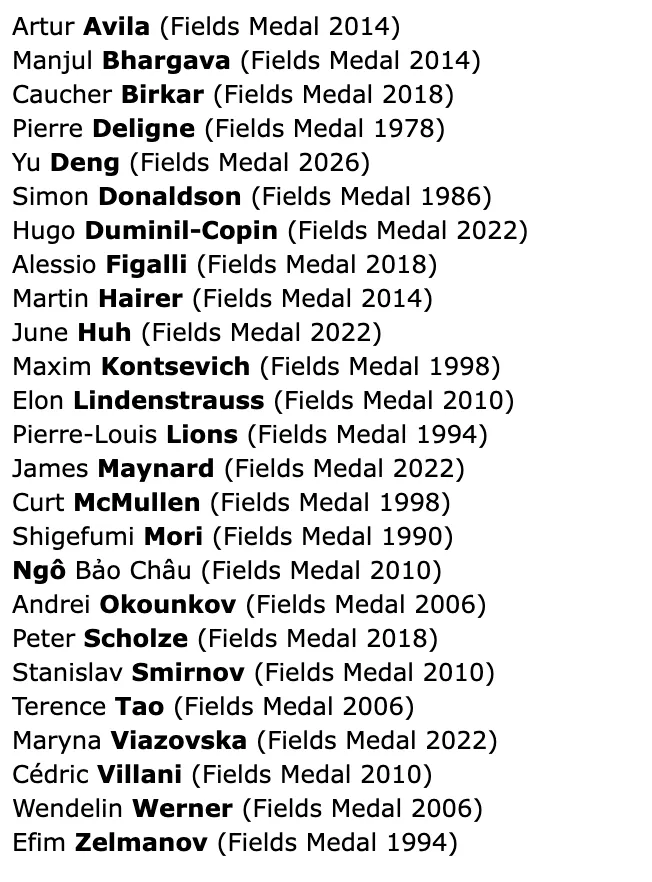 . But the signatories emphasize that the core goal of mathematics is not merely to "obtain answers," but to gain conceptual understanding, distill new methods, and achieve deep insight through the problem‑solving process. These processes require time and are built on human interaction and knowledge transmission within the community.
Their most direct criticisms focus on current practices by AI companies:
- Results are often "announced hurriedly," lacking fully written proofs, a clear exposition of new methods, and adequate citation of prior work;
- This has led to serious disputes over authorship, priority, and potential plagiarism;
- Without mathematicians willing to spend the time to absorb, verify, and incorporate the results into the mathematical corpus, AI‑generated ideas will struggle to truly "come alive," and the essential chains of knowledge transfer between human mathematicians may be broken.
The statement spans Fields Medalists across nearly half a century, from Pierre Deligne (1978) to Deng Yu (2026), encompassing many of the most influential contemporary mathematicians. Tao said the statement was formed after urgent discussions among the 25 medalists over the past week and was released as quickly as possible because "the situation was sufficiently urgent."
This position directly echoes the heated controversy of the previous week: OpenAI announced that roughly 10,000 AI agents produced a key breakthrough related to the Navier–Stokes millennium problem within 88 hours and completed formalization in Lean. At the same time, some human mathematicians also made progress on related questions, leading to public doubts about timelines, sources of inspiration, and authorship. While the statement does not name specific companies, many media outlets interpreted it as a collective response to the current practice of using hard problems as publicity showcases.
Potential impact: warnings from mathematics to broader knowledge production
1. Impact on mathematical research and the community
The statement places "understanding" above "answers," reminding the field that when AI can produce verifiable results at speeds far beyond humans, the question becomes how to ensure new knowledge is fully digested, taught, and transmitted rather than reduced to an opaque "black‑box answer bank." If mathematicians gradually withdraw from deep engagement with AI outputs, the discipline's humanistic and educational functions may be undermined.
2. Impact on AI companies and research practices
Using famous open problems as public benchmarks can quickly demonstrate model capabilities but risks sacrificing academic norms and community trust. The statement may encourage some labs to prioritize complete proofs, clear attribution of contributions, and collaboration with mathematicians when publishing significant mathematical results, rather than pursuing only "firsts" and media attention.
3. Broader implications for scientific discovery paradigms
The signatories make clear this is not unique to mathematics but part of a "wider misalignment" that will affect other sciences and creative professions. When AI similarly produces rapid results in physics, biology, software, and other fields, the same risk of "answers divorced from understanding" will appear. Ensuring AI truly serves human understanding rather than replacing the process of understanding is a cross‑disciplinary challenge.
4. A mixture of potential benefits and tensions
The statement does not deny AI's advances in mathematics, and some mathematicians continue to actively explore human–AI collaboration. The real tension lies in balancing speed versus depth, commercial incentives versus academic values, and automated verification versus human insight. Further signatures, academic discussions, and responses from AI labs will determine how much concrete impact this appeal will have.
5. Impact on the public and policy
A collective voice from top mathematicians brings the question "is AI changing the nature of knowledge?" beyond technical circles to the broader public. It may prompt funders, universities, and technology companies to reassess how to evaluate AI's contributions to basic research and how to safeguard humanity's core role in understanding and transmission.
Conclusion
The joint statement by 25 Fields Medalists is the strongest and most symbolic collective response from the mathematics community to AI's rapid incursion into basic research. It is not simply "anti‑AI," but a profound critique of current incentive structures and publication culture: when solving problems becomes a speedrun and a capability showcase, are mathematics' most valued elements—understanding, insight, and interpersonal knowledge transfer—being marginalized?
The core question posed by Tao and others—"as AI changes how we work, how do we avoid losing the original goals of that work?"—concerns not only mathematics but all fields that rely on deep thinking and cumulative understanding. The statement has been issued and signatures are still being added. The relationship between mathematics and AI is shifting from a technical competition to an open debate about values and paradigms.
▶️ Enjoy this article? Creating is hard!
Follow our YouTube channel:
AI Rosetta
Your likes, subscriptions, and shares are our greatest support! 🙏
For more AI news visit: https://www.airosetta.com