
In March 2026, Ant Group and Google DeepMind respectively released two major embedding models: Ant open‑sourced F2LLM‑v2 on March 19 (arXiv:2603.19223), and Google launched Gemini Embedding 2 on March 10 (gemini‑embedding‑2‑preview). Both represent the cutting edge of embedding technology, but differ fundamentally in positioning, capabilities and applicable scenarios — F2LLM‑v2 is a efficient open‑source multilingual text embedding model, while Gemini Embedding 2 is the world’s first natively multimodal embedding model. Both reach near‑SOTA performance on pure text tasks, but Gemini breaks through in cross‑modal fusion, whereas F2LLM‑v2 has advantages in multilingual coverage, deployment flexibility and open transparency.
1. Model positioning and core capabilities
- F2LLM‑v2 (Ant Group): A general multilingual text embedding family with eight sizes (80M–14B parameters). Built on the Qwen3 Transformer decoder architecture and using the EOS token as sequence representation. Supports over 200 languages with special strengthening for low‑ and medium‑resource languages. Trained on a newly curated set of 60 million high‑quality public samples using a two‑stage LLM‑based embedding training pipeline + Matryoshka Representation Learning (MRL) + model pruning + knowledge distillation to achieve efficient compression while retaining performance. Fully open‑source (models, data, code and intermediate checkpoints released on GitHub CodeFuse‑Embeddings and Hugging Face).
- Gemini Embedding 2 (Google): The first natively multimodal embedding model, built on the Gemini architecture, mapping text, images, video, audio and PDF documents into a single vector space (default 3072 dimensions). Supports interleaved inputs (e.g., mixed text and images, video+audio) and enables cross‑modal semantic search without separate modality conversion or post‑processing. Supports 100+ languages and leverages MRL for flexible dimensionality (3072→1536→768 dims, <2% performance loss after reduction, ~60% storage savings). Currently in public preview and available via Gemini API / Vertex AI only.
Key differences: F2LLM‑v2 focuses on efficient text representation (plain text, multilingual); Gemini Embedding 2 delivers a unified full‑modal space (native fusion of five major modalities), which is the largest recent breakthrough in embedding technology — what previously required CLIP (images) + Whisper (audio) + text embeddings and vector alignment can now be achieved with a single model and one API.
2. Performance benchmarking (centered on MTEB)
Both models reach top levels on MTEB (Massive Text Embedding Benchmark), but emphasize different strengths:
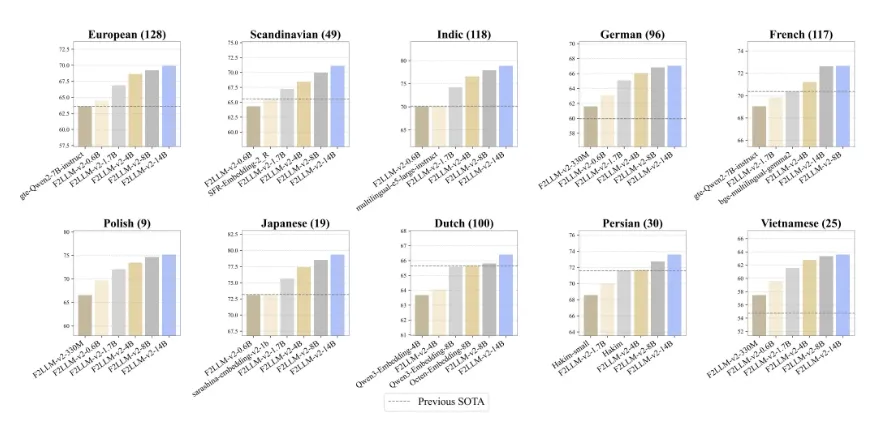
- F2LLM‑v2: Across 17 MTEB subbenchmarks (430 tasks), the 14B variant ranks first on 11 benchmarks, including Multilingual (68.74), English, Code (80.75), Medical and language‑specific tasks (European languages, Hindi, Anatolian, Korean, Polish, Chinese, Japanese, etc.). Smaller models (80M–330M) achieve SOTA in resource‑constrained settings, significantly outperforming similarly sized Qwen3‑Embedding and EmbeddingGemma. MRL keeps low‑dimensional embedding degradation minimal, making them suitable for edge deployment.
- Gemini Embedding 2: MTEB English score 68.32 (about 5.09 points ahead of the runner‑up). Video retrieval benchmarks (Vatex, MSR‑VTT, YouCook2) reach 68.8, well above Amazon Nova 2 (60.3) and Voyage Multimodal 3.5 (55.2). It shows clear advantages on cross‑modal tasks (image‑text retrieval, video+audio semantic matching) while matching F2LLM‑v2’s tier on pure text tasks (reported English MTEB is slightly below F2LLM‑14B in some reports, but overall stronger for multimodal workloads).
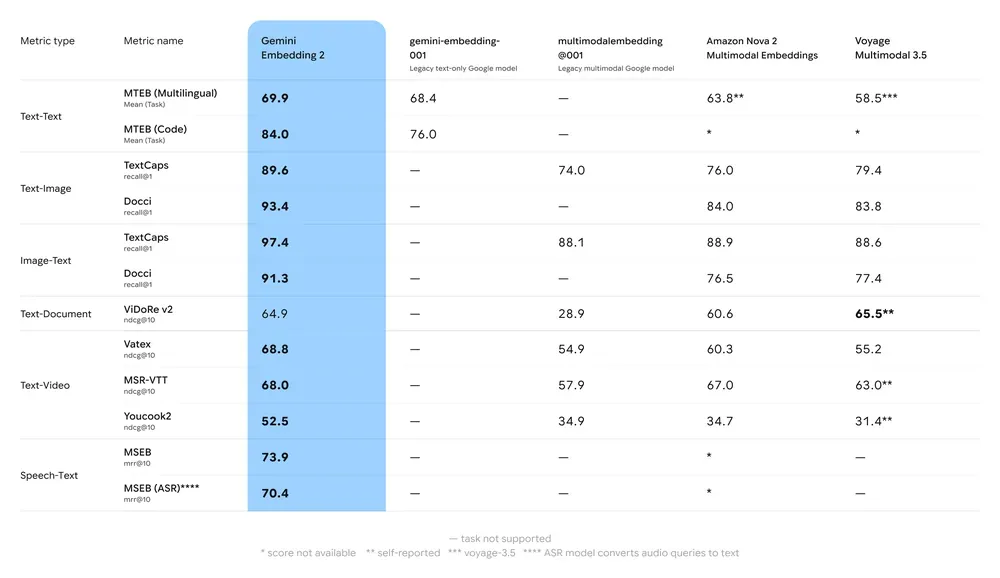
Conclusion: For pure text and multilingual scenarios, F2LLM‑v2‑14B is more comprehensive (especially for low‑resource languages); for cross‑modal (image/video/audio retrieval) scenarios, Gemini Embedding 2 represents a qualitative leap and removes the need for additional pipelines.
3. Deployment, cost and efficiency
- F2LLM‑v2: Self‑hosting friendly. Eight sizes to choose from; pruning and distillation yield high inference efficiency; MRL supports dynamic dimensions (usable down to 8 dims). Fully free and open‑source, suited for SMEs, on‑premises deployment and privacy‑sensitive scenarios. Training/inference costs are controllable within the Qwen3 ecosystem.
- Gemini Embedding 2: Cloud API billing (Gemini API / Vertex AI, charged by tokens or requests). MRL dimensionality reduction can significantly lower storage and compute costs, but it depends on Google Cloud infrastructure. Input limits are explicit (text 8192 tokens, images ≤6, video ≤120s, etc.), making it suitable for enterprise‑scale RAG, knowledge bases, legal forensics and media asset management.
4. Suitable use cases and impact
- F2LLM‑v2 is better suited for: global multilingual search, code retrieval, medical/domain RAG, edge AI, localized applications and open‑source research. Ant Group’s open‑sourcing further lowers the barrier for SMEs and promotes more inclusive AI.
- Gemini Embedding 2 is better suited for: enterprise multimodal knowledge management (legal forensics, video+audio retrieval, mixed image‑text search), next‑generation RAG systems, recommender engines and content moderation. Google ecosystem integration (YouTube, Google Cloud) accelerates commercial deployment.
5. Overall assessment
F2LLM‑v2 and Gemini Embedding 2 are complementary rather than direct rivals: the former represents the breadth and accessibility of open‑source, efficient text embeddings, while the latter represents the depth and innovation of closed‑source multimodal fusion. If your needs are pure text, multilingual support and low‑cost self‑hosting, prioritize F2LLM‑v2 (especially smaller models); if you require unified cross‑media retrieval, simplified pipelines and top cross‑modal accuracy, Gemini Embedding 2 currently stands unmatched.
Both use MRL technology, reflecting a shared trend toward more flexible and efficient embeddings. Going forward, F2LLM‑v2 may further evolve multimodal capabilities, and Gemini may offer more self‑hosting options. Developers can choose based on their scenario (text vs multimodal, open‑source vs cloud) or combine them (use F2LLM for text fine‑grained embeddings and Gemini as a cross‑modal entry point).
For more details, see:
- F2LLM‑v2: arXiv 2603.19223 & GitHub CodeFuse‑Embeddings
- Gemini Embedding 2: Google official blog & Gemini API documentation
▶️ Enjoyed this article? Creating content is hard!
Follow our YouTube channel:
AI Rosetta
Your likes, subscriptions and shares are our greatest support! 🙏
More AI news at: https://www.airosetta.com