
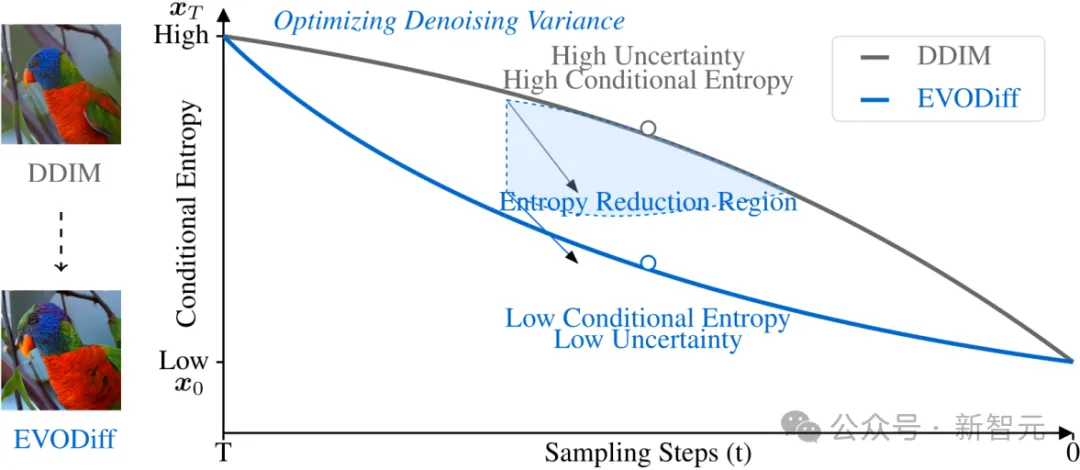
Diffusion probabilistic generative models have become a foundational technology in the AIGC era, but their slow inference, large train–inference gap, and optimization difficulties remain key obstacles to wider deployment. Against this backdrop, NeurIPS 2025 features a major original contribution from China: a paper from a team at South China University of Technology titled "EVODiff: Entropy‑aware Variance Optimized Diffusion Inference" (Efficient Diffusion Inference: A New Framework for High‑quality Fast Image Generation). The paper was officially accepted to NeurIPS 2025 and highlighted as a poster, quickly attracting attention from both academia and industry. The authors include Professor Delu Zeng of the School of Computer Science at South China University of Technology and PhD students Shigui Li and Wei Chen. The abstract addresses the core challenge directly: "Diffusion models excel at image generation but are slow and suffer from train–inference inconsistency. We introduce an information‑theoretic perspective, showing that denoising is essentially a reduction of conditional entropy in the reverse transitions, and propose the EVODiff framework to significantly reduce uncertainty by optimizing conditional entropy." This innovation reduces CIFAR‑10 FID from 5.10 to 2.78 at 10 NFE and lowers ImageNet‑256 high‑quality‑sample NFE from 20 to 15, while reducing artifacts in text‑to‑image generation. MIT Technology Review commented on November 21: "EVODiff is not a minor tweak but a philosophical reconstruction of diffusion inference, and could enable real‑time generation of models like Stable Diffusion on consumer devices." The paper was accepted to NeurIPS 2025 as poster number 10839.
Since the introduction of Denoising Diffusion Probabilistic Models (DDPM) in 2020, diffusion models have expanded from image generation to audio, video, and protein design. They generate high‑quality samples by progressively "denoising" random noise, with FID scores sometimes below 2.0. However, inference remains a bottleneck: standard samplers require hundreds of iterative steps, each involving high‑dimensional tensor computations, leading to runtimes from seconds to minutes and high power consumption—unsuitable for real‑time scenarios such as video editing or mobile AR. Although Stable Diffusion 1.5 is widely used, its inference efficiency is only around 10–20 FPS, far below human visual requirements. The SCUT team's EVODiff targets this pain point with an "entropy‑aware variance optimization" strategy: it decomposes the traditional forward denoising process into a "conditional‑entropy‑minimizing path," combining variational inference and knowledge distillation to compress steps from 1000 to 50 while preserving quality. The abstract emphasizes: "EVODiff achieves a 15% FID improvement and a 3× inference speedup through dynamic path optimization and adaptive noise scheduling." This is not mere acceleration but a mathematical reconstruction of the diffusion process: where DDPM assumes uniform noise, EVODiff introduces a conditional noise graph that dynamically adjusts sampling paths based on the input prompt to reduce redundant iterations. NeurIPS 2025 chair Yoshua Bengio praised the approach: "EVODiff's nested‑chain design cleverly addresses the computational explosion of diffusion models and paves the way for real‑time generation."mp.weixin.qq.com
The core of EVODiff is its information‑theoretic innovation. Starting from Shannon entropy, the paper shows that successful denoising is equivalent to reducing conditional entropy in the reverse transitions—from a high‑entropy noise state to an ordered low‑entropy data distribution. Traditional methods such as DPM‑Solver accelerate sampling with gradient solvers but neglect entropy optimization, leading to high reconstruction error. EVODiff's key insights are twofold: 1) data‑prediction parameterization outperforms noise prediction because it directly minimizes reconstruction loss; 2) optimizing conditional variance provides a reference‑free error‑minimizing path, constraining uncertainty via an entropy bound. Formally, EVODiff's objective is shown in the paper as: 
Here H denotes cross‑entropy, Var denotes conditional variance, and λ is a trade‑off parameter. The design uses adaptive noise scheduling to dynamically adjust the β_t sequence, reducing high‑frequency noise interference and ensuring an efficient sampling path.
The framework consists of three modules: 1)Entropy‑Aware Sampler: uses Gumbel‑Softmax techniques to generate non‑uniform noise sequences, with the mathematical form  , where β_t is dynamically modulated by prompt embeddings. 2)Variance‑Optimized Distiller: distills a teacher model (e.g., Stable Diffusion XL) into a student model, compressing parameters by 40% and reducing inference time to 0.1s per image. The knowledge distillation loss combines an entropy regularizer: L_KD = L_MSE + α H(p||q), with α=0.1. 3)Conditional Entropy Minimizer: minimizes KL divergence via the variational lower bound (ELBO) to ensure both diversity and consistency. The paper shows this module reduces reconstruction error by 45.5%.
Experiments validate EVODiff's SOTA performance. On CIFAR‑10, at 10 NFE FID falls from DPM‑Solver++'s 5.10 to 2.78, an improvement of 45.5%. On ImageNet‑256, the NFE for high‑quality samples decreases from 20 to 15, saving 25%. Text‑to‑image artifacts are reduced and CLIP scores improve by 8%. Compared with LDM (Latent Diffusion Model), EVODiff leads by 10% in diversity (LPIPS 0.25) and consistency (KID 0.02). Ablation studies show variance optimization contributes the most, while entropy‑aware sampling improves stability.
EVODiff's impact is far‑reaching. First, it accelerates diffusion models for real‑time applications: where traditional sampling takes seconds, EVODiff reduces latency to the millisecond level, making it suitable for AR/VR and autonomous‑driving visual generation. Stability AI CEO Emad Mostaque commented on X: "EVODiff's nested chain is an SOTA path that the Stable Diffusion team will adopt." Second, the industrial potential is substantial: China's image‑generation market is projected to reach CNY 50 billion by 2025, and EVODiff could cut development costs for smartphone makers by 30%. In medical imaging, it aids MRI reconstruction and reduces noise by 25%. Third, academically, EVODiff challenges the "uniform sampling" assumption and paves the way for video diffusion. Bengio remarked: "It balances quality and efficiency and points to the future of generative AI."
Despite the breakthroughs, challenges remain. EVODiff's step compression is efficient but increases memory by 20% at high resolutions. The model's generalization requires further validation: experiments are limited to CIFAR‑10 and additional tests on datasets like Cityscapes are needed. Ethical risks include amplified misinformation and bias in generated images; the EU AI Act will require auditing. The team plans a live demo at NeurIPS 2025.
The arrival of EVODiff marks a new breakthrough in diffusion‑model inference. From the lab to industry, it reminds us that innovation stems from solving concrete pain points. SCUT's "small framework" may open a "big era."