
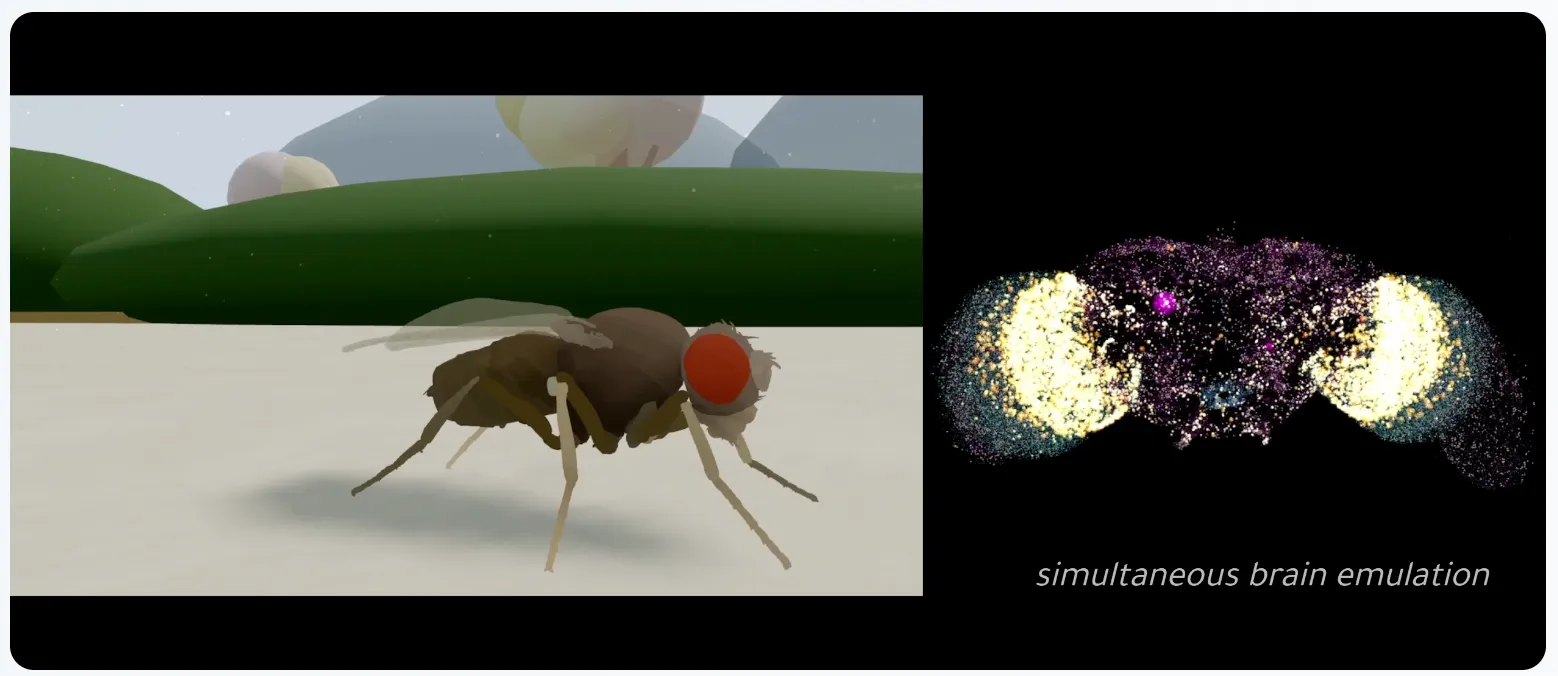
On March 10, 2026, San Francisco biotech startup Eon Systems PBC released a striking video and accompanying technical notes announcing that they had successfully "uploaded" the complete brain connectome of an adult fruit fly (Drosophila melanogaster) into a computer and connected it to the MuJoCo physics engine. This "digital fruit fly" autonomously displayed multiple realistic behaviors in a virtual body—walking, turning, feeding, grooming, and more—with behavioral prediction accuracy of up to 91–95%, and without any additional reinforcement learning or behavioral training. The result was described in the media as the "First Multi‑Behavior Whole‑Brain Emulation," quickly trending across global tech and neuroscience outlets; Elon Musk reshared and commented "Wow" on X, prompting wide discussion from scientific to philosophical communities.
Eon Systems was co‑founded by former DeepMind and Janelia researchers including Philip Shiu. Its mission is to "build the world's largest connectomes and highest‑fidelity brain simulations, ultimately achieving human‑level whole‑brain emulation." The project builds directly on the adult fruit fly whole‑brain connectome released by the FlyWire international consortium in 2024 (published in Nature), which contains about 139,000 neurons and 50–54.5 million synapses. The Eon team converted this connectome into an executable computational model and combined it with the NeuroMechFly v2 neuromechanical body model developed at EPFL, implementing a closed‑loop simulation inside the MuJoCo physics engine. This represents a key transition from "brain mapping" to "brain‑behavior reproduction," and provides early experimental evidence relevant to debates on consciousness uploading and digital immortality.
Implementation details: the full closed loop from real connectome to embodied behavior
Eon Systems' technical approach is highly transparent and centers on a connectome‑driven neural dynamics + physical embodiment, rather than conventional deep learning training. The system is organized into four tightly coupled modules:
1、Connectome data foundation and neuron modeling
The base data come from the FlyWire project (Dorkenwald et al., 2024), which reconstructed the adult fly brain from electron microscopy slices, covering approximately 140,000 neurons and about 50 million synaptic connections. The Eon team used the Leaky Integrate‑and‑Fire (LIF) neuron model described in Shiu et al. (2024) and combined it with machine‑learning–predicted neurotransmitter types (Eckstein et al., 2024) to assign synaptic polarities (excitatory or inhibitory). This model requires no additional training and relies solely on the connectome structure to recover substantial sensorimotor organization, providing a reliable "neural circuit" basis for embodiment.
2、NeuroMechFly v2 body model construction
The body model uses the NeuroMechFly v2 framework from Wang‑Chen et al. (2024). Built from micro‑CT scans of real fruit flies, it provides a high‑precision 3D mesh with 87 independent joints. The body includes muscle actuation, contact mechanics, aerodynamics, and joint constraints, with all physical interactions computed in real time by the MuJoCo engine. This ensures that the digital fly's kinematics and dynamics closely match those of a real fly.
3、Sensor‑brain‑motor closed‑loop integration
The key innovation is closing the loop between the brain model and the body model:
- Sensory input: virtual eyes, antennae, and foot sensors convert environmental information (light, contact, odor, etc.) into neural activity fed into the connectome model.
- Neural processing: LIF neurons propagate signals through the whole‑brain connectome and produce motor neuron outputs.
- Motor execution: outputs directly drive the virtual body's joints and muscles to realize walking, turning, feeding, grooming behaviors.
- Feedback loop: body movements in turn alter sensory inputs, closing the loop.
- The entire system operates without a reinforcement‑learning reward function; behaviors emerge purely from the structural dynamics of the connectome. The paper and demo video show the digital fly autonomously performing up to eight natural behaviors, with trajectory and behavior matches to real flies of 91–95%.
- Validation and visualization
- The Eon team validated the simulation extensively through control experiments: comparisons with real fly behavior videos, kinematic analyses, recordings of neural activity, and more. In the demo, the digital fly freely walks, avoids obstacles, feeds, and grooms its wings in a virtual environment with fluid, natural motion. The team has also open‑sourced part of the code (GitHub: eonsystemspbc/fly‑brain) for researchers to reproduce the work.
This approach contrasts sharply with earlier DeepMind MuJoCo fly work based on reinforcement learning: Eon’s method relies entirely on an authentic biological connectome rather than data‑driven training, demonstrating that "structure can imply function" in a digital context.
Far‑reaching implications for human behavior simulation and ethics
The success of the digital fly goes beyond a technical demonstration; it touches core philosophical and ethical questions about human behavior modeling, the nature of consciousness, and digital immortality.
1. Implications for human brain simulation
Although the fly brain is small (only about 140,000 neurons), it can already give rise to complex behaviors. This offers optimistic evidence for human brain simulation: if 140,000 neurons can drive multi‑behavior outputs, then a human brain with roughly 86 billion neurons might—given future high‑performance computing—also produce high‑fidelity behavioral simulations. Eon Systems has stated that their next goal is to scale to a whole mouse brain (about 70 million neurons) and ultimately to humans. Such progress could accelerate "digital twin brains" for neuroscience, drug screening, and behavioral prediction—for example, enabling clinicians to test drug effects on digital patient brains without real‑world trials.
2. Challenges to philosophy of consciousness and identity
"The digital fly acts autonomously—does it have consciousness?" This question has quickly ignited debate among philosophers. Some argue the result supports the view that consciousness may arise from connectome structure rather than a mysterious 'soul'; others insist that behavioral emulation ≠ subjective experience. If entire human brains can one day be uploaded and embodied, will digital immortality be possible? Would a post‑uploaded "digital me" still be the same person? These questions could redefine death, identity, and human rights.
3. Ethical and social risks
- Privacy and data rights: whole‑brain connectomes are effectively "maps of thought," and future human brain data collection would pose extreme privacy challenges. If uploading technology matures, a "brain data black market" or coercive uploading could emerge.
- Military misuse: embodied AI brains could be applied to autonomous weapons or surveillance systems, raising ethical concerns about weaponized autonomy.
- Inequality: digital immortality could be affordable only to the wealthy, intensifying social stratification.
- Animal welfare extension: while current work involves fruit flies, extending simulation to higher animals raises questions about whether digital simulation could constitute "digital harm."
The UN AI Ethics Committee and multiple neuroscientists have called for rapid development of a "digital life rights" framework. Eon Systems' founder Alexander Wissner‑Gross said the team is drafting fidelity standards for brain emulation and welcomes global ethical dialogue.
Technical limits and future outlook
Despite the breakthrough, clear limitations remain:
- So far the system models behavior but does not demonstrate complex emotions or "self‑awareness."
- Computational resource requirements are enormous (currently running only on high‑performance clusters).
- Scaling to mammalian brains faces major data‑collection and computational‑explosion challenges.
Eon Systems plans to pursue whole‑mouse embodied emulation in 2027–2028 and to open‑source additional tools. Combined with community efforts like FlyWire and NeuroMechFly, the field is accelerating from a "fruit‑fly era" toward a "mammal era," ultimately aiming at humans.
Conclusion: the dawn of digital life
Eon Systems' digital fruit fly experiment used a real connectome plus physical embodiment to make a fly "live" in a computer. It not only demonstrates the feasibility of connectome‑driven behavior but also pushes humanity into deep debates about consciousness uploading, digital immortality, and human‑machine integration.
As AI gracefully reproduces biological brain behavior, the boundaries between science and ethics are being rewritten. This may be one of the most striking news stories of 2026 and a possible new starting point for human self‑inquiry.
As the era of digital life arrives, we must embrace technological wonder and ethical caution alike—because the next mind to be uploaded might be ours.
▶️ Enjoyed this article? Creating great content takes effort!
Subscribe to our YouTube channel:
AI Rosetta
Your likes, subscriptions and shares mean the world to us! 🙏
For more AI news, visit:
https://www.airosetta.com