
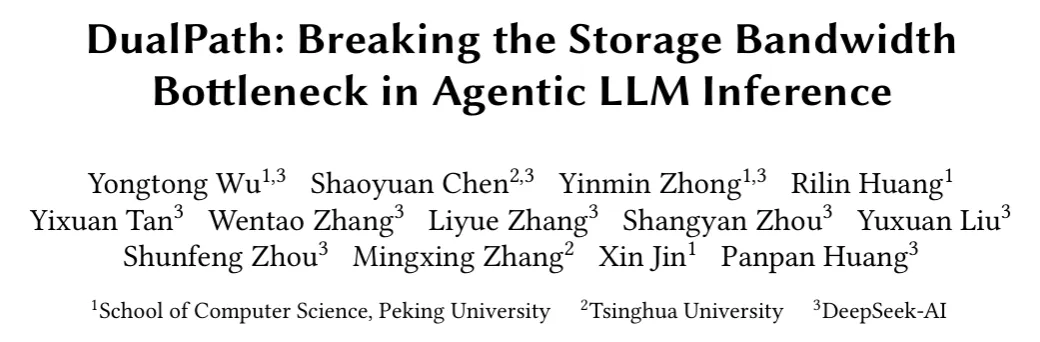
On February 25, 2026, Chinese AI startup DeepSeek published the paper "DualPath: Breaking the Storage Bandwidth Bottleneck in Agentic LLM Inference" (arXiv:2602.21548) on arXiv. The paper, authored by DeepSeek's core research team in collaboration with Peking University and Tsinghua University, is the first systematic proposal addressing storage bandwidth bottlenecks in multi‑turn inference scenarios for Agentic LLMs (agentic large language models). DualPath introduces a "dual‑path KV‑Cache loading" mechanism together with a global scheduler to overcome a fundamental asymmetry in current disaggregated inference architectures. On real Agentic workloads it reports up to 1.87× offline inference throughput improvement and an average 1.96× online service throughput improvement without violating SLOs (service‑level objectives). The result is regarded as a major advance for efficient inference in the Agentic AI era and provides key technical support for the upcoming DeepSeek V4 inference engine.
Storage bandwidth bottleneck in Agentic LLM inference
The paper opens by noting that as Agentic LLMs shift from single‑turn Q&A toward multi‑turn tool calls, long‑context planning, and complex decision‑making, the inference performance bottleneck has moved from computation to KV‑Cache storage I/O. In today's mainstream disaggregated inference architectures:
- Prefill phase (initial KV‑Cache population) must load massive KV‑Caches from external persistent storage, saturating the storage NIC bandwidth (Figure 1 in the paper shows prefill engines' storage NIC utilization approaching 100%).
- Decode phase (autoregressive generation) consumes almost no storage bandwidth, leaving the storage NIC idle.
This asymmetry severely limits overall system throughput: prefill engines become the bottleneck while decode engines sit idle, and GPU utilization struggles to exceed 40%. Measurements on real Agentic workloads (Figure 2) show traditional architectures sustain GPU utilization around 30–40% long‑term, far below the 80%+ common in compute‑bound tasks.
DualPath key innovations: dual‑path KV‑Cache loading + global scheduling
DualPath proposes two core innovations to break this bottleneck:
- Dual‑path KV‑Cache loading mechanism In addition to the traditional "storage→Prefill" path, DualPath adds a "storage→Decode" path:
- KV‑Cache is first loaded into the Decode engine's local memory (leveraging the storage bandwidth that is otherwise idle during the Decode phase).
- The Decode engine then efficiently transfers KV‑Cache to the Prefill engine via RDMA over the compute network (remote direct memory access over the compute network). This design exploits the compute network's high bandwidth (the paper's experiments use 8×400Gbps/node RDMA), avoids storage‑network congestion, and does not interfere with the latency‑critical communication paths of model execution. Figure 3 illustrates this dual‑path dataflow architecture comparison.
- Global scheduler DualPath introduces a global scheduler across Prefill and Decode engines to dynamically balance the two engine types' loads:
- When Prefill load is high, KV‑Cache is preferentially loaded into Decode engines and forwarded;
- When Decode load is high, the system switches back to the traditional path. Table 1 shows this dynamic scheduling yields significant end‑to‑end throughput gains.
Experiments on DeepSeek's in‑house inference system validate results across three Agentic LLMs of different scales (Llama‑3‑70B, Mixtral‑8x22B, and DeepSeek family models) under realistic multi‑turn tool‑call workloads:
- Offline inference throughput: up to 1.87× improvement
- Online service throughput: average 1.96× improvement (without violating SLOs)
- GPU utilization: increased from ~40% to nearly 80% (see Figure 4)
Comparison with existing methods and significance
DualPath differs from approaches such as Speculative Decoding, PagedAttention, and Medusa by not relying on model‑internal acceleration tricks; instead, it attacks the problem at the system‑level data path and via global scheduling, directly resolving the fundamental asymmetry of disaggregated architectures. Table 2 in the paper shows DualPath's gains in bandwidth‑limited scenarios far exceed those of existing methods.
The work has deep practical implications for deploying Agentic AI:
- In multi‑turn complex tasks, inference latency and throughput are core bottlenecks—DualPath directly improves overall system efficiency.
- For enterprise deployments, DualPath greatly reduces demand for high‑end storage NICs, lowering infrastructure costs.
- In edge AI scenarios, the dual‑path mechanism offers a viable solution for low‑bandwidth environments.
DeepSeek's strategic positioning and outlook
The timing of DualPath's release comes ahead of DeepSeek V4's expected launch and is seen as a core technology preview for V4's inference engine. Together with two other major DeepSeek papers released earlier this year:
- "mHC: Manifold‑Constrained Hyper‑Connections" (published on New Year's Day 2026): uses manifold‑constrained hyper‑connections to recover residual identity mappings and significantly mitigate training instability.
- "Conditional Memory via Scalable Lookup" (published January 12, 2026): proposes the Engram conditional memory module as a new axis of LLM sparsity, outperforming MoE in experiments at the 27B scale.
These three papers form a coherent chain: mHC improves training stability, Engram expands sparsity, and DualPath revolutionizes inference efficiency. Through successive foundational advances, DeepSeek is transitioning from consumer‑grade multimodal models toward an efficient, scalable, end‑to‑end large‑model capability stack.
Although the paper does not disclose V4 details, the community widely expects V4 to deeply integrate DualPath as a core component of its Agentic inference engine. The DeepSeek team has indicated they will gradually open‑source parts of DualPath in future releases to foster community collaboration.
Conclusion
"DualPath" redefines performance boundaries for Agentic LLM inference from a system‑level perspective. It demonstrates that as AI enters the agentic era, model‑only optimizations are no longer sufficient to overcome bottlenecks—innovations in system data paths and global scheduling are equally critical. DeepSeek's work not only provides strong technical backing for V4's release but also offers a new paradigm for efficient inference worldwide.
In a 2026 landscape where AI compute and efficiency competition is intensifying, DualPath reminds us that decisive factors are often not model scale but deep insight into system bottlenecks and elegant solutions. The era of efficient Agentic AI inference may accelerate from here.
▶️ Enjoy this article? Content creation is hard work!
Follow our YouTube channel:
AI Rosetta
Your likes, subscriptions, and shares are our greatest support! 🙏
More AI news at: https://www.airosetta.com