
On February 4, 2026, a joint MIT and Harvard team posted a new paper on arXiv titled Generative Modeling via Drifting (arXiv:2602.04770). The paper, authored by Mingyang Deng, He Li, Tianhong Li, Yilun Du and Kaiming He, proposes a novel generative modeling paradigm—Drifting Models. The method transfers the distribution‑matching process that traditionally requires iterative inference in diffusion and flow models into the training phase, enabling truly high‑quality one‑step generation.
The paper reports striking results on ImageNet 256×256: a latent‑space FID of 1.54 and a pixel‑space FID of 1.61 for one‑step generation, surpassing previous one‑step generators and approaching or exceeding some multi‑step diffusion models. The community has quickly called this a "paradigm shift" in generative modeling, marking a key advance from multi‑step iterative synthesis toward efficient one‑step generation.
Pain points of traditional generative models: the iterative inference bottleneck
Mainstream generative models (such as diffusion models, flow‑based models, and GANs) fundamentally learn a pushforward map from a noise distribution to the data distribution. However, they share a core limitation: the mapping learned during training is fixed, while inference typically requires many iterative steps to approach the target distribution.
Diffusion models require hundreds to thousands of denoising steps, flow models can be single‑step but are extremely hard to train, and GANs are single‑step but prone to mode collapse. This training–inference asymmetry leads to low efficiency, high computational cost, and poor real‑time performance, which is particularly limiting for high‑resolution, semantically complex, or interactive scenarios such as video generation, robotic control, and interactive design.
The authors state in the abstract: "Generative modeling can be framed as learning a map f whose pushforward distribution matches the data distribution. Existing methods either require iterative inference or suffer unstable training. We propose Drifting Models, which evolve the pushforward distribution during training, naturally supporting one‑step inference."
Core idea of Drifting Models: "drift" during training, "one‑shot" at inference
The core innovation of Drifting Models is to move the distribution evolution from inference time into training.
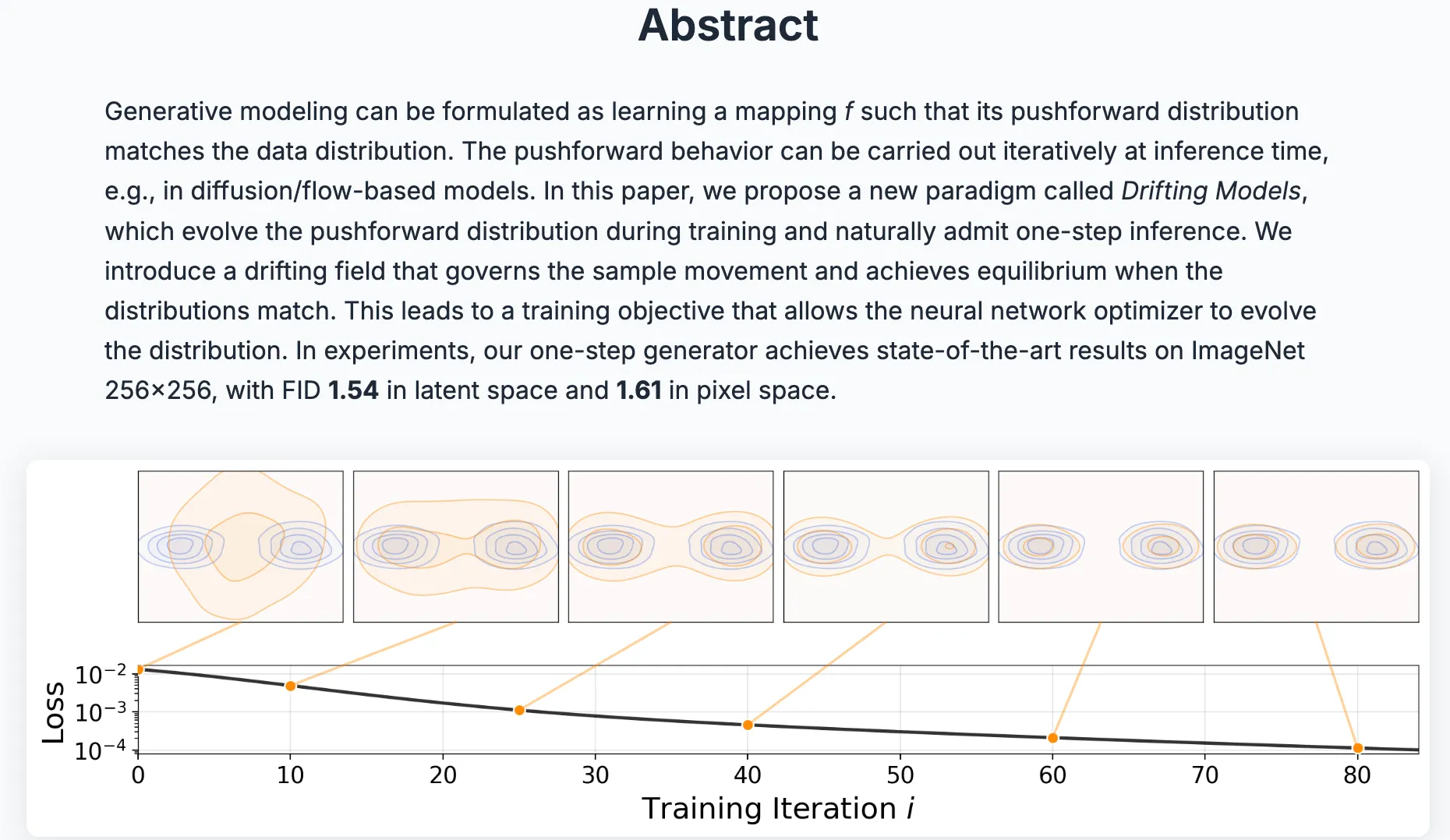
In traditional approaches, the model learns a fixed map f: noise → data, and inference must repeatedly apply f (or its inverse) to gradually move samples. Drifting Models instead make the mapping itself "drift" during training: the model learns a sequence of evolving mappings f_t that, at different training stages, push the distribution from simple noise toward the complex data distribution.
Concretely, the authors introduce a Drifting Loss that computes the "drift direction" between the current generated distribution and the real data distribution across multiple scales using a feature encoder. This direction guides parameter updates so that the model's pushforward distribution continuously "drifts" toward the data distribution during training. At convergence, the model implements a direct one‑step function from noise to high‑quality data.
As illustrated in the paper's Figure 1, training in Drifting Models can be visualized as a dynamic "drift trajectory": early stages are noise‑dominated and simple, while later stages are complex and detail‑rich, and no repeated inference iterations are required at test time.
The paper also proposes a Multi‑scale Drifting Loss (Figure 3), extracting feature maps from different stages of a ResNet and independently computing kernels, drift vectors, and losses for each feature. The weighted sum of these losses substantially improves the model's ability to capture fine‑grained textures and high‑level semantics.
Experimental results: ImageNet one‑step SOTA and strong robotics generalization
On the standard ImageNet 256×256 benchmark, Drifting Models achieve the best results among one‑step generators:
- Latent‑space FID: 1.54 (previous best one‑step models ~2.1–3.5)
- Pixel‑space FID: 1.61
- One‑step generation: only a single forward pass (one neural function evaluation)
Figures 4 and 5 in the paper show that images generated by Drifting Models significantly outperform previous one‑step methods in detail, coherence, and diversity, and the quality gap with multi‑step diffusion models (e.g., DiT, SiT) has narrowed substantially while achieving orders‑of‑magnitude speedups.
Surprisingly, Drifting Models also exhibit strong generalization beyond images. In robotics control experiments, the drift mechanism outperformed standard reinforcement learning baselines in continuous control and trajectory planning tasks, demonstrating the paradigm's applicability to continuous dynamic systems (see paper Figure 7). The authors compared different pretrained feature encoders (MAE, DINOv2, etc.) and found a tailored MAE encoder performed best for computing the drifting loss, supporting the method's robustness.
Comparison with existing paradigms: from "iteration" to "drift"
Drifting Models contrast clearly with existing generation paradigms:
- Diffusion models: multi‑step inference, stable training, but slow.
- Flow models: single‑step inference possible, but very difficult to train and architecture‑sensitive.
- GANs: fast single‑step inference, but suffer from mode collapse and unstable training.
- Drifting Models: dynamic drifting during training, single‑step inference, combining stability and efficiency.
Kaiming He’s team has long worked in vision and generative modeling; their Drifting paradigm is viewed as a redefinition of the classic "generation‑as‑mapping" perspective. The community has rapidly engaged in discussions, seeing this work as a fresh approach to the efficiency–quality tradeoff in generative models.
Potential impact and future directions
Drifting Models have multiple far‑reaching implications for AI generation:
- Real‑time generation deployment: high‑quality one‑step generation could accelerate real‑time video, interactive design, and game content generation.
- Computation‑efficiency revolution: greatly reduced inference cost may enable high‑performance generative models on consumer devices.
- Robotics and embodied intelligence: the drift mechanism is naturally suited to continuous dynamic systems and may accelerate embodied AI.
- Theoretical inspiration: explicitly modeling distribution evolution during training provides a new mathematical framework for generative models.
The paper also candidly notes limitations: the drifting loss is sensitive to the choice of feature encoder, and performance at very high resolutions (e.g., 1024×1024) still has room for improvement. Future work could combine more advanced encoders or hybrid drifting strategies to further enhance results.
The authors announced on the project page that they will soon open‑source the ImageNet training code and pretrained models to facilitate community reproduction and extension.
Conclusion: the "drift" era of generative models
Generative Modeling via Drifting proposes the Drifting Models paradigm, reframing the core logic of generative modeling: rather than forcing the model to "walk step by step" at inference, it lets the model "drift step by step" during training. This shift yields a leap in one‑step generation quality and opens new avenues for understanding and generating complex distributions.
In a period of rapid AI progress in 2026, Drifting Models remind us that superior generative capability may depend less on deeper networks or more parameters and more on understanding distribution evolution. As generative models move from "iterative simulation" to "drift shaping," the efficiency and creative reach of AI‑driven content will likely be extended again.
This work, completed by Kaiming He’s team in collaboration with MIT and Harvard, also highlights the continuing impact of Chinese researchers in top‑tier international AI research. With code release and community follow‑up, we can expect to see Drifting paradigms applied to video generation, 3D content, robotic control, and beyond.
▶️ Enjoy this article? Creating content is hard!
Follow our YouTube channel:
AI Rosetta
Your likes, subscriptions and shares are our greatest support! 🙏
More AI news at: https://www.airosetta.com