
On April 17, 2026, after several papers and long‑awaited demand from users, Chinese AI startup DeepSeek officially released the highly anticipated DeepSeek V4. This is the company’s next major open‑source large model following the V3 series. The model adopts an approximately 1.6 trillion‑parameter MoE (Mixture of Experts) architecture and has achieved leading results on coding benchmarks such as SWE‑Bench Verified, seen by the industry as an important breakthrough for domestic open‑source models’ programming capabilities. DeepSeek V4 is available via the official API and the Hugging Face platform and plans to fully open‑source its weights and code, marking the continued leadership of Chinese AI firms in efficient large models.
The release of DeepSeek V4 comes amid intense global AI competition. Earlier open‑source releases such as Zhizhi AI GLM‑5.1 and Minimax2.7 sparked a wave of domestic model activity; DeepSeek V4’s debut further consolidates China’s position on the high‑performance open‑source track. DeepSeek’s CEO said the goal of V4 is "to deliver near‑ or better‑than top international closed models’ coding and inference capabilities at extreme cost‑performance," providing more practical AI tools for developers, enterprises and researchers.
Core innovations: Engram conditional memory and efficient MoE design
The biggest innovation of DeepSeek V4 is its Engram conditional memory. This mechanism enables the model to efficiently retrieve and utilize key information when processing ultra‑long contexts exceeding 1 million tokens, significantly improving long‑document analysis, multi‑file code understanding and complex reasoning. Unlike traditional vector retrieval, Engram uses a conditional memory approach that dynamically activates relevant knowledge based on the current task, reducing interference from irrelevant information and achieving an efficient fusion of "memory‑as‑computation."
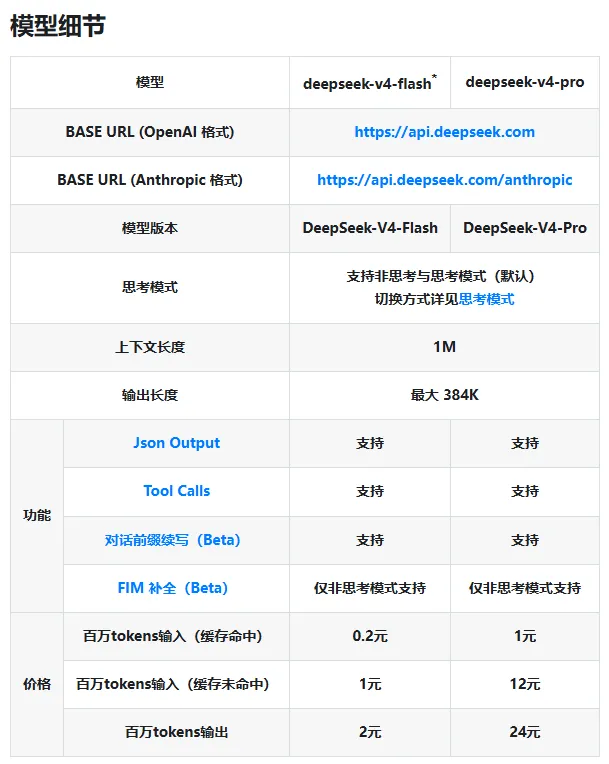
On the architecture side, DeepSeek V4 is released in two variants. The V4‑pro version uses an MoE architecture with approximately 1.6 trillion total parameters and about 49B activated parameters, while the V4‑flash version uses approximately 284B亿 total parameters and about 13B activated parameters. Combined with DeepSeek’s Sparse Attention mechanism, the design maintains high performance while substantially reducing inference cost. The model supports a 1M‑token context window and achieves 97% accuracy on the Needle‑in‑a‑Haystack test, far exceeding the 84.2% of standard attention mechanisms. This design enables V4 to excel at handling large code repositories, long research reports and similar scenarios, while its inference cost is roughly one tenth that of comparable closed‑source models.

Coding capability is a standout feature of DeepSeek V4. On the SWE‑Bench Verified benchmark, V4 scores over 80%, leading Claude Opus 4.6 (around 80.8%) and GPT‑5.4 (around 77.3%). On HumanEval it scores about 90%, with markedly improved autonomous planning and debugging capabilities on complex multi‑file projects. The DeepSeek team says these results stem from large‑scale code data cleaning and targeted reinforcement learning for agentic tasks, making the model more practical in real software engineering scenarios.
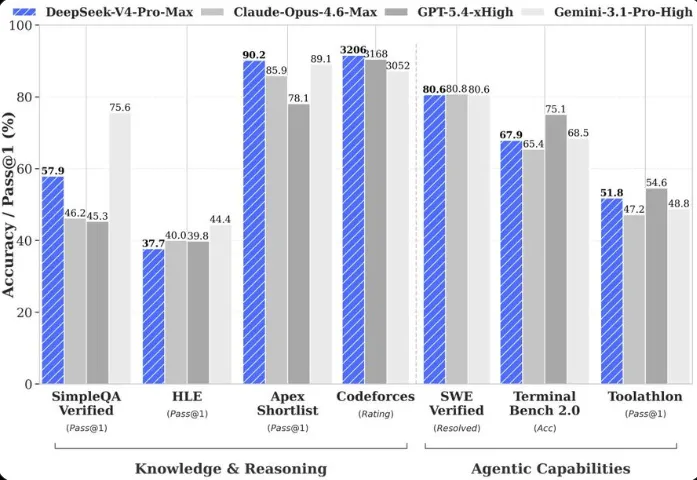
V4 also supports native multimodal input (text, image, video) and performs strongly in mathematical reasoning (AIME 2026 score 92%) and general knowledge (MMLU score 89%). Overall, V4 achieves a "small‑activation‑big‑effect" outcome, reflecting DeepSeek’s accumulated expertise in training efficiency and model compression.
Benchmarks and cost‑performance advantages
According to official and third‑party evaluations, DeepSeek V4 leads on several key benchmarks:
- SWE‑Bench Verified: 80%+ (leading most open‑source models, approaching or surpassing some top closed models)
- HumanEval: ~90%
- MMLU: ~89%
- Needle‑in‑a‑Haystack (1M token): 97%
- Inference cost: input about $0.14 per million tokens, output about $1.75 per million tokens, significantly lower than Claude and GPT series
This cost‑performance advantage makes V4 particularly suitable for developers, local deployment and enterprise applications. After open‑sourcing, the community has begun integrating it into agent frameworks such as OpenClaw and Cline, which is expected to further lower the barrier to AI coding tools.
Industry impact: domestic open‑source AI enters the high‑performance era
The release of DeepSeek V4 has multiple impacts on the global AI ecosystem:
- Open‑source community vitality: Full open‑sourcing will attract many developers for fine‑tuning and vertical optimization, driving explosive growth in AI Agents, code assistants and related tools.
- International competitive landscape: V4’s lead in coding capability further narrows the gap between Chinese AI and top international closed models, offering global developers a cost‑effective alternative.
- Commercialization model: By open‑sourcing to attract attention while retaining enterprise‑grade API services, DeepSeek forms a healthy "open‑source benefits + commercial loop" model, offering a new example for the industry.
- Pressure on closed‑source giants: Companies like OpenAI and Anthropic will face competition from high‑performance open‑source models and may accelerate their own model iteration and pricing adjustments.
For China’s AI industry, V4’s success reaffirms the feasibility of a "high‑efficiency MoE architecture + domestic compute" path. DeepSeek’s training practice on Huawei chips also provides an important reference for a domestically controllable AI development path.
Challenges and future outlook
Despite strong results, DeepSeek V4, as a new model, still has room for optimization in ultra‑long contexts, complex multilingual tasks and long‑term stability. After open‑sourcing, balancing community contributions with commercialization and addressing potential safety risks will also be new challenges for DeepSeek.
The DeepSeek team says it will continue iterating the V series and strengthen cooperation with the open‑source community. The consecutive open‑source releases of GLM‑5.1, Minimax2.7 and DeepSeek V4 together mark 2026 as the beginning of a "high‑performance open‑source era" for domestic large models. As more companies follow, this trend could help China’s AI take an increasingly important position on the global stage.
DeepSeek V4’s release is not only a technical breakthrough but also a concentrated expression of confidence and capability in domestic open‑source AI. It demonstrates that with autonomous compute, accumulated data and engineering optimization, open‑source models can match or even surpass closed‑frontier models on key benchmarks. This event may accelerate a global shift from "closed‑source monopoly" toward a new pattern in which "open‑source accessibility + high‑end competition" coexist.
▶️ Enjoyed this article? Creating great content takes effort!
Subscribe to our YouTube channel:
AI Rosetta
Your likes, subscriptions and shares mean the world to us! 🙏
For more AI news, visit:
https://www.airosetta.com