
After major AI companies (including OpenAI, Google, xAI and Anthropic) released their latest model upgrades, Chinese AI startup DeepSeek struck back, officially open‑sourcing DeepSeek‑V3.2 and its high‑performance variant V3.2‑Speciale on December 1. Both models adopt an "inference‑first" design tailored for the agent era and have been hailed as the "new king of open‑source AI." V3.2, the formal successor to V3.2‑Exp, delivers GPT‑5–level balanced performance; V3.2‑Speciale goes further in deep reasoning, reportedly surpassing GPT‑5 and rivalling Google’s Gemini 3.0 Pro, achieving gold‑level results in top competitions such as the International Mathematical Olympiad (IMO) and the International Olympiad in Informatics (IOI). This release marks an open‑source breakthrough in complex reasoning and, by releasing under an MIT license combined with ultra‑low‑cost API access (1,000,000 tokens for just $0.28), reshapes the commercial AI landscape and has ignited debate about US–China AI competition.
DeepSeek’s move is timely. In 2025 the global AI market is shifting from a "scale race" to a contest in "reasoning efficiency." OpenAI’s GPT‑5 and Google’s Gemini 3.0 Pro dominate high‑end applications as closed high‑performance offerings, but steep training and inference costs (GPT‑5 reportedly exceeds $10 per 1M tokens) deter many developers. The DeepSeek V3.2 series aims to fill that gap with a 685 billion‑parameter model, a 128K context window and open weights. V3.2 is already fully deployed on DeepSeek’s app, web platform and API; V3.2‑Speciale is currently limited to API access (dedicated endpoint: https://api.deepseek.com/v3.2_speciale_expires_on_20251215) and will be offered on a limited basis until December 15, after which its capabilities will be merged into the standard edition. Both models are freely available for download on Hugging Face, support LoRA fine‑tuning and full‑parameter training, and include Python scripts compatible with the OpenAI format to ease developer integration.
On the technical side, the V3.2 series’ headline innovation is the "DeepSeek Sparse Attention" (DSA) mechanism, which reduces the traditional Transformer’s quadratic attention complexity toward near‑linear. DSA uses a "lightning indexer" that selects only the top‑k (fixed at 2048) critical historical tokens per query for core computation; the indexer itself runs in FP8 with a small number of heads, adding negligible overhead. Under a 128K long context, decoding cost falls by about 70% versus V3.1‑Terminus, dropping from $2.40/1M tokens to $0.70/1M tokens. Training proceeds in two stages: first a "dense warm‑up" that freezes weights from V3.1‑Terminus so the indexer can mimic dense attention distributions (2.1B tokens); then a switch to sparse mode for full‑parameter training over 943.7B tokens, using a low learning rate to ensure a smooth transition. V3.2 also introduces the "Thinking in Tool‑Use" feature, embedding reasoning into tool calls and supporting both "thinking" and "non‑thinking" modes for tool interaction—useful for tasks like code debugging and multi‑step planning.
In reinforcement learning (RL), DeepSeek invested more than 10% of pretraining compute and adopted a GRPO‑style framework: an unbiased KL estimate provides clean reward signals, off‑policy sequence masking preserves safe training with older rollouts, and MoE routing consistency avoids sampling bias. Data synthesis is another key strength: the training mix covers 1,800+ environments and 85,000+ complex instructions, including search‑agent trajectories, code‑interpreter scenarios and multi‑tool interactions, simulating realistic tasks such as travel planning and web research. These innovations help the V3.2 series stand out in agent performance—for example, maintaining contextual coherence across multi‑turn interactions instead of merely generating outputs.
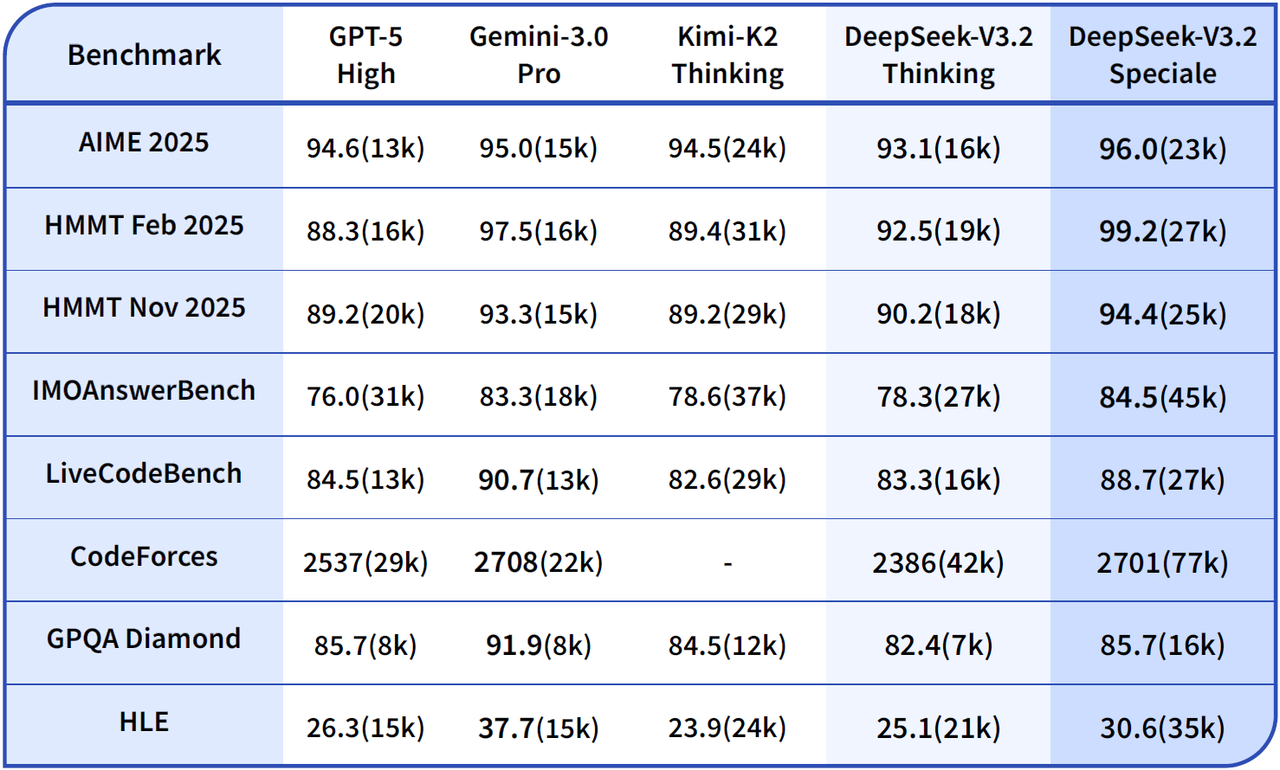
(Note: V3.2‑Speciale excels on complex tasks but requires higher token usage. It is currently available only via API (no tool support) to facilitate community evaluation and research.)
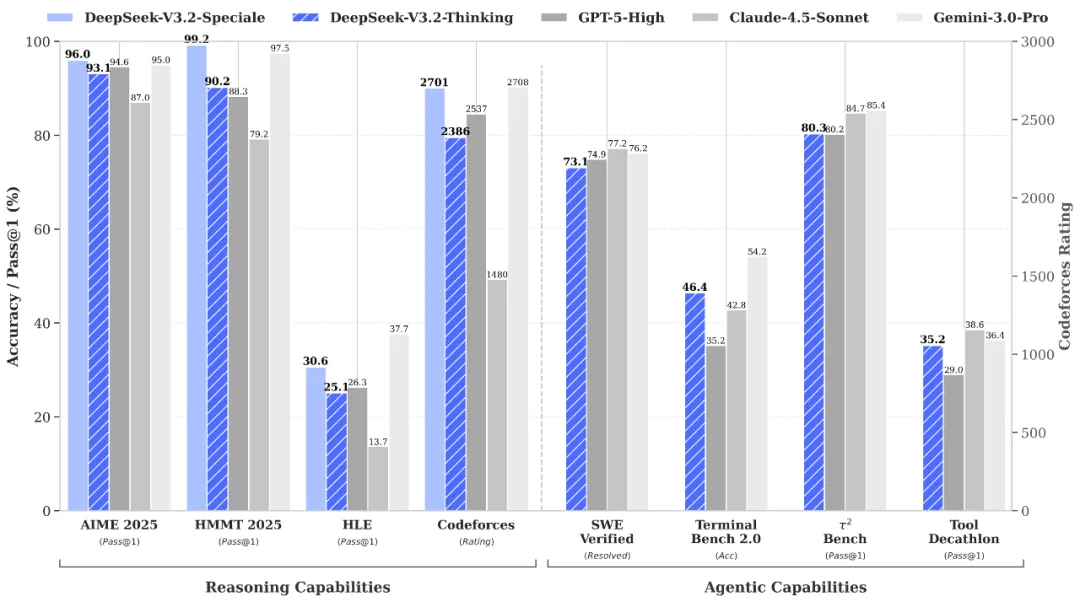
Benchmark results reinforce its "reasoning‑strong" reputation. V3.2 scored 93.1% pass@1 on AIME 2025 and 92.5% on HMMT 2025; V3.2‑Speciale rose to 96.0% on AIME (surpassing GPT‑5‑High at 94.6% and Gemini 3.0 Pro at 95.0%) and 99.2% on HMMT (above Gemini’s 97.5%). In competition‑grade tasks, the Speciale variant achieved 35/42 on the 2025 IMO (gold level), 492/600 on IOI (10th place), solved 10/12 problems in the ICPC World Finals (2nd place), and earned a gold medal at China’s Mathematical Olympiad (CMO). On coding benchmarks, V3.2 fixed 73.1% of bugs in SWE‑Verified (slightly below GPT‑5‑High’s 74.9%) and reached 46.4% on Terminal Bench 2.0 (exceeding GPT‑5’s 35.2%). Compared with Claude 4.5, V3.2 is only slightly behind on complex tool‑usage benchmarks but overall matches or exceeds GPT‑5 baselines. These results owe much to synthetic data distillation; Speciale’s high‑compute "deep thinking" mode consumes roughly 2–3× the tokens.
V3.2 is not without limitations. World knowledge—especially on recent events—still lags closed models; token efficiency can be weaker on extremely hard provable tasks; and Speciale does not support tool calls, positioning it as a pure internal‑reasoning model. Developer feedback indicates strong long‑context efficiency but notes that very high‑load scenarios may need additional error handling. Nevertheless, its advantages are clear: a 25–30× cost advantage over GPT‑5/Gemini combined with open‑source licensing dramatically lowers the access barrier.
The release has wide industry implications. As a representative of Chinese AI, DeepSeek has bypassed U.S. export controls and, using reportedly modest resources (the report cites resource usage about 1/30 that of Google), achieved cutting‑edge performance—evidence of the open‑source path’s potential. VentureBeat analysis suggests this could challenge U.S. tech dominance and help shift AI from "industrial rocket science" to mass infrastructure. EU privacy concerns (Germany and Italy have already banned related apps) and U.S. device restrictions remain, but the spread of open‑source models appears irreversible. On X, DeepSeek’s official post gathered over 10,000 likes and users called it "a warm color in an AGI winter." A Reddit thread in r/LocalLLaMA drew hundreds of upvotes, with developers praising that "open source has finally caught up to closed models."
Looking ahead, DeepSeek plans to expand pretraining scale to close knowledge gaps and to explore ultra‑long contexts of 10M–100M tokens. The arrival of the V3.2 series not only paves the way for the agent era but also signals that open‑source AI may lead the next wave of innovation. Developers and researchers are flocking to test the models—the question of whether this "reasoning box" can truly supersede GPT‑5 and Gemini will likely be answered in community benchmarks and evaluations.