
After a relatively long wait, Hangzhou startup DeepSeek on Monday (2025‑09‑29) released its latest experimental model DeepSeek‑V3.2‑Exp to developers and the public, positioning it as an "intermediate step" toward the next‑generation architecture. In its official announcement and developer platform, the company said V3.2‑Exp builds on V3.1‑Terminus and introduces a sparse attention mechanism called DeepSeek Sparse Attention (DSA), designed to improve training and inference efficiency in long‑context scenarios while significantly lowering compute costs. The company stated the model is available in its applications, web interface and API, and that API pricing has been reduced by more than 50% to broaden adoption and testing.
In summary, the DeepSeek‑V3.2‑Exp release highlights the following:
1. Introduction of a sparse attention mechanism (DeepSeek Sparse Attention, DSA)
- By selecting only a subset of key tokens in attention computations, it substantially reduces computational complexity.
- DSA is an improved version of the Native Sparse Attention (NSA) approach that won the 2025 ACL (Association for Computational Linguistics) Best Paper award; that paper was coauthored by DeepSeek with Peking University and the University of Washington.
- It improves efficiency and stability for long‑context processing, suitable for tasks such as long‑document QA, code understanding and multi‑turn dialogue.
2. Significant reduction in inference and training costs
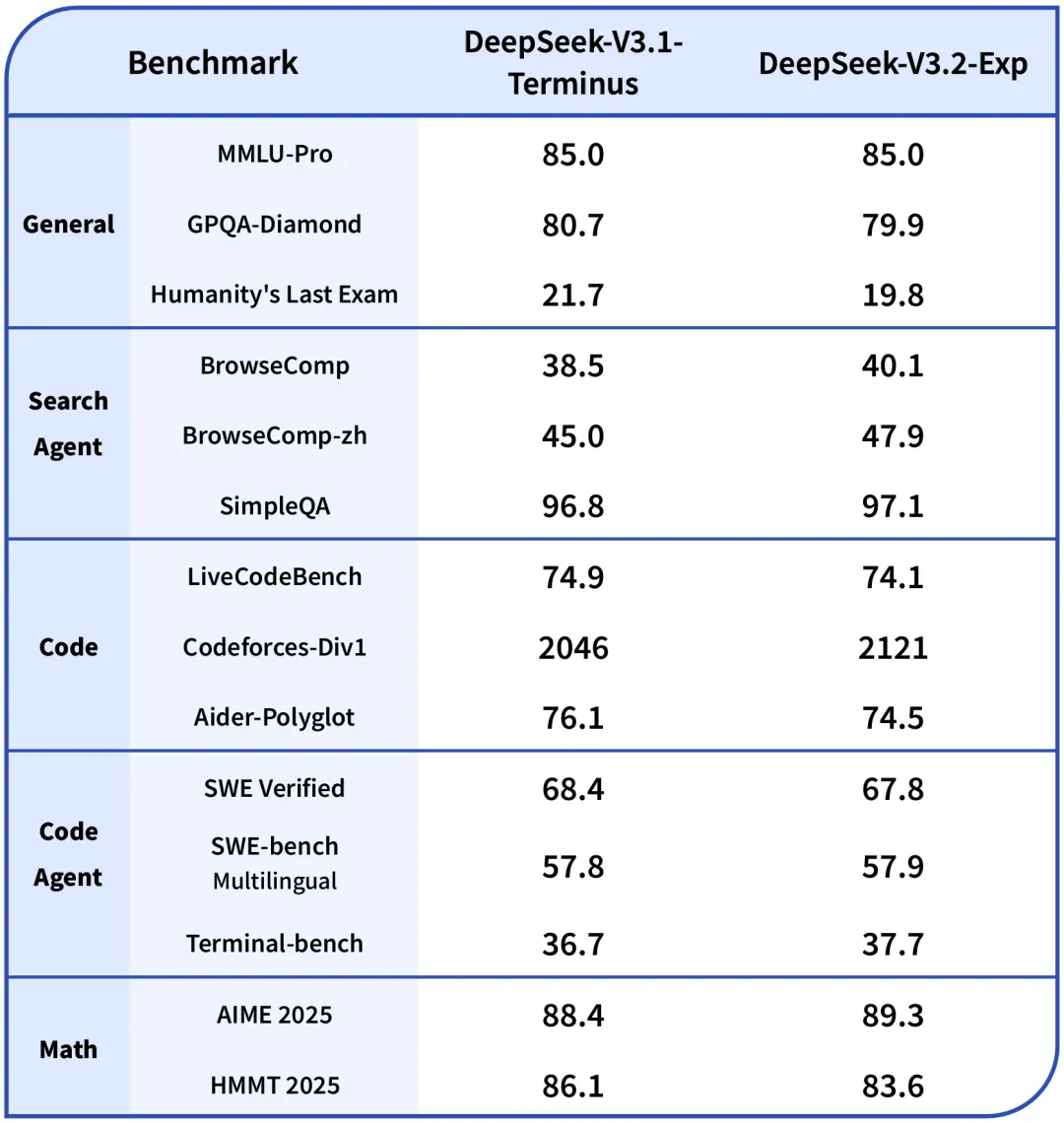
- It substantially lowers compute consumption while maintaining comparable output quality.
- API pricing has been reduced by over 50%, making it more attractive to enterprises and developers.
3. Positioned as an "interim" or transitional release
- V3.2‑Exp is positioned as an experimental interim release to test the new mechanism and gather market feedback.
- It aims to accumulate experience for subsequent major version iterations (e.g., V3.5 or V4).
4. Open source and developer support
- Parts of the codebase and inference scripts have been released on Hugging Face and ModelScope.
- This enables researchers and engineers to get started and reproduce results quickly.
5. Commercial strategy: price cuts + user base expansion
- By lowering prices and opening the API, the company aims to attract more developers.
- It could be advantageous in large‑scale and cost‑sensitive scenarios such as customer service bots and knowledge‑base retrieval.
6. Optimization for domestic AI chips 🧩
- V3.2‑Exp has been deeply optimized for domestic AI chips to ensure efficient operation in non‑NVIDIA GPU environments.
- This helps increase utilization of domestic compute resources and reduce dependence on overseas hardware.
From a technical perspective, DeepSeek’s DSA belongs to the sparse attention family: by focusing attention computations on a subset of key tokens or using a learnable indexing selection mechanism, it moves attention complexity from the typical quadratic O(n²) toward near‑linear regimes. Such approaches have become a mainstream solution for ultra‑long contexts in recent years, but implementation details and selection strategies directly affect model performance and stability. DeepSeek has open‑sourced parts of the implementation and inference scripts in its Hugging Face repository to facilitate community reproduction and testing across different sequence lengths and tasks.
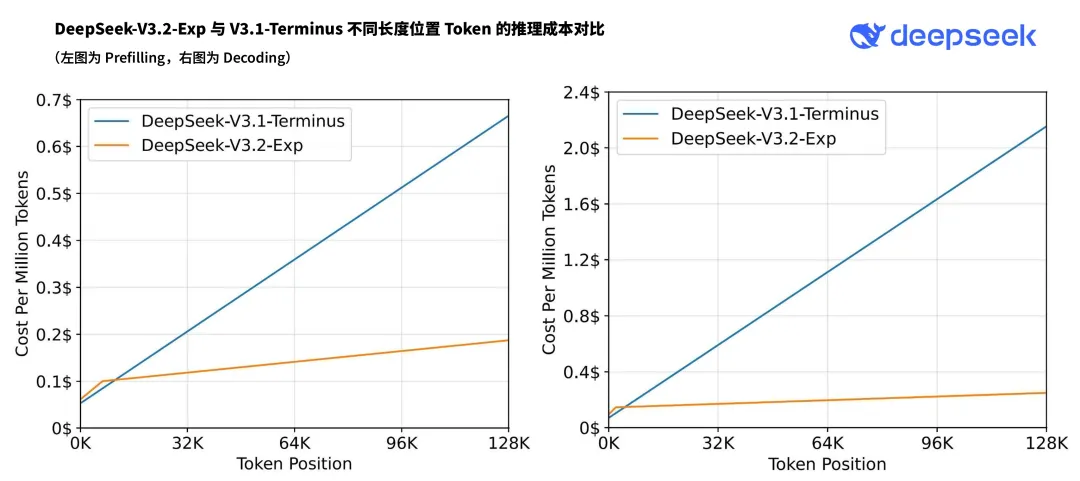
On the industry impact, V3.2‑Exp is not billed by DeepSeek as a "revolutionary" upgrade but rather as an engineering and architectural validation: it explores whether architectural sparsification can feasibly compress costs while maintaining comparable generation quality. Observers note that if DeepSeek can deliver similar user experiences at lower compute cost in real product scenarios, it will hold a clear advantage in cost‑sensitive applications (such as large‑scale online APIs, chatbots, and enterprise on‑prem deployments), which may pressure average API pricing in the market and domestic and international competitors. The company’s strategy also sends a commercial signal: using price cuts to attract traffic and expand the pool of model users to rapidly collect real‑world feedback for further iteration.
Media and analysts offered varied angles on DeepSeek’s release. Reuters reported that V3.2‑Exp is an experimental version in DeepSeek’s transition to a "next‑generation architecture" and may not spark the same scale of industry disruption as prior releases like V3 or R1; nevertheless, if it achieves real gains in cost and long‑context handling, it will strengthen the company’s market competitiveness. Bloomberg and the South China Morning Post also noted the company’s adaptation strategy for domestic AI chips and decentralized deployments, saying DeepSeek seeks to use engineering innovations to narrow gaps in compute and ecosystem.
It is worth noting that DeepSeek’s recent open‑source and low‑price strategies are not isolated moves. The company has previously published several codebases and algorithmic details and introduced optimizations such as Native Sparse Attention (NSA) in prior versions to improve long‑sequence training efficiency; V3.2‑Exp can be seen as another practical test along that path. At the same time, external attention to DeepSeek has not been entirely positive: reports and discussions about possible improper borrowing of some external model methods have occasionally appeared, raising higher demands for transparency and compliance.
For developers and enterprise users, short‑term focal points include: the quality–cost tradeoff of V3.2‑Exp across different tasks (such as long‑document QA, code understanding, and multi‑turn dialogue), the generalization stability of DSA on extremely long contexts, and the maturity of the officially open‑sourced code or inference optimization tools. DeepSeek’s simultaneous release on platforms like Hugging Face and ModelScope means researchers and engineers can more quickly run reproduction experiments and compare other sparse/efficient attention variants to determine the architecture’s practical value.
The release of DeepSeek‑V3.2‑Exp looks more like a "probe"—collecting engineering data for the next generation of larger and more innovative architectures while using pricing to attract a broader user base. It reflects Chinese AI startups’ ongoing attempts in model engineering and cost control and reminds the industry that pursuing lower costs must be balanced with model reliability and transparency of data and methods. In the coming weeks and months, as more benchmark tests, community reproductions and product‑level feedback emerge, the community will better assess the real‑world value of DSA and V3.2‑Exp.