
August 22, 2025 – Chinese AI startup DeepSeek AI this week officially released its open‑source large language model (LLM) DeepSeek‑V3.1, marking another milestone in the company's AI development. DeepSeek‑V3.1, an iteration of the V3 series, combines advantages of the previous DeepSeek‑V3 and DeepSeek‑R1, introduces a hybrid inference mode (supporting both thinking and non‑thinking paths), and achieves significant improvements in tool invocation, agent capabilities, and overall efficiency. The release not only strengthens DeepSeek's competitiveness in the open‑source AI ecosystem, but also provides developers with more efficient and practical tools, especially for programming, search and complex task handling. The model's launch has sparked industry discussion, with many experts saying it will further boost China's global AI influence.
DeepSeek AI was founded in 2023 and is headquartered in Shanghai. The company, driven by the mission "explore AGI with curiosity, solve fundamental problems with long‑termism," focuses on developing efficient, open‑source AI models. Since the V3 series debut in 2024, it has been noted for its large parameter counts (671B total parameters, 37B effective activations) and low cost; earlier versions have been widely downloaded and used on Hugging Face. V3.1 is not a wholly new model but an optimized iteration of V3: parameter scale remains the same while performance is improved through fine‑tuning. The company said in a blog post that the upgrade aims to address previous shortcomings in tool usage and multi‑step reasoning, while adding optimizations for domestic chips.
One core upgrade is the hybrid inference mode design. DeepSeek‑V3.1 supports a "thinking mode" and a "non‑thinking mode," which users can switch between via API parameters. In thinking mode, the model performs deeper multi‑step reasoning, suitable for complex search and planning tasks; in non‑thinking mode, it emphasizes speed and conciseness, suitable for everyday conversations or quick responses. This design draws on approaches from OpenAI's GPT series and Anthropic's Claude models, but DeepSeek highlights higher efficiency: output tokens are reduced by 20–50% and inference speed is significantly improved. The company says mode switching is implemented via simple tags, greatly lowering the development barrier.
In benchmark tests, DeepSeek‑V3.1 delivered strong results. SWE‑Bench Verified (software engineering benchmark) score rose from V3's 45.4% to 66.0%, an increase of about 48% over R1's 44.6%. On SWE‑Bench Multilingual the score reached 54.5%, roughly an 86% improvement over the previous generation. Terminal‑Bench scored 31.3%, improving 135% and 449% over V3 and R1 respectively. These gains stem from optimizations in tool invocation and agent capabilities, such as stronger multi‑step reasoning and complex search handling. The company also introduced the UE8M0 FP8 data format, designed for next‑generation domestic chips to ensure efficient performance on local hardware.
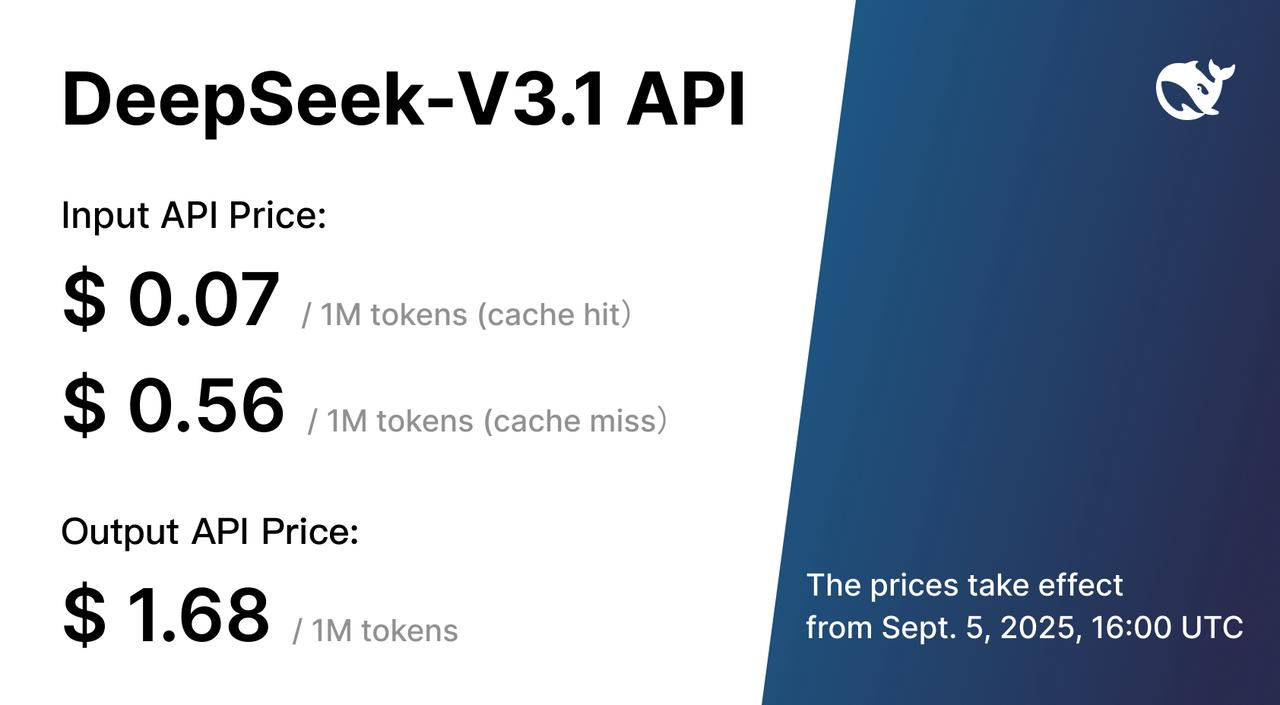
At the API layer, DeepSeek‑V3.1 brings multiple developer‑friendly features. The context window expands to 128K tokens and the model supports the Anthropic API format, making it easier to integrate with tools like Claude Code. The Beta API introduces Strict Function Calling, ensuring outputs strictly follow schema definitions and avoiding inconsistent responses seen in prior models. Pricing remains competitive: input tokens $0.56 per million tokens, output tokens $1.68 per million tokens, substantially below GPT‑5's pricing (input $1.25/million, output $10/million). This makes DeepSeek‑V3.1 attractive to the open‑source community and enterprises, particularly in cost‑sensitive scenarios.
The release has prompted speculation about DeepSeek's product‑line strategy. The anticipated DeepSeek‑R2 (successor to R1) has not yet appeared; instead the company delivered a "hybrid" upgrade to V3. South China Morning Post suggested this may reflect cautious positioning of the R series, aiming to ensure R2 can compete with top closed‑source models like GPT‑5 or Claude 4. The relatively low‑key WeChat group announcement for V3.1—a brief notice—has fueled speculation about internal adjustments at DeepSeek.
From an industry perspective, DeepSeek‑V3.1 reinforces China's leadership in open‑source AI. China has become a global innovation hub in AI, and companies like DeepSeek are challenging Silicon Valley giants with low‑cost, high‑performance models. Reuters reported that the upgrade's support for domestic chips reflects efforts toward hardware self‑reliance amid US‑China tech tensions. Bloomberg said V3.1's release could accelerate open‑source AI adoption and drive SMEs to adopt AI tools. On X, user feedback was largely positive: many developers praised improvements in programming tasks, citing SWE‑Bench scores that surpass GPT‑5‑mini. However, some critics noted that the thinking mode does not support function calling, limiting advanced agent applications.
Compared with other models, DeepSeek‑V3.1 stands out in the open‑source camp. Versus Qwen3 235B, it achieves comparable scores in thinking mode but at a lower price. Compared with closed‑source models like GPT‑5, V3.1's open‑source nature allows community‑driven customization and optimization, fostering innovation. The model card on Hugging Face shows V3.1 supports BF16, FP8 and FP32 formats, offering high inference efficiency suitable for local deployment. YouTube analyses described this version as "impressive" for code generation and tool use, noting strong performance on benchmarks such as Gomoku Arena.
Looking ahead, the release of DeepSeek‑V3.1 may presage the arrival of R2. The company says it will continue investing in AGI research and emphasizes long‑termism. Experts believe this iteration will accelerate AI democratization but stress attention to ethics and data privacy. DeepSeek's low‑price strategy could disrupt the market and push global AI competition toward a more inclusive direction.