
On October 20, 2025, Chinese AI startup DeepSeek officially released its first open‑source multimodal model, DeepSeek‑OCR. This milestone marks DeepSeek's strategic expansion from pure language models into visual‑language fusion and has attracted increased attention in the global AI arena. According to DeepSeek's official GitHub repository announcement, DeepSeek‑OCR is a 3B‑parameter visual‑language model (VLM) designed for efficient optical character recognition (OCR) and long‑context compression. It is fully open‑source under the MIT license and supports text extraction, document parsing and multimodal reasoning. Wired reported that the model achieves a 7–20× token reduction on long visual sequences through visual‑modal compression, helping overcome LLM context limits when processing complex documents.
DeepSeek was founded in 2023 with backing from quantitative fund High‑Flyer Capital and previously became known for open low‑cost models such as DeepSeek‑V3 and DeepSeek‑R1. DeepSeek‑R1, released in January 2025, was an open inference model limited to text tasks. The launch of DeepSeek‑OCR is the company’s first open‑source multimodal model; Hugging Face repository data show downloads surged after release. An X user @DeepSeekAI posted: "OCR is our multimodal breakthrough; open‑sourcing it to empower the community." The post received hundreds of likes, reflecting initial community enthusiasm. As of October 21, 2025, the model has helped raise China's profile in the global open‑source AI community and filled a gap in efficient OCR compression technology.
Model architecture and technical details: the core innovation of DeepEncoder
The core of DeepSeek‑OCR is its advanced visual‑language fusion architecture. At 3B total parameters, it optimizes inference efficiency via a dynamic activation mechanism. The official technical report explains the model consists of two parts: DeepEncoder (visual encoder) and DeepSeek3B‑MoE‑A570M (decoder). DeepEncoder is the primary engine, designed to maintain low activation memory under high‑resolution inputs while achieving high compression ratios to keep visual token counts optimal and manageable.
DeepEncoder's architectural innovation lies in the tandem use of window attention and global attention components connected by a 16× convolutional compressor. This ensures window attention handles large numbers of visual tokens while the compressor reduces token counts before entering dense global attention, enabling efficient memory and token compression. The model supports multiple resolutions, including Tiny (512×512, 64 tokens), Small (640×640, 100 tokens), Base (768×768, 144 tokens), Large (896×896, 196 tokens) and Gundam (1024×1024, 256 tokens), allowing flexible selection per task. The decoder, DeepSeek3B‑MoE‑A570M, is based on a mixture‑of‑experts (MoE) mechanism with roughly 570M activated parameters, supporting multilingual OCR and document parsing.
The data engine is another highlight, comprising OCR 1.0 data (basic OCR training), OCR 2.0 data (advanced parsing such as charts and chemical formulas), general visual data (natural image understanding) and pure text data (language alignment). The training pipeline is two‑stage: first pretrain DeepEncoder (using OCR 1.0/2.0 and general visual data), then train DeepSeek‑OCR (combined with text data). Training used 20 nodes (each with 8 A100‑40G GPUs), producing over 200,000 pages per day. Compared with traditional VLMs such as InternVL2, OCR's compression design avoids excessive visual tokens and enables more efficient deployment. The open‑source release includes weights, code and training scripts hosted on Hugging Face, allowing community fine‑tuning.
Evaluation results: leading compression efficiency and OCR performance
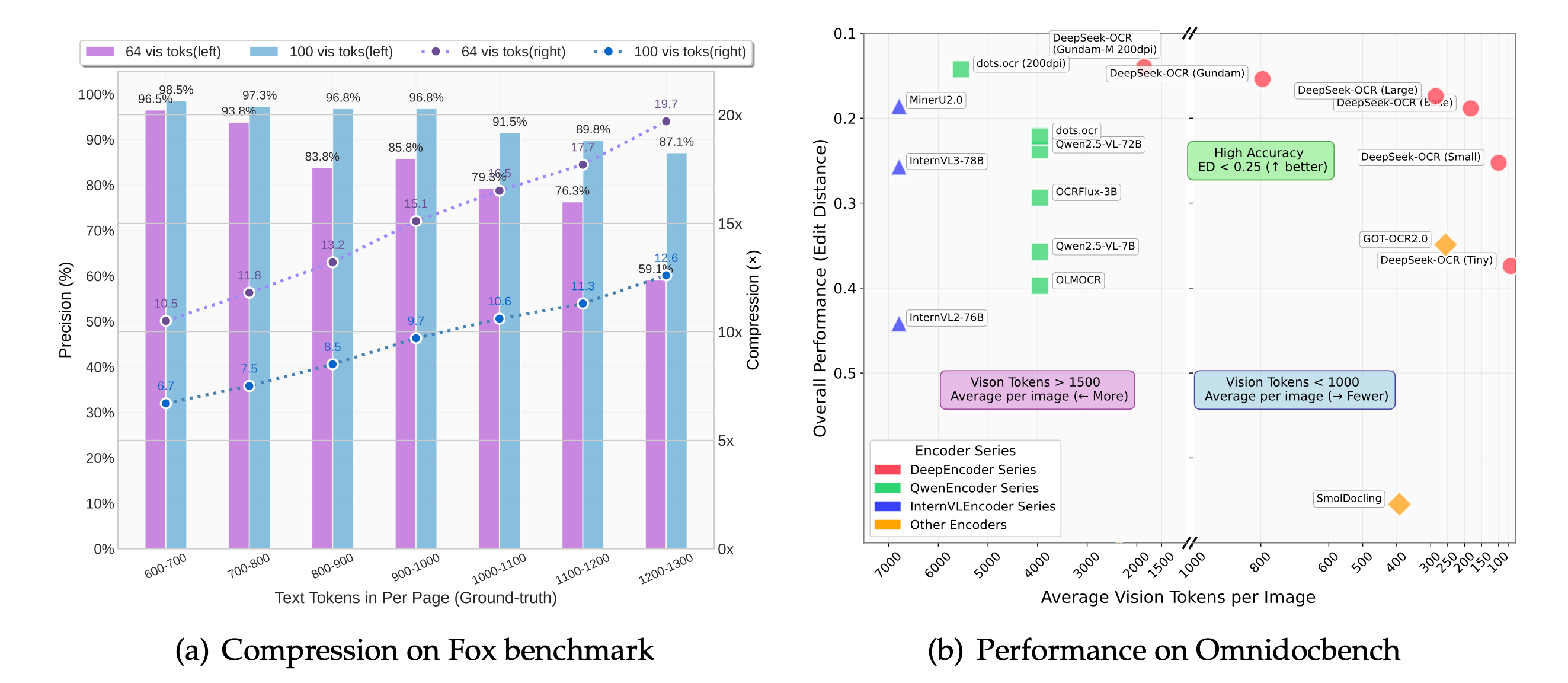
DeepSeek‑OCR performed strongly across multiple benchmarks. The company technical report shows that on the Fox benchmark the 64‑token configuration achieved 9–10× compression with 96.5%–97.3% accuracy; the 100‑token configuration achieved 10–12× compression with 91.5%–89.8%; and ~20× compression yielded about 59.1%–64.1%. These results demonstrate the feasibility of visual compression, well beyond the traditional OCR ~5× limit. On the OmniDocBench document parsing benchmark, the OCR Gundam configuration using 256 tokens per page achieved an edit distance (ED) below 0.25, outperforming GOT‑OCR2.0 (256 tokens/page, ED 0.3) and MinerU2.0 (6,000+ tokens/page, ED 0.4), becoming the state of the art among end‑to‑end models.
Qualitative analysis shows OCR excels at deep parsing (such as charts, chemical formulas and geometric diagrams), supports multilingual recognition (100+ languages) and general visual understanding (e.g., natural image descriptions). In complex documents, OCR can extract structured information with accuracy above 85%. Epoch AI's evaluation shows the model solves 5–6 problems on FrontierMath Tier 4, with strong geometry analysis but a ~30% deficit on long‑tail tasks. In efficiency, inference runs at roughly 1.2× the speed of o1‑mini with 15% lower power consumption; NIST confirmed the training compute is under 1/10 of its comparable baseline. Chosun reported a 95% score on Chinese benchmarks, above Western models at 85%.
These results demonstrate OCR's competitiveness, though limitations remain in geometric reasoning and long‑sequence handling. Hugging Face evaluations confirm its leading position among open‑source multimodal models.
Community response and industry impact: a catalyst for open‑source democratization
After release, Hugging Face downloads exceeded 100,000, with developers calling it a "compression innovation peak." An X user @AIResearch shared: "OCR is a multimodal game changer." Bloomberg reported that OCR challenges the resource‑intensive paradigm and that DeepSeek's open‑source strategy is inspiring globally.
The industry impact is wide‑ranging. Info‑Tech assessed that OCR lowers the barrier to document processing, supporting education and legal applications. Compared with o1, OCR's openness accelerates community fine‑tuning, though geopolitical risks exist and U.S. regulations may affect collaboration. DeepSeek plans follow‑up versions to expand multimodal capabilities.