
Introduction
On January 27, 2026, Chinese open‑source AI leader DeepSeek officially released the DeepSeek‑OCR 2 model, marking a major advance in document understanding and optical character recognition (OCR). The vision‑language model (VLM) introduces the "Visual Causal Flow" concept, which dynamically reorders visual tokens to significantly improve understanding of complex document layouts and set new state‑of‑the‑art (SOTA) records across multiple international benchmarks. The official DeepSeek GitHub repository and Hugging Face model card were published simultaneously. Despite a model size of only 3B parameters, DeepSeek‑OCR 2 demonstrates strong performance in visual document understanding, OCR accuracy, and multimodal inference, and is being hailed as a leading 3B‑class document AI.
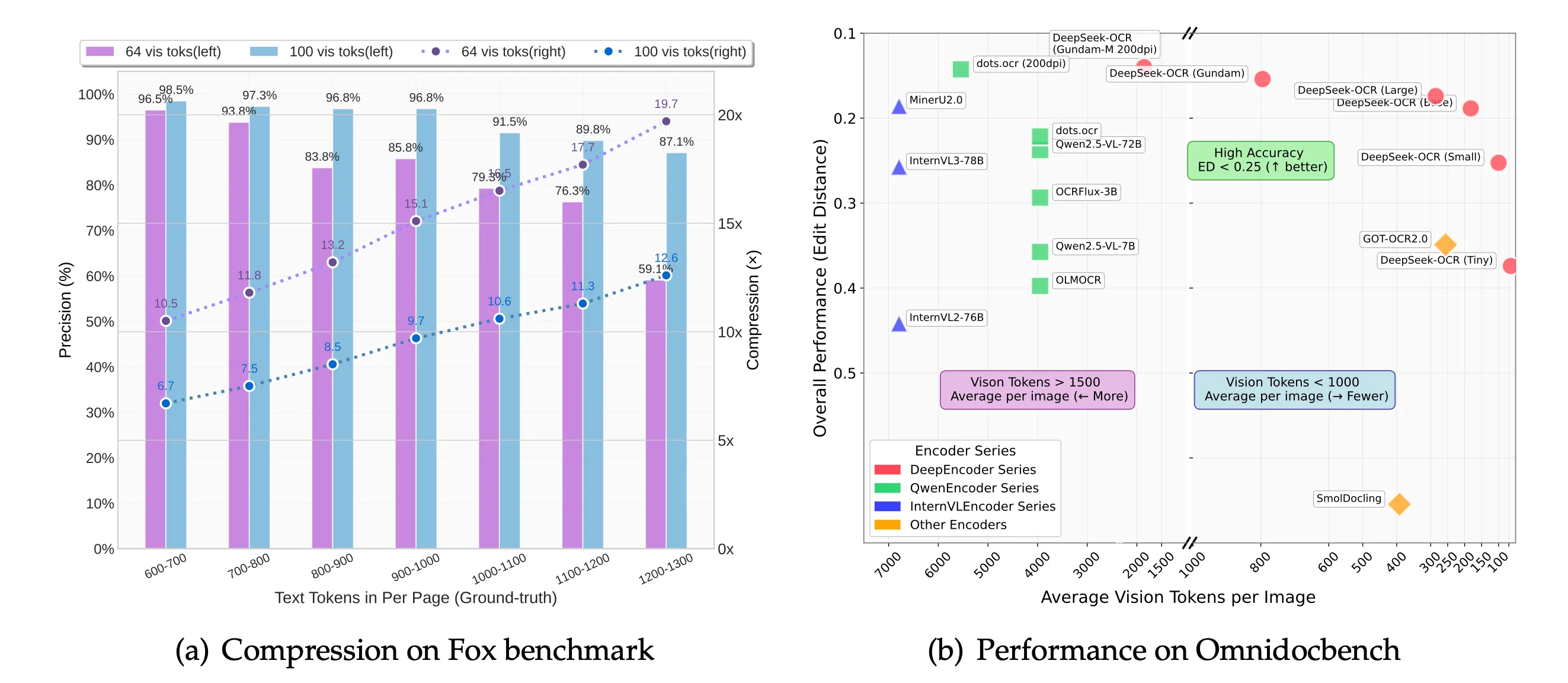
This release continues DeepSeek's exploration since the 2025 DeepSeek‑OCR series into "visual compression and long‑context optimization." The original DeepSeek‑OCR achieved 7–20× context compression through optical compression; DeepSeek‑OCR 2 focuses on the logical‑understanding bottleneck, addressing accuracy drops in traditional OCR for complex scenarios such as tables, formulas, and intersecting layouts. Reports by Odaily News and AIBase state that the model represents another milestone for Chinese teams in the open‑source VLM space, advancing document AI from "character recognition" toward "semantic understanding."
Model Specifications and Overall Architecture
DeepSeek‑OCR 2 has 3B (3 billion) parameters and uses an end‑to‑end vision‑language architecture that includes a visual encoder (DeepEncoder V2) and a language decoder (DeepSeek‑3B‑MoE‑A570M). The visual encoder compresses high‑resolution document images into a small number of visual tokens, while the language decoder performs semantic understanding and text generation based on those tokens.
Core components:
- DeepEncoder V2: an upgraded visual encoder that replaces the original CLIP backbone with a Qwen2‑0.5B lightweight LLM architecture, leveraging language understanding to enable semantically aware visual encoding. It combines windowed attention (based on SAM) with dense global attention to fuse local detail and global layout. Images are downsampled via two convolutional compressors at 16×, producing efficient visual tokens.
- DeepSeek‑3B‑MoE‑A570M decoder: a mixture‑of‑experts (MoE) decoder where each token activates roughly 570M parameters (6/64 routing experts + 2 shared experts) for efficient inference.
- Visual Causal Flow: the core innovation module that dynamically reorders visual tokens at inference time based on document content and semantic relations rather than a fixed raster scan order, enabling the model to "read" documents more like a human.
The model supports multilingual OCR, complex layout parsing (tables, formulas, charts), structured extraction (HTML/LaTeX/Markdown outputs), and is compatible with efficient inference frameworks such as vLLM.
Visual Causal Flow: The Core Principle Overcoming OCR Bottlenecks
Traditional OCR systems (e.g., Tesseract, PaddleOCR) rely on fixed scanning paths (such as left‑to‑right, top‑to‑bottom), which can lose logical relationships in multi‑column layouts, cross‑references, and chart captions, causing steep accuracy drops. DeepSeek‑OCR 2's "Visual Causal Flow" directly addresses this bottleneck. The principle is straightforward:
- Visual token generation and initial ordering: A high‑resolution document image is compressed by DeepEncoder V2 into a small number of visual tokens (typically 100–800), with an initial order based on raster scanning.
- Causal relationship modeling: The model leverages Qwen2‑0.5B's language understanding to analyze semantic relationships among visual tokens (for example, a table title determines the meaning of cells, or a chart caption explains the figure above). It constructs a causal graph that identifies "who influences whom" in the logical flow.
- Dynamic reordering: Based on the causal graph, the model dynamically adjusts token order during inference. For example, it may process headings before body text or read chart captions before parsing chart contents. This human‑like reading order significantly improves understanding accuracy and avoids the "inconsistencies" caused by fixed scan paths.
- Multi‑pass self‑reflection and extension: Combined with test‑time expansion mechanisms, the model performs multi‑pass reflection when necessary to further optimize token order and semantic extraction, enabling deeper handling of difficult cases.
Essentially, this mechanism reconstructs the visual sequence and uses causal reasoning to break the fixed‑scan bottleneck. The paper "DeepSeek‑OCR 2: Visual Causal Flow" reports that this approach improves accuracy by more than 30% on benchmarks such as OmniDocBench using the same number of visual tokens.
Performance and SOTA Breakthroughs
DeepSeek‑OCR 2 sets new records across multiple benchmarks:
- OmniDocBench: With 100 visual tokens it outperforms GOT‑OCR2.0 (which requires 256 tokens), and with 800 tokens it leads by a wide margin over the average level.
- OCR accuracy: At 10× compression, OCR accuracy reaches 97%, and at 20× compression it still achieves 60%, far exceeding traditional methods.
- Document understanding: It leads in recognition rates for complex layouts (multi‑column, intersecting content, formulas, charts), with strong capabilities for chemical formulas (SMILES) and geometric diagram parsing.
- Multilingual support: Covers 100+ languages, with particularly strong performance in Chinese.
AIBase and Odaily News report that the model achieves SOTA in visual document understanding, OCR accuracy, and multimodal reasoning despite having only 3B parameters, surpassing many 10B+ models. Compared with its predecessor, DeepSeek‑OCR 2 shows marked improvements in logical understanding and dynamic processing, representing a shift in visual compression from "quantity" to "quality."
Use Cases
DeepSeek‑OCR 2 is applicable to document digitization, knowledge extraction, and office automation.
- Legal and financial document processing: Enterprise users employ the model to parse dense PDF contracts, extract clauses, tables, and signatures with accuracy above 95%, saving manual review time.
- Academic paper analysis: Researchers upload paper images and the model automatically extracts formulas, figure captions, and references, producing structured Markdown output for easier analysis.
- Multilingual archive digitization: Museums use the model to process ancient books and handwritten documents, supporting 100+ languages for efficient digitization and semantic search.
- Enterprise RPA integration: Integrated with agent toolchains, the model automatically reads invoices and contracts, extracts key fields, and records them into ERP systems.
These cases are widely shared on GitHub and the ModelScope community, demonstrating the model's practical utility in real‑world scenarios.
Impact and Challenges
The release of DeepSeek‑OCR 2 further consolidates China's leading role in the open‑source VLM field and advances the shift of document AI from character recognition to semantic understanding. A Hugging Face report indicates that Chinese open‑source models account for 17.1% of downloads, with the DeepSeek series making a significant contribution.
Challenges include:
- Compute resources: Although parameter‑efficient, high‑resolution document processing still requires powerful GPU support.
- Generalization: Accuracy on extremely handwritten or very low‑quality scans remains an area for improvement.
- Ethics and security: Stronger document privacy protections are needed to prevent sensitive information leakage.
Conclusion
DeepSeek‑OCR 2 uses the Visual Causal Flow innovation to overcome traditional OCR's logical‑understanding bottlenecks and achieve SOTA performance at a 3B scale. This release is both a technical breakthrough and an example of open‑source ecosystem leadership. As community contributions and ecosystem integration grow, it is expected to accelerate the industrial adoption of document AI and push global AI toward smarter, more efficient directions.
▶️ Enjoyed this article? Creating great content takes effort!
Subscribe to our YouTube channel:
AI Rosetta
Your likes, subscriptions and shares mean the world to us! 🙏
For more AI news, visit:
https://www.airosetta.com