
SIMA 2 (Scalable Instructable Multiworld Agent 2) is the second‑generation AI agent model released by Google DeepMind on November 13, 2025, representing a major milestone in DeepMind's research on generalist AI agents. Built on SIMA 1 (March 2024), it integrates Google's Gemini model for the first time (specifically the Gemini 2.5 Flash‑Lite variant), transforming AI from a simple instruction follower into an "interactive gameplay partner" with reasoning, dialogue, and self‑learning capabilities. SIMA 2 is designed to train agents in virtual 3D worlds to achieve cross‑environment generalization and to pave the way for real‑world robots (such as autonomous vehicles or domestic assistants). The following provides a detailed explanation based on authoritative sources including the DeepMind blog, TechCrunch, and MIT Technology Review.
Model background and motivation
The SIMA series stems from DeepMind's pursuit of "generalist agents": building AI that can perform tasks in arbitrary 3D environments rather than being limited to a single game (for example, AlphaGo was limited to Go). SIMA 1 (released 2024) could learn hundreds of basic skills via screen observation and virtual keyboard/mouse control but was constrained to instruction following and struggled with complex reasoning. The motivation for SIMA 2 is to address this limitation by integrating Gemini's language and vision capabilities to achieve high‑level goal understanding, complex reasoning, and goal‑directed actions even in unseen environments (such as worlds generated by Genie 3). DeepMind regards it as a key step toward AGI, supporting a self‑improvement loop and eventual transfer to robots.
Core features and innovations
At its core, SIMA 2 is a multimodal agent architecture that handles text, speech, and image inputs and supports real‑time interaction. Key innovations include:
- Gemini integration: Gemini 2.5 Flash‑Lite acts as the "brain", enabling natural language explanations (for example, "I will now gather resources because the goal is to build a shelter") and handling vague instructions (such as "explore the nearby area").
- Self‑learning mechanism: Trained from human demonstration videos plus Gemini‑generated labels, the agent shifts to "self‑directed play": generating tasks, experimenting by trial and error, and using Gemini feedback to iterate data in a closed training loop. This reduces reliance on large amounts of human data and helps the agent learn not to repeat mistakes.
- Cross‑environment generalization: Trained across nine games (such as Goat Simulator 3, No Man's Sky, and Valheim), it can transfer skills to new environments (for example, photo‑realistic worlds generated by Genie 3). Task success reached 65% (SIMA 1 was 31%; human average 71%).
- Multimodal input: Supports text, speech, and images; outputs actions plus explanations; and enables collaboration (for example, dialoguing when a user interrupts).
Feature comparison table (SIMA 1 vs. SIMA 2):
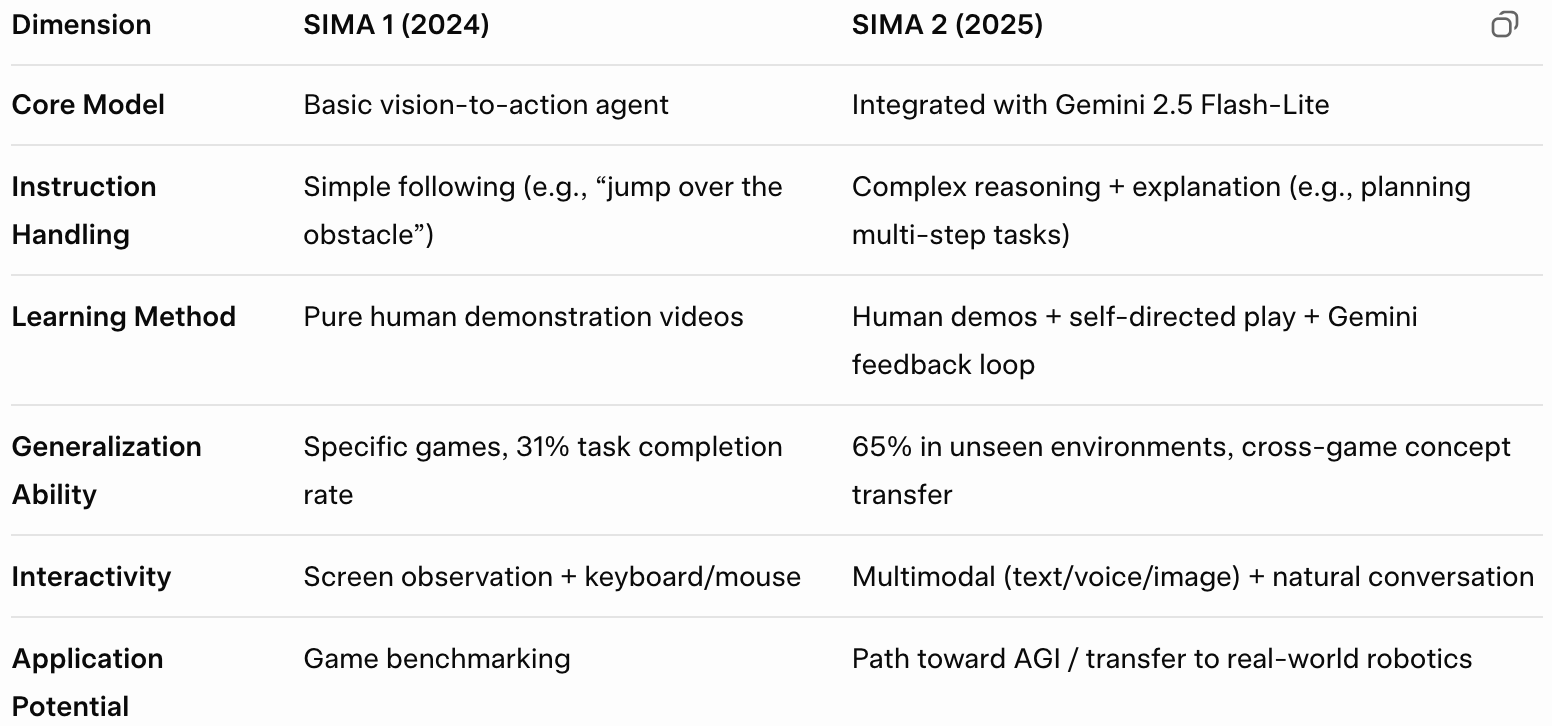
Source: DeepMind blog.
Experimental validation and performance
DeepMind tested SIMA 2 on 600+ tasks:
- Benchmark games: Goat Simulator 3 (learning new skills such as "destroying the environment with the goat"); No Man's Sky (exploration and resource collection); Valheim (survival and building).
- New environments: Combined with Genie 3 to generate worlds from prompts (for example, "volcanic landscape"), SIMA 2 can recognize and interact with objects (such as benches and butterflies).
- Performance metrics: Task success rate 65% (human 71%), reasoning accuracy improved twofold; error rate reduced by 50% after the self‑learning loop.
- Limitations: Still weak on long multi‑step tasks (10+ steps); limited memory window; challenges in 3D visual interpretation (such as occluded objects).
Impact and outlook
SIMA 2 is viewed as a hard‑mode breakthrough toward AGI: pure visual input plus real‑time action, surpassing GATO (DeepMind's 2022 multi‑task agent). DeepMind emphasizes that its skills can transfer to robots (such as autonomous navigation), and Frederic Besse described "games as a real‑world testbed." It is currently available in a limited preview to researchers and developers, and parts are expected to be open‑sourced in 2026.
TechCrunch and MIT Technology Review commented that SIMA 2 is "approaching human player levels" but still needs to address generalization bottlenecks to push the transition from games to embodied AI. For more details see the DeepMind blog (https://deepmind.google/blog/sima‑2‑an‑agent‑that‑plays‑reasons‑and‑learns‑with‑you‑in‑virtual‑3d‑worlds/).