
In April 2026, Google DeepMind officially released the GrandCode AI system. In three Codeforces live programming contests held in March 2026, the system entered under different usernames and won them all, becoming the first AI worldwide to consistently defeat all human competitors in real, high‑pressure contest settings. This marks a historic leap for AI in programming from an "assistant" to an "independent competitor." The research paper has been uploaded to arXiv (arXiv:2604.02721v1) and was produced by the DeepReinforce team.
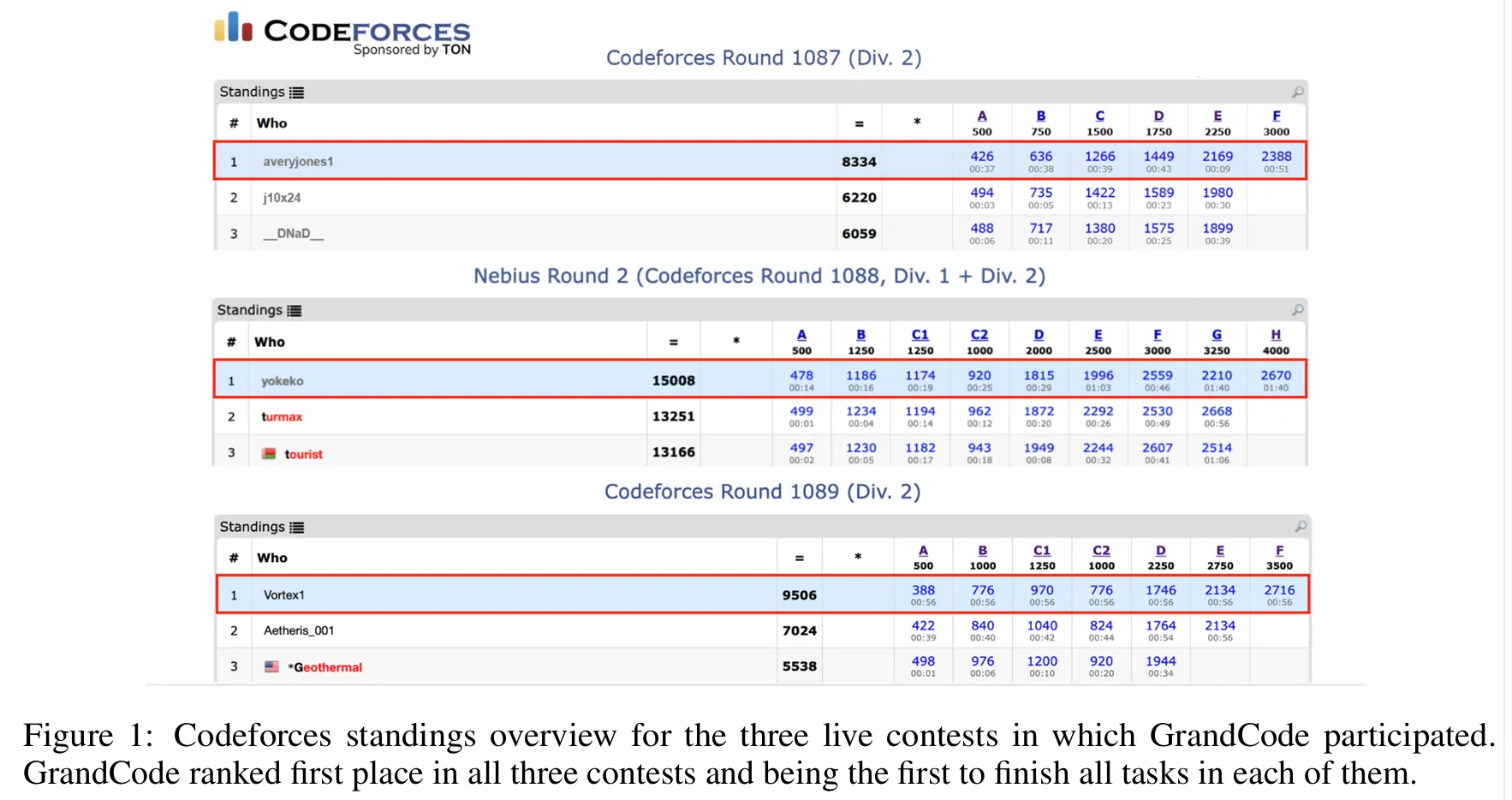
Codeforces is one of the world's most authoritative programming contest platforms, where participants must solve algorithmic problems within time limits. GrandCode won first place in Rounds 1087, 1088 and 1089 under the usernames averyjones1 (completed in 51 minutes, score 8334), yokeko (completed in 1 hour 40 minutes, score 15008) and Vortex1 (completed in 56 minutes, score 9506); in each case it was the first contestant to finish all tasks. These results far exceed previous AI systems such as AlphaCode, AlphaCode2 and OpenAI o3, drawing strong reactions from the global AI and programming communities.
Multi‑Agent Reinforcement Learning Architecture: GrandCode's Core Breakthrough
GrandCode adopts a multi‑agent reinforcement learning architecture, which is key to its superhuman performance in real‑time, high‑pressure environments. The system consists of four highly collaborative agents that form a closed‑loop workflow:
- Primary Problem‑Solving Expert: responsible for core reasoning and code generation, quickly proposing solutions from problem statements.
- Hypothesis Generation Expert: proposes multiple verification hypotheses and intermediate steps to broaden solution pathways.
- Summarization Expert: compresses lengthy reasoning into key points to avoid context overload.
- Test‑Case Generation Module: generates adversarial test cases to validate solution robustness.
The four agents use a coordination mechanism for efficient division of labor: the primary expert produces initial code, the hypothesis expert supplies verification paths, the summarization expert optimizes outputs, and the test‑case module conducts adversarial testing against potential flaws. This design substantially improves stability and correctness on complex problems.
Training proceeds in offline and online stages. The offline stage builds foundational capabilities through continual learning, supervised fine‑tuning and multi‑component reinforcement learning; the online stage dynamically selects strategies based on problem difficulty—simple problems produce direct code generation, while complex ones trigger multi‑agent collaboration. The core optimization algorithm, Agentic GRPO (Agentic Generalized Reward Policy Optimization), enhances multi‑turn interactive learning via immediate rewards and delayed correction mechanisms.
Test‑case generation employs a difference‑driven generation method (exposing differences among solutions) and a solution‑attack approach (designing tests targeting known solution weaknesses), greatly enhancing robustness. GrandCode also supports multimodal input, directly handling images and charts rather than relying on text conversion, which offers clear advantages in contests.
Additionally, the system incorporates a dynamic routing mechanism and context parallelization techniques, optimizing a hybrid architecture that combines linear and standard attention to improve computational efficiency. During testing, reinforcement learning uses a ranking‑based relaxed objective for per‑problem optimization. Code evaluation follows a three‑tier system—executability, correctness and efficiency—to ensure high‑quality outputs.
Benchmarking and Historical Comparison
DeepMind previously released AlphaCode (Codeforces rating about 1300, roughly the top 54% globally) and AlphaCode2 (85th percentile). Gemini 3 Deep Think ranked 8th on historical problems, and OpenAI o3 ranked 175th globally. GrandCode achieves comprehensive outperformance in real live contests: acceptance rate rose from a baseline 64% to 85%, and Level‑5 hard‑problem solution rate improved from 4/20 to 15/20, demonstrating a qualitative leap.
Industry Significance: A New Era for AI Programming Capability
GrandCode's breakthrough carries multiple far‑reaching implications:
- Programming education and the redefinition of programmer roles: An AI that beats humans in live contests requires rethinking what and how we teach. Programmers may shift toward system design, problem formulation and AI collaboration rather than purely manual coding.
- Surge in software development efficiency: GrandCode's multi‑agent collaboration, real‑time learning and multimodal processing provide powerful tools for practical software engineering, potentially shortening development cycles and improving code quality.
- New human‑AI collaboration paradigms: The system can not only compete independently but also act as a supercharged assistant for human programmers, enabling joint completion of more complex tasks and underpinning future co‑creation models.
- Open‑source and ecosystem impact: Although GrandCode is not fully open‑sourced, its paper and technical details offer important references to the community. Similar systems are expected to accelerate open‑source developments and upgrade the global programming tools ecosystem.
Challenges and Outlook
Despite strong contest performance, GrandCode still requires further validation of its generalization and long‑term stability on more complex real‑world engineering tasks. Balancing AI autonomy with human oversight and addressing potential code security risks are critical issues for future development.
The DeepMind team says GrandCode is not only a technical achievement but also an important exploration of future human‑AI collaboration. With model iteration and more real‑world applications, the system is expected to play a larger role in software development, algorithm contests and education.
From AlphaCode to GrandCode, Google DeepMind's sustained investment in programming AI is pushing the field from "assistive coding" toward "independent competition." This breakthrough not only resets technical benchmarks but also poses a new question for the industry: as AI capability rapidly surpasses humans in certain areas, how should we redefine human roles in programming and innovation?
The arrival of GrandCode signals a new era for AI programming. It not only changes contest dynamics but may also reshape the entire future ecosystem of software development.
Extended Analysis: Deep Technical Breakdown
The core innovation of GrandCode is its multi‑agent reinforcement learning framework. Traditional single‑agent systems can get trapped in local optima; multi‑agent design, through task specialization and collaboration, significantly improves exploration and problem‑solving depth. The primary expert focuses on efficient generation, the hypothesis expert expands the solution space, the summarization expert ensures concise and effective outputs, and the test‑case module acts as an adversary that continuously challenges solution robustness. This internal "red‑blue adversarial" mechanism is key to GrandCode's leadership in high‑pressure contests.
On the training side, the system uses the Agentic GRPO algorithm. This approach combines policy optimization ideas from reinforcement learning with a ranking‑based relaxed objective function that dynamically adapts to each problem, mitigating the sparse‑reward issue common in traditional reinforcement learning. The dynamic routing mechanism allocates computational resources according to problem complexity, ensuring quick handling of simple problems and sufficient collaborative resources for complex ones.
Multimodal input capability further improves practical utility. Contest problems that require interpreting charts or images can be handled directly by GrandCode without manual transcription, providing a clear competitive edge in real contests.
Deep Impact on Programming Education
GrandCode's success raises new challenges for programming education. Traditional curricula emphasize syntax, algorithms and data structures; the future may require stronger focus on "AI collaboration skills"—how to describe problems effectively, validate AI output and integrate human‑AI solutions. Some universities have already begun exploring mandatory courses on AI‑assisted programming to cultivate human‑AI collaboration abilities.
At the same time, this development promises an efficiency revolution in software engineering. Enterprises can leverage systems like GrandCode to accelerate code generation, automate testing and bug fixes, and significantly shorten development cycles. AI‑assisted programming is expected to become standard practice in software engineering within the coming years.
Security and Ethical Considerations
Breakthroughs in programming AI also introduce security risks. Systems like GrandCode could be misused to generate high‑quality malicious code or automated exploit tools. DeepMind emphasizes responsible AI and calls for corresponding regulatory frameworks and technical safeguards.
Overall, GrandCode is not only a technical milestone but also a signal of shifting human‑AI relations. It demonstrates that AI has surpassed humans in specific domains while reminding us that future human roles will likely focus more on strategic design and creative work rather than repetitive tasks.
This breakthrough foretells a new era in AI programming: it changes contest rules and may reshape the future software development ecosystem.
▶️ Enjoy this article? Creating it took a lot of effort!
Follow our YouTube channel:
AI Rosetta
Your likes, subscriptions and shares are our greatest support! 🙏
More AI news at: https://www.airosetta.com