
At the end of July 2026, multiple media outlets reported that Google’s AI lab DeepMind has disbanded the core team supporting the AlphaFold system. AlphaFold, known for accurately predicting protein 3D structures and helping its principal contributors win the 2024 Nobel Prize in Chemistry, is regarded as one of AI’s most successful applications in scientific discovery. The team’s dissolution marks a strategic shift at DeepMind from specialized science‑focused AI toward general large models and agent systems centered on Gemini.
Details: team restructuring and strategic pivot
Since AlphaFold first emerged in 2018, it has gone through multiple iterations. AlphaFold 2 achieved breakthrough accuracy in 2020, and AlphaFold 3 in 2024 expanded predictions to protein, nucleic acid and ligand interactions and partnered with Isomorphic Labs to advance drug discovery. The team was led by core members such as Demis Hassabis and John Jumper, focusing long‑term on the intersection of structural biology and AI.
According to reports, DeepMind has systematically adjusted the team structure:
- Most researchers have been reassigned to other projects, especially those related to the Gemini large model, agent systems and general scientific AI.
- The formerly independent AlphaFold unit has been dissolved, and technical maintenance and future iterations may be folded into broader scientific‑AI initiatives or the Isomorphic Labs ecosystem.
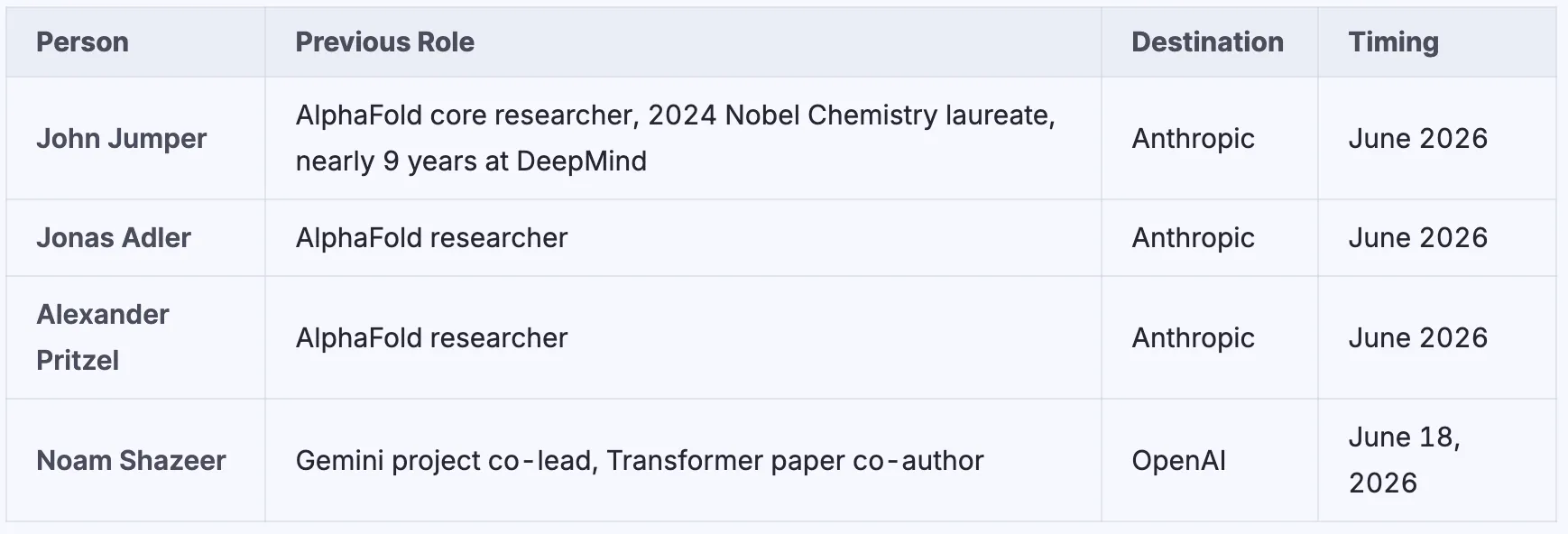
- This move comes against Google’s broader consolidation of AI resources around the Gemini series; there have been earlier reports of talent departures to competitors such as Anthropic.
DeepMind has not issued a detailed official statement, but observers generally view this as a deliberate choice by the company to concentrate limited resources on general intelligence and scalable products.
Background: from scientific breakthrough to general AI competition
AlphaFold’s success demonstrated AI’s huge potential on specific scientific problems, but also exposed resource tensions between specialized models and general large models. In recent years, rapid iteration of large language models and multimodal agents has pushed tech giants to build unified foundation models and then cover vertical domains via fine‑tuning or tool calls.
At the same time, Google has steadily increased its investment in Gemini, and as AlphaFold has become a mature scientific tool, its marginal innovation space has relatively narrowed. Transferring team resources to general AI can be seen as a response to current industry trends.
In addition, significant departures of core team members also catalyzed the AlphaFold team’s dissolution, and the loss of that talent represents a substantial hit for Google.
Potential impacts: dual shock to science AI and industry structure
1. Impact on structural biology and drug discovery AlphaFold changed the paradigm for protein‑structure prediction; its databases and tools are still widely used by researchers worldwide. The team’s dissolution will not cause immediate service disruption, but over the long term subsequent version updates, new feature development and academic support may slow. Drug‑discovery projects that rely on continual innovation may need to seek alternatives or turn to open‑source communities and other institutions.
2. Impact on DeepMind and Google’s AI strategy The move reinforces Google’s “Gemini‑centered” unified strategy, helping concentrate compute and talent to face competitors such as OpenAI and Anthropic. However, it could also weaken DeepMind’s unique brand in “AI for Science” and reduce its ability to deliver Nobel‑level scientific breakthroughs over time.
3. Impact on AI talent and the open‑source ecosystem Reassignments and external departures of core members may provide other organizations (including startups and academic labs) with high‑level structural‑biology AI talent. Meanwhile, parts of AlphaFold’s code and models are already open‑source, and the community may take on more maintenance and improvement work.
4. Implications for industry trends The event highlights a key tension in current AI development: although specialized scientific models can have far‑reaching impact, they often give way in resource allocation to general large models. The future of “AI for Science” may move toward a general‑model‑plus‑domain‑tool approach rather than long‑term investment in independent specialized teams.
Industry view: the next phase for science AI
The disbanding of the AlphaFold team does not mean the end of protein‑structure prediction technology, but signals a transition from a “breakthrough project” to “mature infrastructure.” DeepMind’s choice to shift focus to Gemini reflects the intensity of the general‑AI competition and raises questions: on the path to AGI, will specialized scientific breakthroughs continue to receive sufficient sustained resources?
DeepMind’s disbanding of the AlphaFold team is a notable turning point in the AI industry in 2026. It reflects the reality of resources concentrating on general intelligence while reminding us that truly world‑changing scientific tools often require long‑term, focused investment to keep shining.
▶️ Enjoy this article? Creating content is hard work!
Follow our YouTube channel:
AI Rosetta
Your likes, subscriptions and shares are our greatest support! 🙏
More AI news at: https://www.airosetta.com